Why EPC companies are struggling to scale AI
So where are EPC companies going wrong with AI? In many cases, AI initiatives are treated primarily as IT experiments rather than a change to how engineers, planners, commercial managers, and site teams actually work. As a result, productivity gains remain local, adoption is inconsistent and economic impact is difficult to sustain.
Companies also often overlook the fact that AI fundamentally changes skill requirements and ways of working in an organization. Effective adoption requires capabilities such as prompt‑driven engineering interaction, AI‑supported quality assurance and human‑in‑the‑loop decision making – it’s not just a case of deploying tools and tweaking governance structures.
Our survey of
R&D and engineering
decision-makers bears out these findings. It showed that:
- 65% of respondents are uncertain about their AI capabilities and resources for transformation
- 84% lack a dedicated R&D or engineering AI strategy
- 56% are willing to adopt AI but are not yet ready
- 48% have not implemented any AI in their core engineering processes.
In terms of challenges respondents faced, the most frequently cited obstacles included a lack of AI ownership and strategy, resistance to change, insufficient AI expertise and cybersecurity concerns. These are all organizational challenges, not technology barriers, reinforcing why implementation approach matters more than tool selection.
This also underlines why successful AI adoption cannot be left to fragmented initiatives across individual functions or departments. While experimentation at the functional level is important, scaling AI requires clear direction from top management: where AI should create value, which use cases matter most, what level of standardization is required and how adoption will be embedded in the company’s operating model.
In short, the challenge of turning AI potential into actual impact is more organizational than technological. It lies in employee skill sets, leadership expectations, willingness to trust AI-supported outputs and the ability to embed AI into daily routines and processes, from standard operating procedures to quality gates and performance expectations. Whether an organization is taking its first steps in AI or attempting to scale it, successful adoption therefore goes beyond a technology rollout toward a workforce and
operating model transformation.
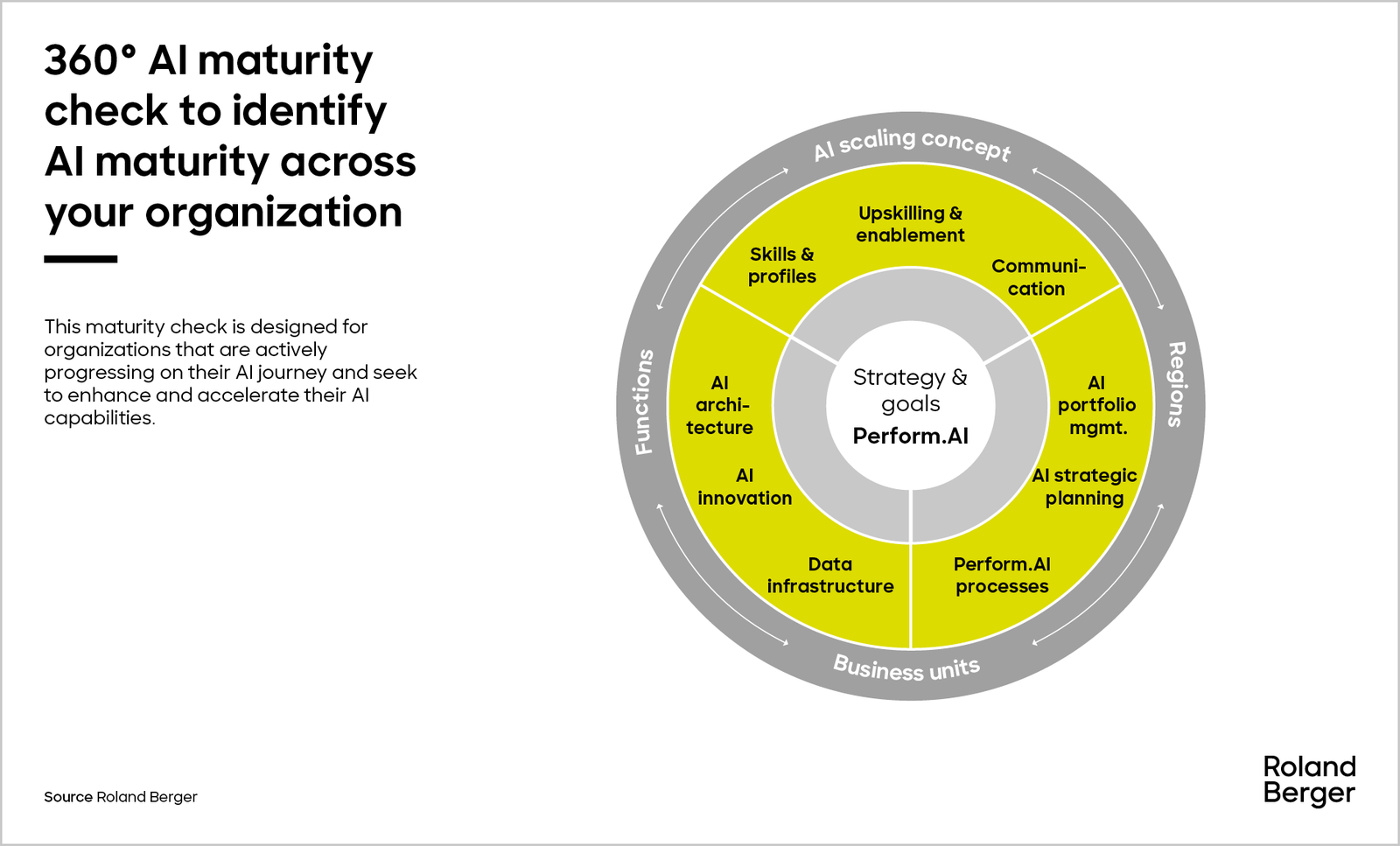
Where to start: Roland Berger’s AI Maturity Assessment tool
Before deciding where to act – or what to do next – EPC leadership teams need a clear and unbiased view of their organization's current AI position. This transparency is a prerequisite for defining the structured execution roadmap outlined below. Without it, organizations risk either misjudging their ability to absorb change and overinvesting, or dispersing effort across initiatives without meaningful impact.