A critical bridge to sustainability
One of the main benefits of WtS production is the variety of feedstocks and pathways can that be used to produce WtS. This includes the HEFA process, today the most widely used, whose feedstocks already include waste oils. This also includes agricultural residues, forestry residues, (some of) municipal solid waste, and other waste feedstocks, being processed either via the AtJ, Fischer-Tropsch (FT) or soon the MtJ process to make SAF.
Ultimately, the long-term “most sustainable” solution (as demonstrated by the Roland Berger SAF Sustainability Index) is power-to-liquid (PtL) technology. This involves combining green hydrogen with sustainably captured CO2 to produce a gas which can be readily converted to SAF. Today in most regions PtL remains costly, albeit the Inflation Reduction Act (IRA) is contributing to an improvement in the cost competitiveness of PtL in the US. However, the critical benefit of PtL is that it is largely feedstock unconstrained (only constrained by the availability of green energy), and is thus likely to form the backbone of most future production as industrialization occurs and costs come down. A key focus of our report was therefore to examine if WtS could act as a bridging technology on the journey to future SAF production pathways such as PtL.
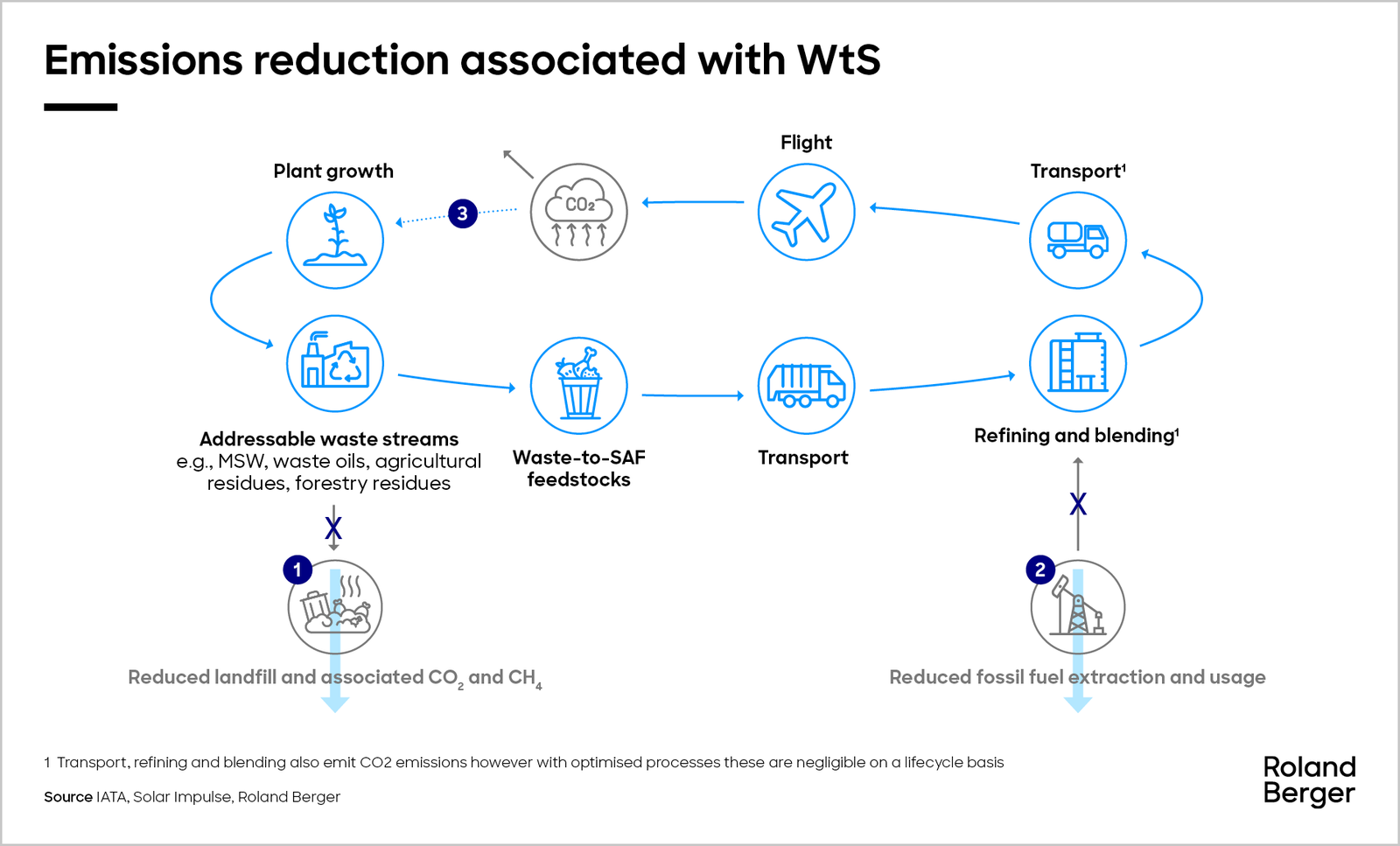
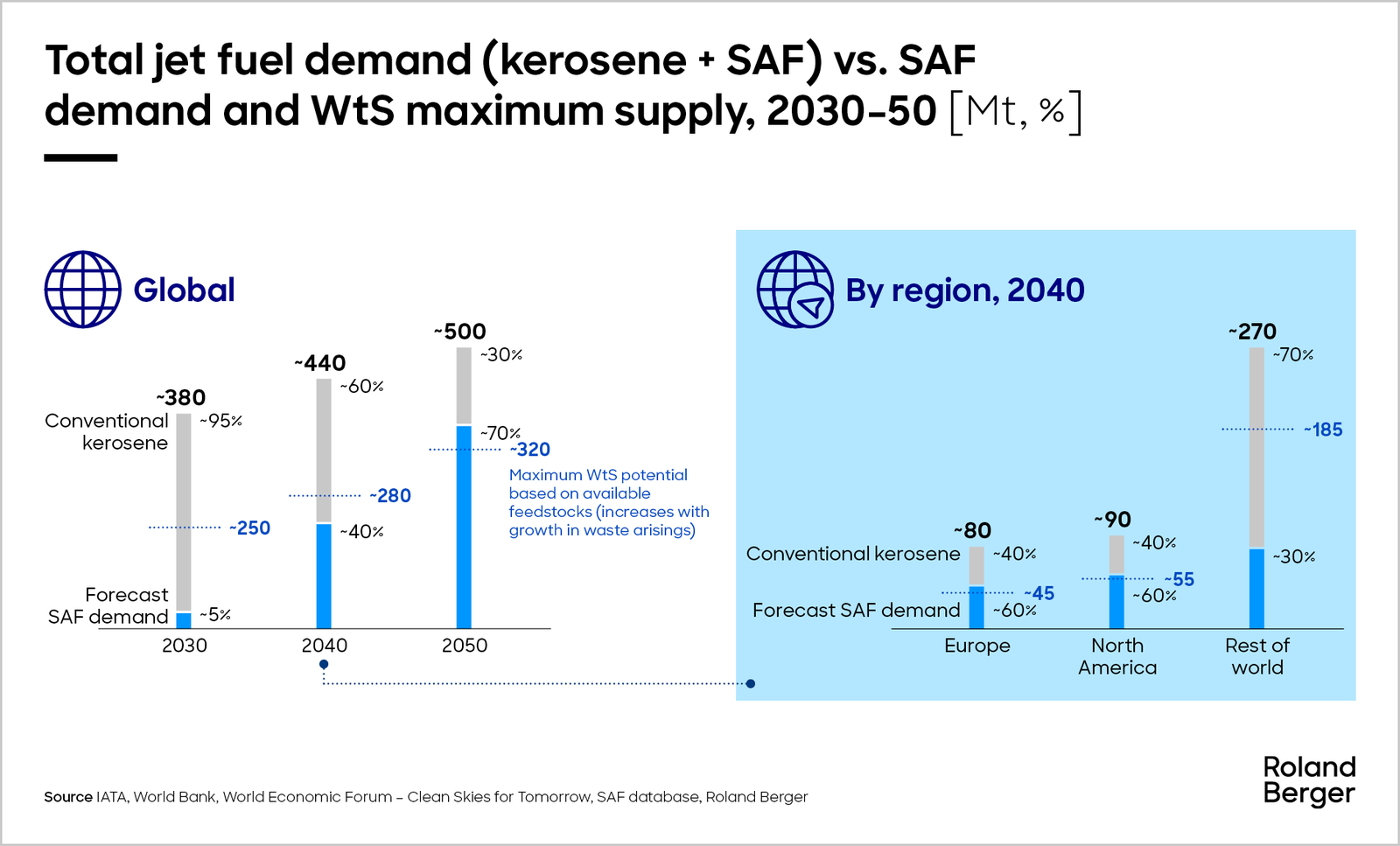
The report finds that WtS has a strong business case today, with commercially available technologies, a strong emissions reduction profile versus alternative SAF production pathways, and a compelling economic logic that benefits from rapid expected SAF market growth, subsidies and waste gate/tipping fees. The supply potential of WtS is also significant, supporting a 'portfolio' approach to scaling up SAF production that manages the risks and limitations of each pathway.