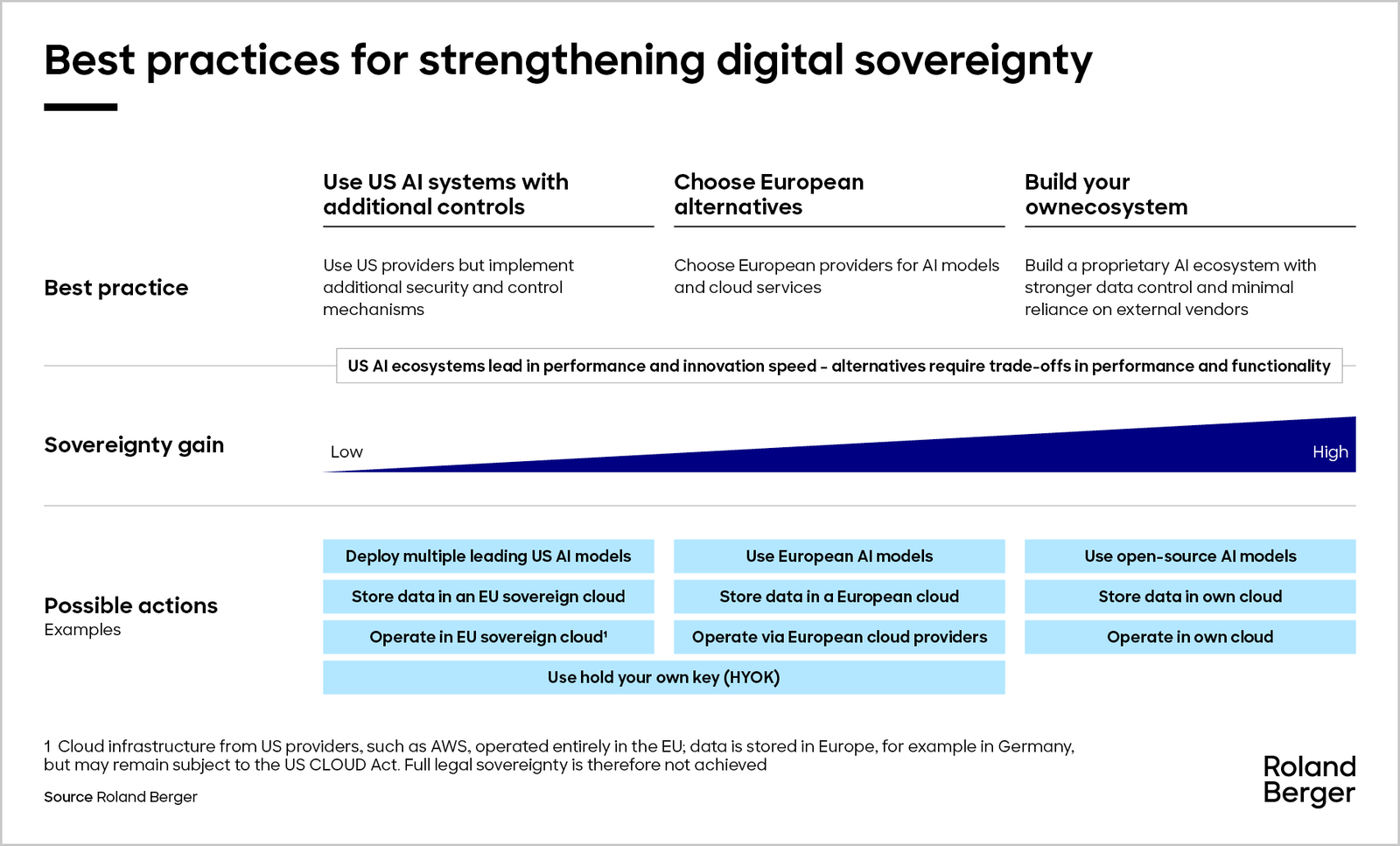
- Best practice 1: Use US AI systems with additional controls
Some institutions are using US providers but implementing additional control mechanisms, such as multi-model setups, sovereign-cloud controls or exit readiness
- Best practice 2: Choose European alternatives
Another strategy for reducing dependence on the United States is to choose European providers for cloud, SaaS and AI models instead, typically starting with selected use cases as a second source or fallback option
- Best practice 3: Build your own ecosystem
Other players are building their own AI ecosystems with stronger data control and minimal reliance on external vendors, for example open-source models and self-managed operations
A tiered target architecture
Not all data and processes are equally critical, and not every component must be operated in a fully sovereign way immediately. A tiered target architecture focuses sovereignty efforts where risks and regulatory requirements are highest: sensitive and critical workloads are operated in a more sovereign manner, while less critical areas can continue to run on established cloud, SaaS and AI services. This hybrid approach increases sovereignty where it delivers the greatest value, while preserving performance and innovation capability.
Importantly, different institutions will have different ambition levels with regard to sovereignty. Each institution should define its own sovereignty target along dimensions such as data control, operational steering capability, architectural portability and contractual transparency, aligned with its specific business model and risk profile. Full technological decoupling is not a universal requirement – what matters is a controlled, institution-specific management of dependencies.
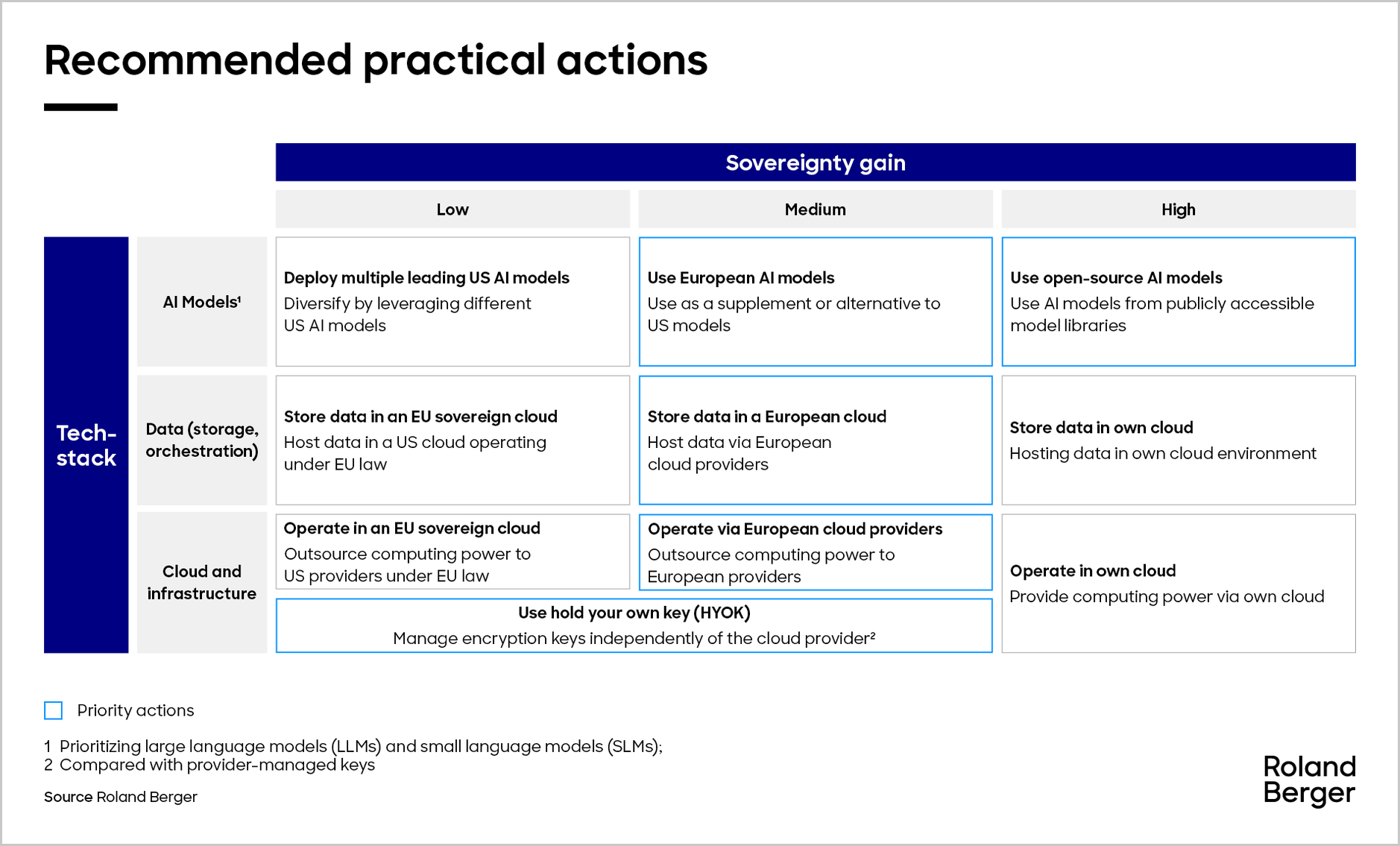
Four practical actions for banks
The path to greater digital sovereignty involves a strategic and phased approach for diversifying the technology stack. This includes strengthening vendor risk management practices to ensure more rigorous assessment and continuous monitoring of external dependencies. Equally important is the principle of retaining control over truly critical capabilities: highly sensitive operations and strategic data assets should remain in-house wherever feasible, rather than being run on external services or outsourced to third-party providers. This approach combines selective insourcing with enhanced oversight of external partnerships and technological dependencies.
We recommend four practical levers across the technology stack, which banks can combine selectively depending on workload criticality and sovereignty ambition. Each delivers a different sovereignty gain for a different level of effort, balancing the pragmatic use of external solutions with strategic self-reliance in mission-critical areas.