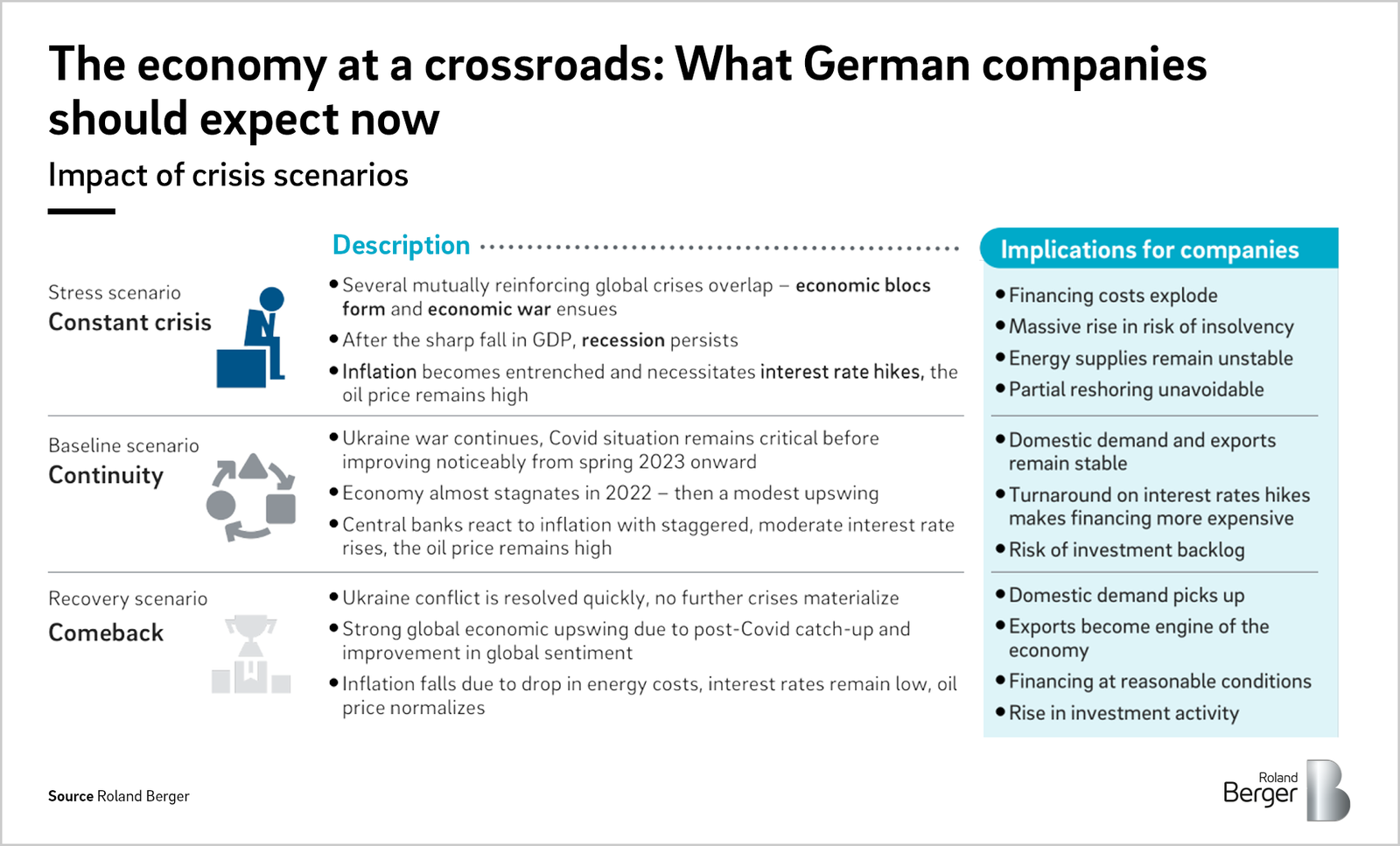
The Roland Berger experts used a simulation model to analyze the overall impact of all four crises and construct three scenarios:
Baseline scenario:
The Ukraine war continues and the Covid situation does not improve noticeably until spring 2023. The economy stagnates in 2022, followed by a modest upswing. Moderate interest rate rises are sufficient, but inflation and oil prices remain high.
Stress scenario:
There are several mutually reinforcing global crises. Inflation is becoming entrenched, necessitating larger interest rate hikes, and the oil price remains high. This scenario suggests a looming three-year recession. It will take until 2024 to get back to 2020 levels.
Recovery scenario:
The Ukraine conflict is resolved quickly and no further crises materialize. There is a global economic upswing due to the post-Covid catch-up. Inflation levels off due to a drop in energy costs, interest rates remain at a low level, and the oil price normalizes.
Our scenarios offer a big-picture view. Drilling down to the details creates the following economic outlook for Germany up to 2024:
GDP:
In the baseline scenario, GDP increases only moderately through 2024, despite a catch-up effect in 2023. The excess burden compared with the recovery scenario equates to more than three percentage points of GDP. If the crises worsen or new ones emerge (stress scenario), there is every chance of a three-year recession with an impact of -5% this year. It will take until 2024 to get back to 2020 levels.
Inflation:
Inflation is very likely to exceed the 5% mark on average for 2022 and could even rise to over 7% in the stress scenario. Both the baseline and stress scenarios anticipate inflation falling slightly in 2023 and 2024 to below 6% and 4% respectively due to offsetting effects. However, it is highly unlikely that the ECB's price stability target of 2% will be achieved in any scenario.
Interest rate level:
The full impact of the interest rate hikes is not expected to be felt until 2023. In the baseline scenario, a nominal interest rate (3M Euribor) of around 1% can be assumed for the next two years. In the stress scenario, the interest rate could rise to over 4%, a level not seen since the financial crisis of 2008/2009.
Energy prices:
In the baseline scenario, the oil price (as a benchmark for energy prices overall) is expected to significantly exceed the all-time high of 2012 and fall again from 2023. In the stress scenario, by contrast, it will stay high at over USD 150 per barrel of UK Brent. Gas prices will remain high overall and show no appreciable decline.