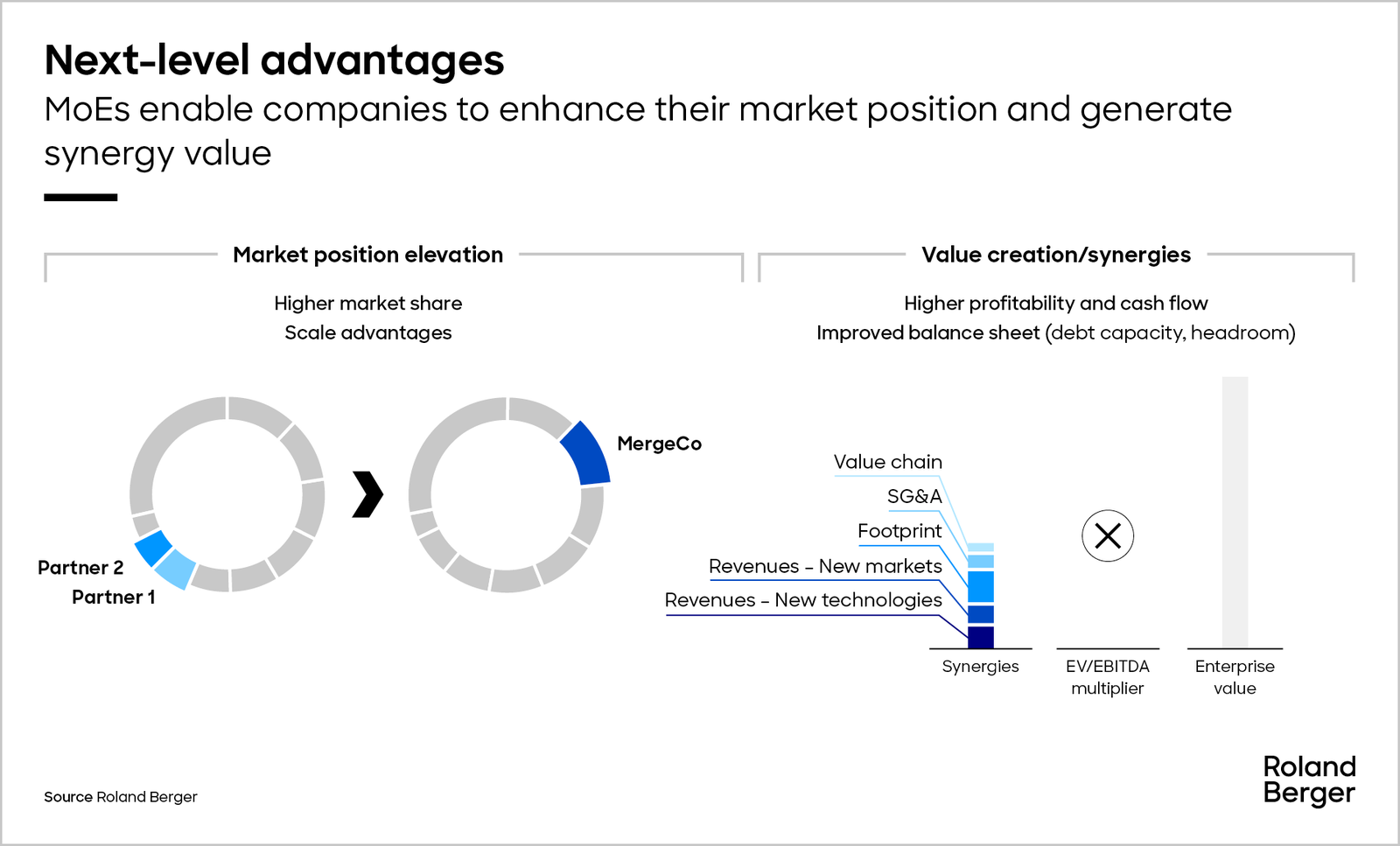
MoEs are experiencing a boom. Across industries, we are seeing a noticeable uptick in the number of our customers seeking to combine forces to create value.
Private equity
(PE) is getting in on the act, too, adding to the boom as players grapple with aging assets and look for new exit routes.
In both cases, MoE offer an attractive solution. For companies, they hold the prospect of quickly generating scale, value, market share and synergies. This is particularly true for companies finding themselves in a "stuck in the middle" situation, where they are generating suboptimal financial profiles that limit their attractiveness to shareholders, acquirers, capital markets and lenders. And for PE players, MoEs open up not only a faster path to an IPO for portfolio companies but also an alternative exit route to continuation vehicles for PortCos where a trade sale or IPO would not capture the entire intrinsic value – either due to unresolved performance issues or because of attractive growth prospects.
A key advantage of the MoEs concept is that no purchase price is paid, as it is an all-share transaction. This distinguishes the merger approach from traditional acquisitions and significantly reduces the financial risk of the transaction – while still allowing participants to benefit from the combined strengths of the merged entity.
But MoEs are not straightforward. They are complex transactions, with success dependent on ensuring a good partner fit,
maximizing synergies
, effective collaboration and a coherent target business model. In short, the buyer and seller must be in lockstep throughout the planning and execution of the merger.
To help both partners navigate the intricacies and potential pitfalls throughout the entire process, we developed a Merger Helix. The framework, described in our "Mergers of equals: An end-to-end approach to build value creation engines" publication, enables two mirrored M&A processes to be executed in parallel so they can generate value and secure future growth for both partners.
Growth and exit problems solved
So, who needs an MoE, and why? Our experience points to four common problem types for which an MoE is often the most effective strategic option:
1. Resolving a "stuck in the middle" situation: The core issue for companies in this position is structural: insufficient scale. They cannot operate as efficiently as market leaders with high economies of scale in combination with lower pricing power on the customer and the supplier side. An MoE directly addresses the issue by combining two businesses that are individually subscale into a single entity that clears that threshold – without the cost or dilution of a traditional acquisition.
2. Actively participating in a market consolidation: In industries undergoing consolidation, smaller players face a binary choice: grow or be acquired on unfavorable terms. MoEs offer a third path by combining complementary businesses to achieve a step change in market position without the asymmetries of a traditional acquisition.
3. Exit option for aged portfolios: Around 30% of PE portfolios globally are more than seven years old, creating mounting pressure to find exit paths for assets that are not yet ready for traditional sale or IPO. The response – continuation vehicles (CVs), in which a GP (general partner) transfers prized assets from an aging fund into a new continuation fund – has grown dramatically. Yet continuation funds are a holding mechanism, not a value creation solution. MoEs offer something more powerful: by merging an aged portfolio asset with a complementary partner, PE sponsors can generate genuine operational and financial synergies, improve the asset's EBITDA profile, enhance its marketability and ultimately unlock new and better exit routes.
4. Combining capabilities in high-growth environments: The current technology landscape creates a specific version of the "stuck in the middle" situation. Many companies simply lack the scale, complementary assets or financial resources to keep up. MoEs offer a compelling alternative: by combining technology stacks, talent and customer bases in an all-share transaction, two companies can jointly achieve the critical mass needed to compete in high-growth environments – without the cash expenditure or loss of ownership that an acquisition would require.