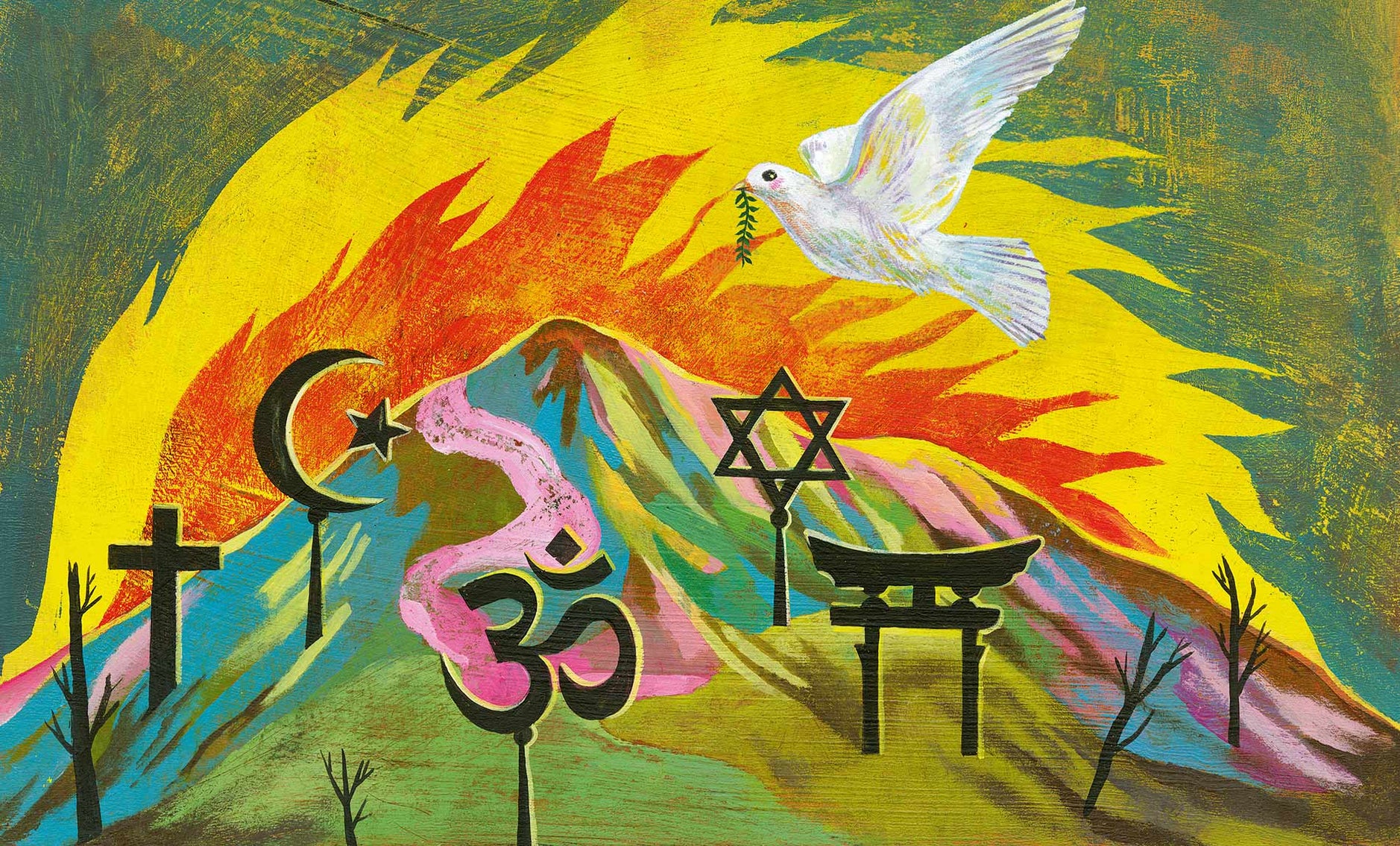
In history, though, religion has not always settled for peaceful competition. There are wellknown episodes showing a strong combination of religion and success – namely military. The Muslim expansion all around the Mediterranean from the 7th to 9th century AD was mainly driven by religious zeal, just like the crusades of the Middle Ages or the conquests of South America in the 16th century: The Holy Cross of Santiago promised victory (not to mention gold) to the Spanish adventurers. "The expansionary element is not typical for all religions," says the German anthropologist Dieter Haller. He sees it as a feature of religions that define themselves as approaching an ideal or paradise, like Islam or Christianity: "This kind of teleologic or goal-driven thinking is dynamizing moral behavior and economic action. But you get completely different dynamics if a religion, like Buddhism, does not strive for an ideal, but sees life as an alienation from this ideal." So the difference between "paradise" and " nirvana" is more than just religious: A Buddhist conqueror would fight his battles not for his religion, but in spite of it.
A common mission is beneficial for the corporate climate
In business, religion can also be a dynamizing factor. There are a lot of entrepreneurs who identify themselves with a religion – from the Catholic Brenninkmejier family running the C&A retail chain to Islamic banking or real estate agents with links to Scientology. As with military success stories, business cases linked to a religious attitude often take place in an early stage of expansion: The unifying effect of one strong belief can lead to a more coherent, focused, motivated workforce and can be a decisive factor in beating the competition as the company represents more than just an opportunity to earn money.
Devdutt Pattanaik, an Indian leadership expert and former "Chief Belief Officer" of a large Indian retail chain, even calls for a mythologization of companies. For him, a mythology is something that "tells people how they should see the world" – something a company with a strong mission can offer its employees. "When institutional beliefs and individual beliefs are congruent, harmony is the resultant corporate climate," Pattanaik says. He doesn't recommend the leaders to brainwash their staff, however. Quite the contrary: "When people are treated like switches in a circuit board, that's when disharmony descends."
There is a thin line between harmony and polarization whenever religion enters into secular affairs. What looks like heaven on earth when the beliefs of the workforce are homogenous can turn into a hell of a nightmare as soon as employees and/or management belong to different religions. This increase in diversity will definitely happen when a company starts to grow beyond the cultural sphere of its origin – and then it's too late to take religion, faith and/or mythology out of a company's DNA. So even if religion can be a driver of growth for smaller companies, it will be more like a limit of growth for bigger ones. Keeping the faith isn't as simple as it sounds.