Global roundup
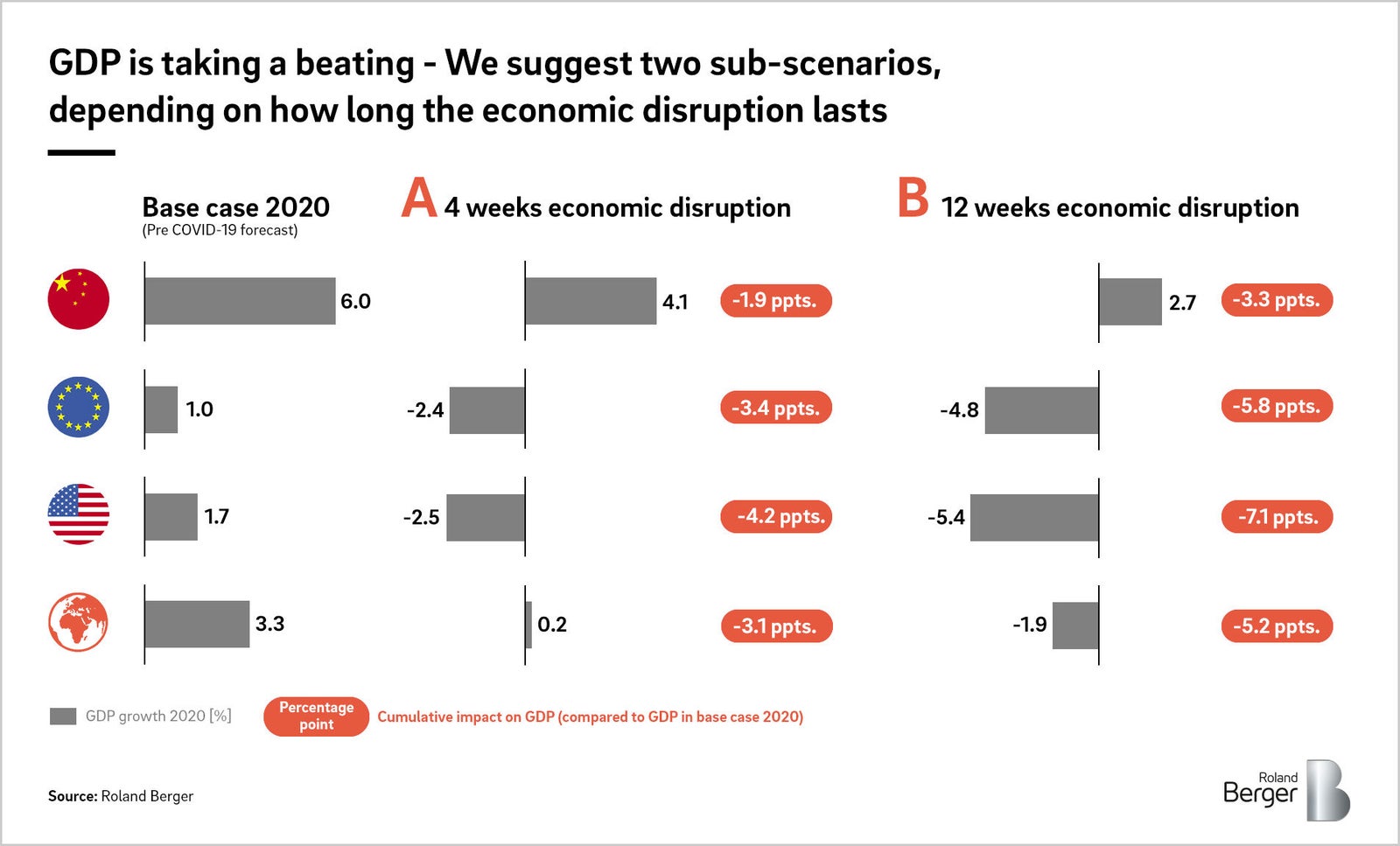
One thing is clear: GDP is currently taking a severe beating. However, the size of the impact in different parts of the world will depend fundamentally on how long the present economic disruption lasts. We foresee a drop in GDP growth in 2020 compared to the pre-crisis base case ranging from 1.9 to 7.1 percentage points.
China is further along the coronavirus curve than Europe and the United States. The government's actions have been effective, quarantine measures have been gradually lifted and social and economic life is slowly returning to normal. In the event of a four-week economic disruption, China will feel the effect of closures of production sites and lack of demand from the United States and Europe, but production will quickly return to normal driven by pent-up domestic demand and demand from key trading partners post-lockdown (Japan, South Korea). The result will be a drop in GDP growth of just 1.9 percentage points in 2020 compared to the pre-crisis base case. In the event of a 12-week economic disruption, European and US demand will remain in the doldrums for longer and domestic demand will not completely compensate for this, leading to a drop in GDP growth of 3.3 percentage points.
If mitigation actions by governments in Europe are effective, we could see the number of new infections declining here at the beginning of Q2 2020. A four-week period of economic disruption will mean negative growth in Q1 and Q2, i.e. we will have a recession and GDP growth for the whole of 2020 will be down 3.4 percentage points. Should the disruption continue for 12 weeks, on the other hand, we foresee a steep drop in growth in Q2 2020, with the closure of many non-essential production sites and a substantial increase in unemployment, especially in the services sector. In this case GDP growth for the year could be hit by as much as 5.8 percentage points.
Four weeks of economic disruption in the United States will mean a temporary halt in production by some manufacturers and a dip in consumer confidence. The recovery will then be driven by the strong US economy, consumer spending, public investment and government relief packages. The result will be a 4.2 percentage point drop in GDP. With 12 weeks of disruption, recovery with positive growth rates will not occur before Q4 2020, production will see lengthy delays, layoffs will drive down consumer demand and asset and credit bubbles may burst. In this scenario GDP growth could dive by as much as 7.1 percentage points.