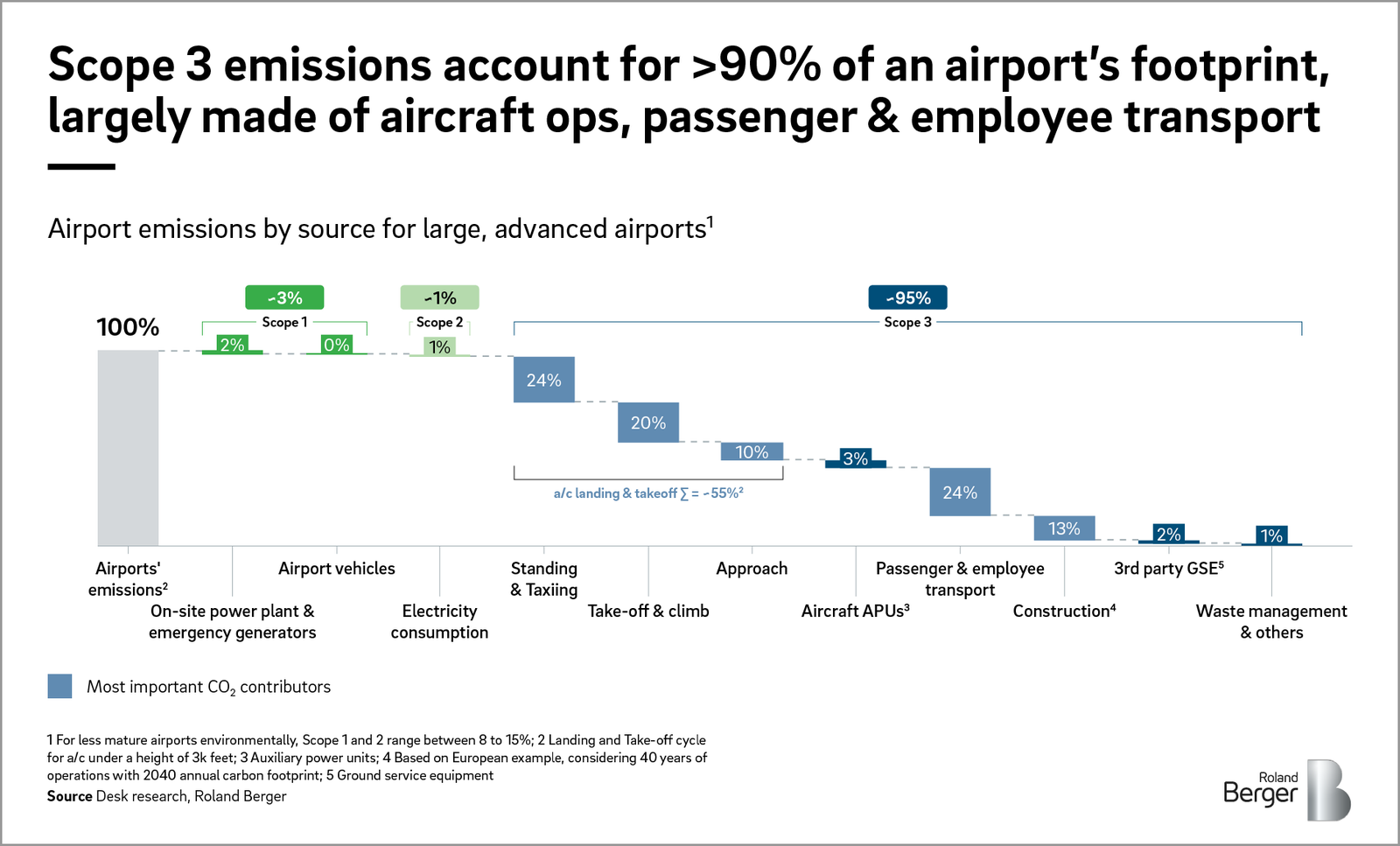
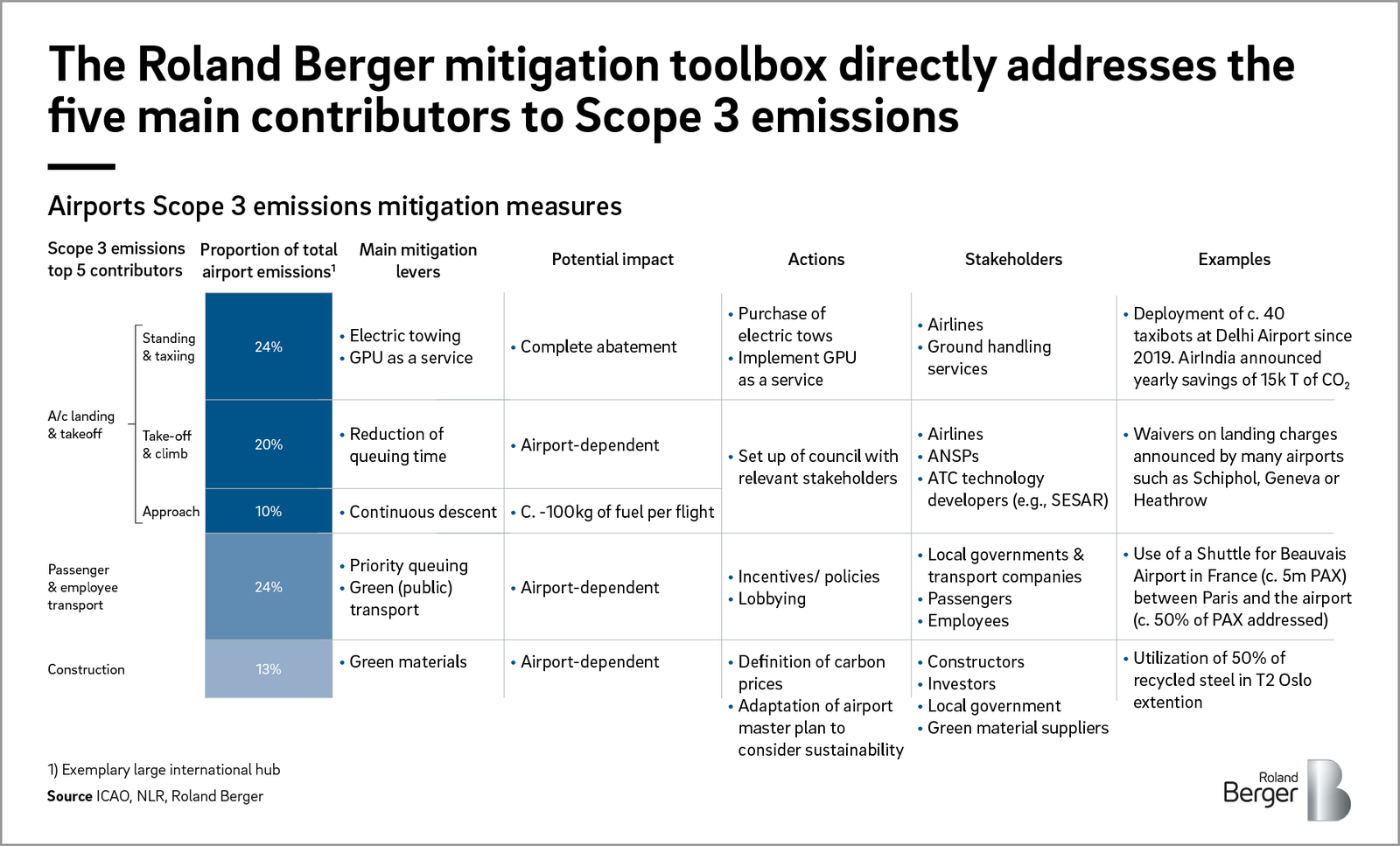
The key challenge in addressing these emissions is that it requires airports to ‘influence up’ in order to change the behaviors of their customers and partners. Furthermore, many genuine improvement options require close liaison with more than just airlines, ground service providers, airline navigation service providers (ANSPs) and even air traffic control (ATC) technology providers: Given the public nature of some of these organizations, it may also be necessary to involve local or national governments. Overall, reducing the Scope 3 emissions of airports therefore means aligning lots of different stakeholders, none of whom can significantly influence the problem on their own and all of whom have individual business objectives.
Airports find themselves at the center of this puzzle and are uniquely placed to influence all other members of the group. In light of this privileged position, one possibility – an approach that Roland Berger has successfully employed and moderated to help clients in similar situations – is to set up a council, enabling all relevant stakeholders to find the best way forward together. Via the agency of such a body, stakeholders can be influenced to jointly address emissions and other key sustainability concerns.
To complement this approach, carefully considered incentives – such as the waivers or rebates on landing charges announced by Schiphol, Geneva and Heathrow airports – may also be an effective way to align the different players and encourage best practices.
Passenger and employee transport
-
Transport
links that ferry both passengers and employees to and from airports are the source of another 24% of total airport-linked emissions. This issue too must therefore be addressed as a matter of urgency.
- Climate-friendly public transport is an obvious and powerful instrument here. Either way, airports must align effectively with transport suppliers, and this will again require them to lobby and work closely with various external stakeholders – in this case public transport companies and local governments in particular.
- Ambitious policies encouraging passengers and employees to switch to greener modes of transport have already shaved almost a quarter off this source of GHG emissions at some airports. In Paris, for example, a more ecofriendly shuttle – half of which runs on biogas, with the other half scheduled to follow – already addresses about 50% of the five million passengers commuting annually between the French capital and Beauvais Airport.