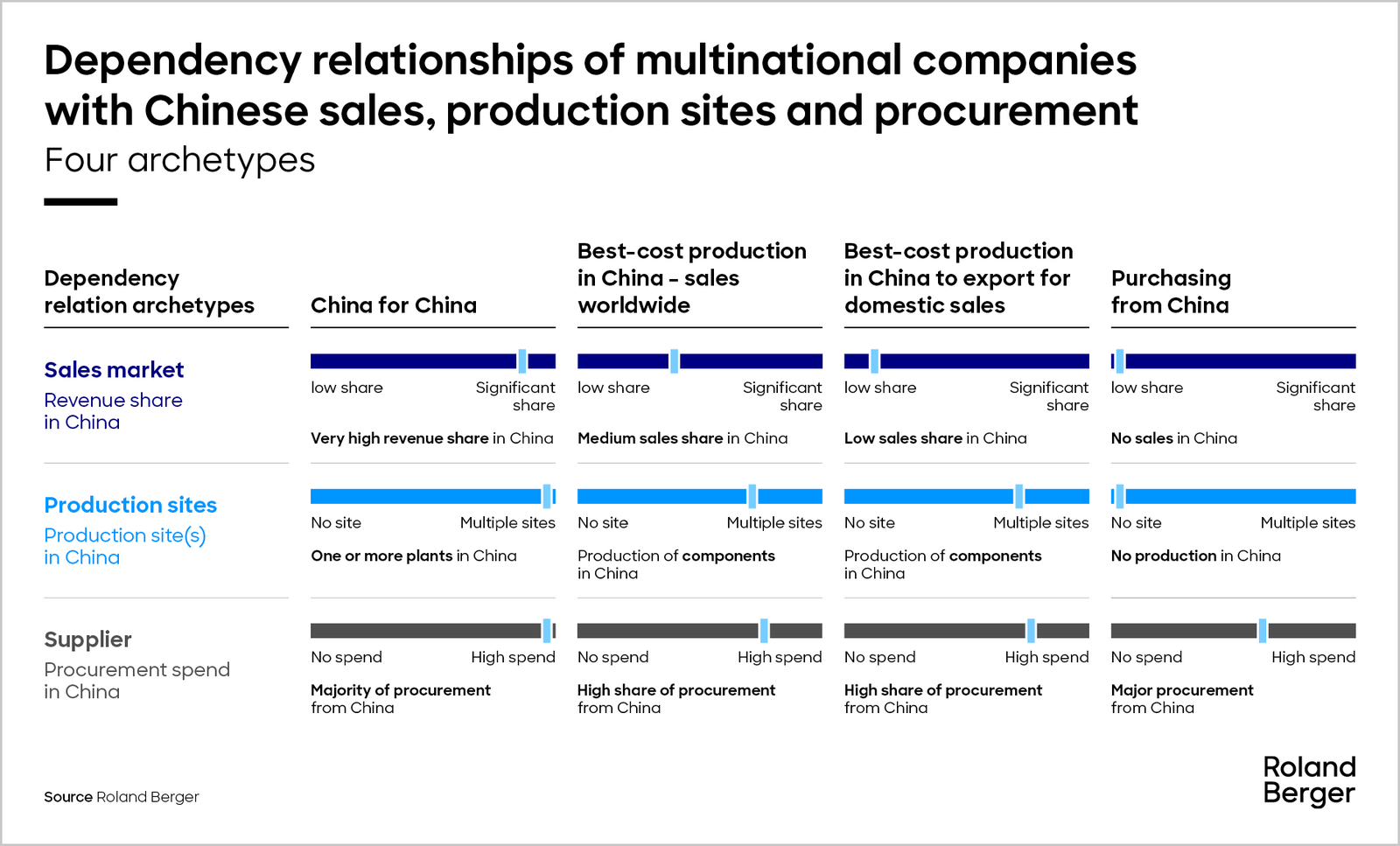
If the current dependency is rated “very high”, companies can participate further in the rising domestic consumption of the Chinese market, and develop a China-for-China approach, resulting in our first archetype. This means relying on local production capabilities and a localized supply chain, for localized products, and processes, with local legal entities.
In case of a lower dependency on revenues in China but with Chinese production sites for the global or own domestic market, the “best-cost country production” archetypes can be applied. A potential step to mitigate risks and to continue benefiting from labor cost arbitrage is the regionalization or diversification of Asia, in a “China plus 1” or “China plus 2” strategy, investing in new “best-cost countries” in Southeast Asia such as Viet Nam, Thailand, or Malaysia while continuing production in China. It is not without risk, as the current productivity in these countries cannot compete with China’s output per worker yet, and large regional differences in the quality of infrastructure. Addressing these challenges by, e.g., on-the-job training or an improvement infrastructure, is critical as the Southeast Asian cost advantages are expected to shrink in the next decades as well. A potential alternative to Southeast Asia is a nearshoring approach, increasing production capacities in Eastern Europe or in Mexico to supply Europe and the US.
Aside from dependencies on the Chinese sales market and Chinese production sites, there is also a dependency on the purchasing of materials, parts or components, creating our 4th archetype of China being a supplier. Here, dual sourcing or targeted supplier changes can reduce dependencies and improve supply chain resilience. However, for a China-for-China archetype, a high sourcing dependency can also be interpreted positively by Chinese customers.
These simple high-level archetypes might give an indication for companies to re-think their China strategy and how to deal with the New China story in the coming years.