Large-scale, long-distance solutions
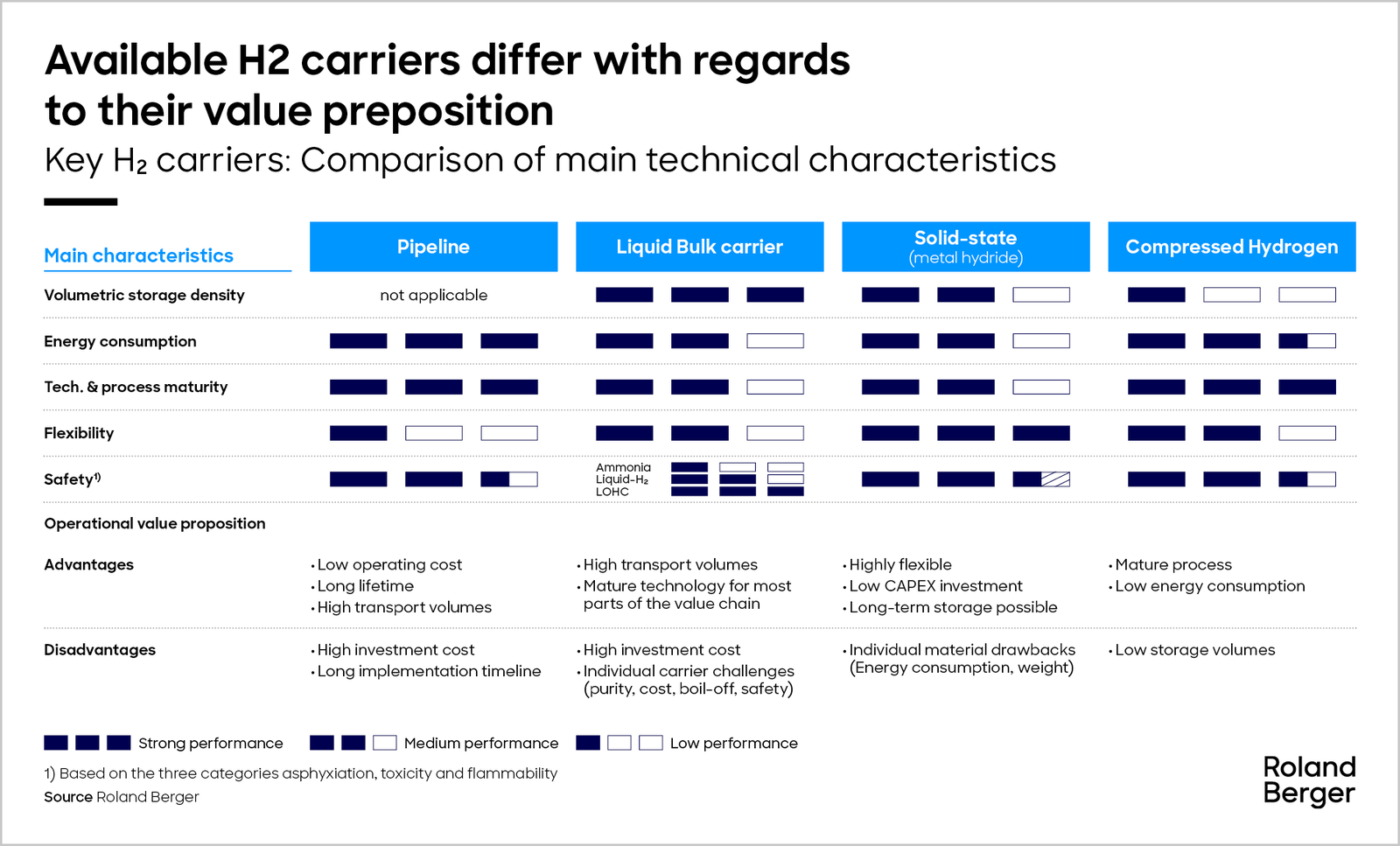
Pipelines are currently one of the most common means of transporting energy. Their strengths include a long lifetime, low operating costs, and high transport volumes. These characteristics also make pipelines a promising choice for transporting hydrogen. What’s more, they can function as buffer storage by adapting pressure for fluctuating volumes and ensuring continuous supply – an essential requirement for major off-takers like fertilizer producers or steel plants.
Pipelines do have several drawbacks, however, especially the high up-front capital investment required. Approval and construction processes can also be lengthy and often need complex cross-border coordination. Repurposing natural gas pipelines for hydrogen transportation may offer potential cost savings, but concerns remain over material compatibility with older installments and, how to phase-over from legacy natural gas usage to hydrogen transport.
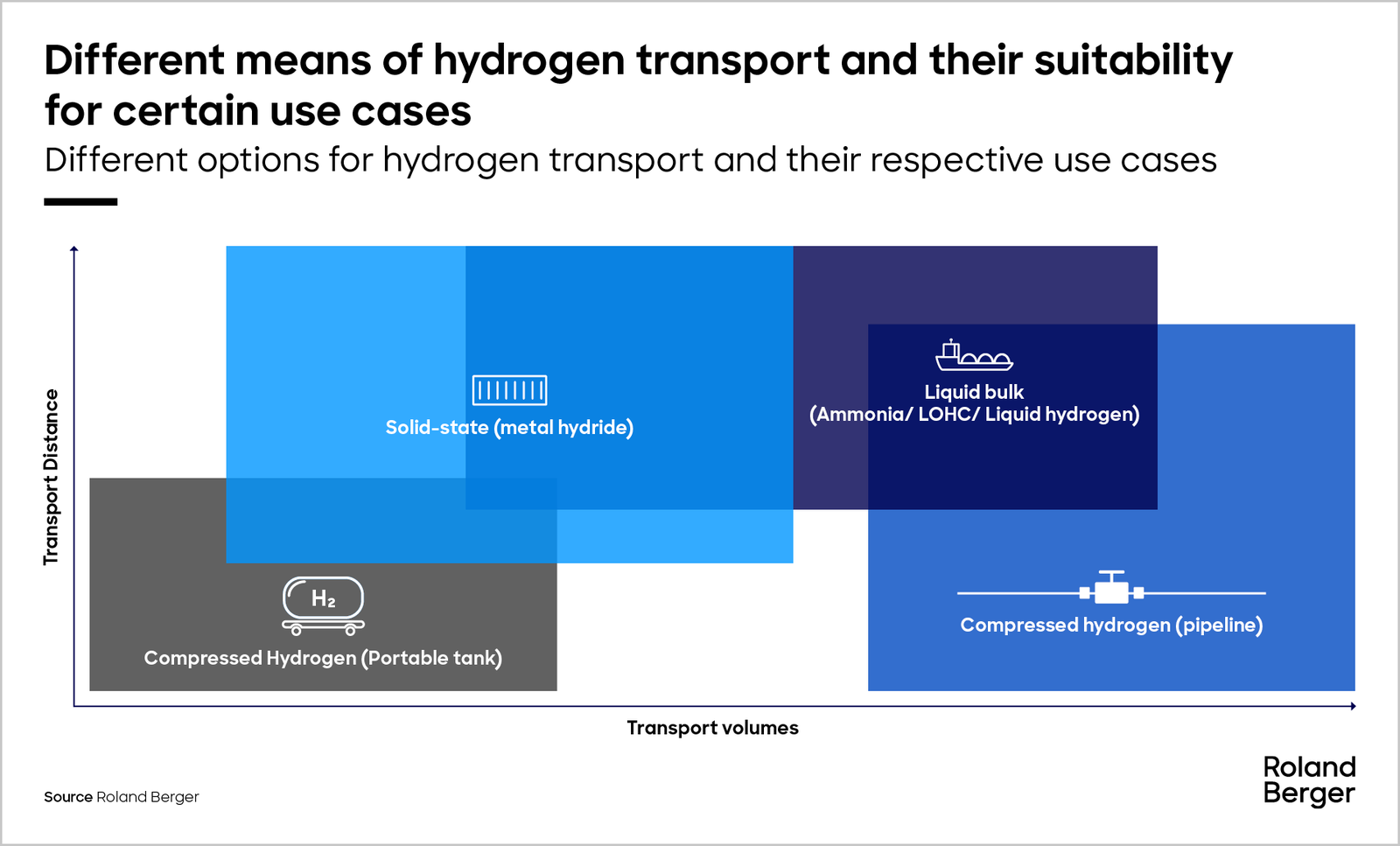
As a result, pipelines offer some promise for clean hydrogen transport in the future, but cannot be considered a widespread solution for the present. They are only expected to play a significant role once a certain market maturity and scale is reached.
Instead, large-scale, export-oriented hydrogen production projects are directing their attention to
liquid bulk transport.
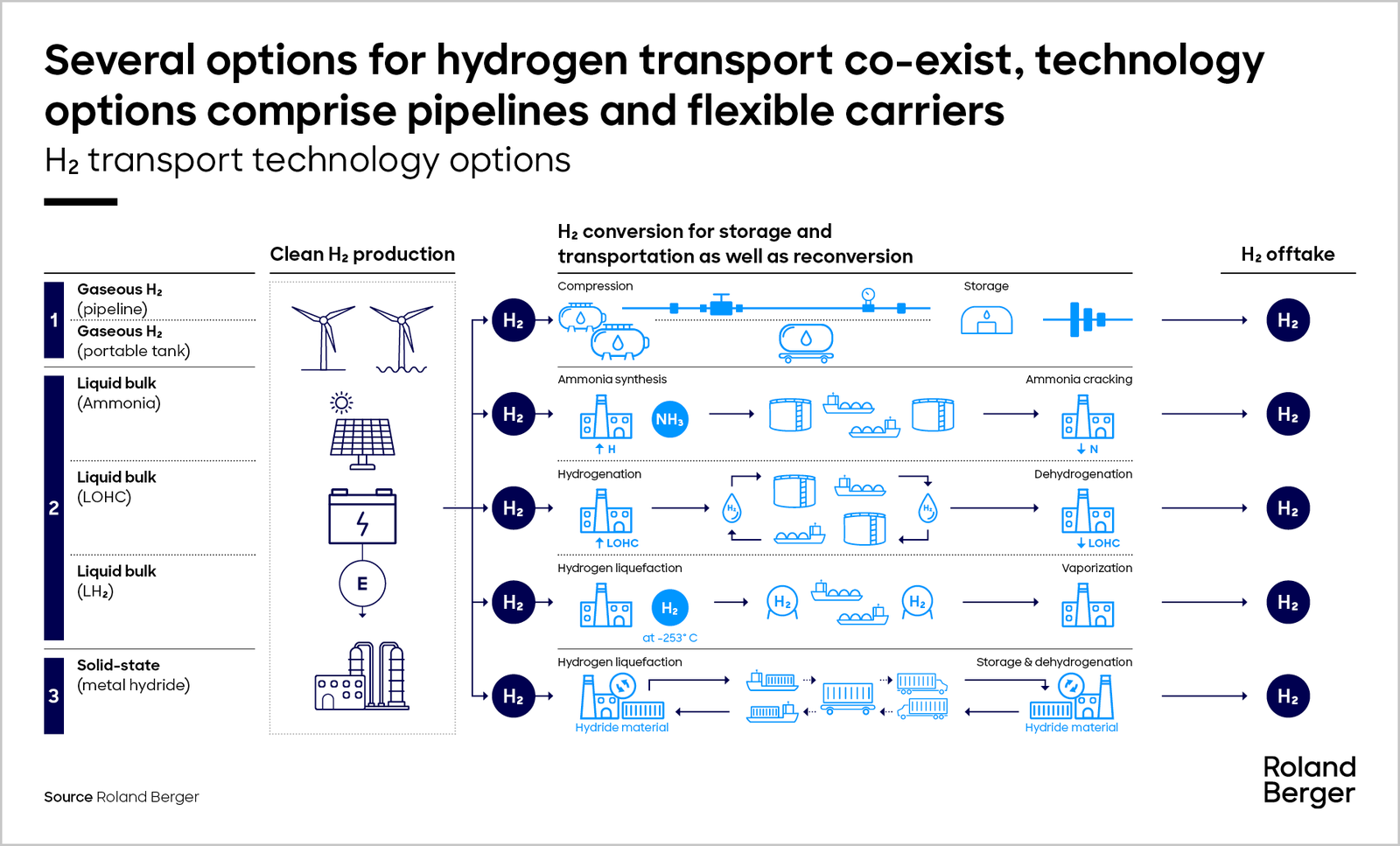
This solution offers several options: hydrogen can be liquefied, as demonstrated in a first shipment between Australia and Japan in 2022; it can be converted to ammonia, as planned for the NEOM green hydrogen project in Saudi Arabia; or it can bonded to liquid organic hydrogen carriers (LOHC), as envisioned for imports to the port of Amsterdam.
Although a variety of technological solutions exists, the underlying principle is similar across all liquid bulk carriers: hydrogen undergoes an often energy-intensive process to achieve significantly higher volumetric density and reduced reactivity. This transformation enables transport with relatively compact and cost-effective tank units. Upon reaching their destination, carrier materials can either be directly employed in industrial applications, as is the case with ammonia, or converted back into hydrogen.
These solutions are typically based on proven chemical processes, but large-scale chemical equipment is needed to achieve acceptable unit costs. That’s not all: the dominant solution in the market, ammonia, must also overcome substantial safety challenges. Despite being globally handled at scale, securing regulatory approval for transporting ammonia through densely populated areas is uncertain. These limitations limit the use cases for liquid bulk carriers and hinder flexible scaling alongside the expected dynamic market development.