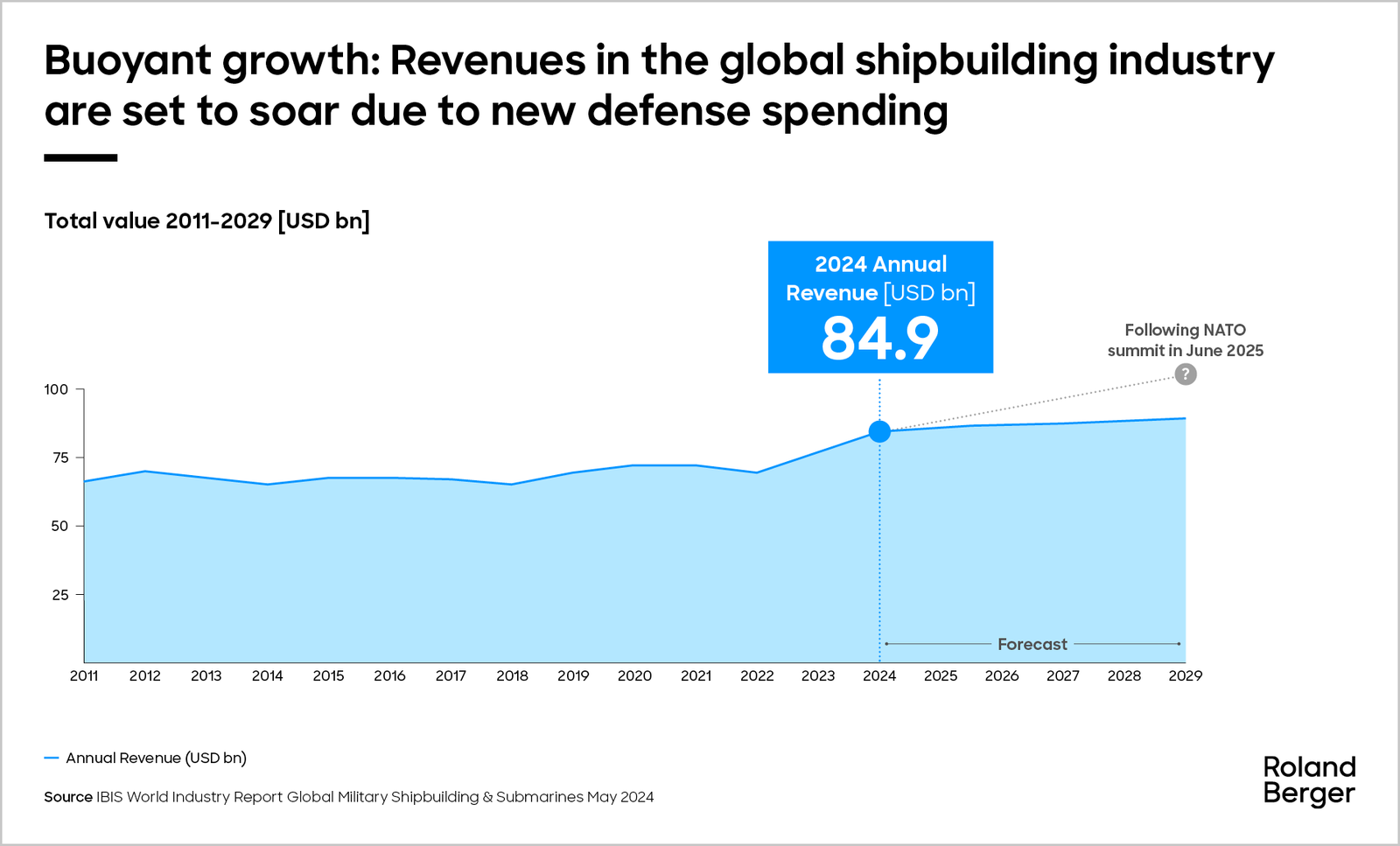
Several countries are already advancing plans to modernize and expand their naval capacities. Germany, Norway, and Canada are investing in new submarine fleets, while Australia and the United States are working to significantly enlarge their overall naval capabilities. These plans often include the addition of uncrewed and autonomous underwater and surface vessels. The US Navy, for example, aims to build a fleet of 500 vessels, comprising 350 crewed and 150 uncrewed ships.
Regional expansion to meet growing demand
To accommodate market growth, regional shipbuilding capacities are expanding. In Saudi Arabia, the International Maritime Industries (IMI) shipyard – the largest in the Middle East, with a 12-million-square-meter facility capable of producing 40 newbuild vessels and servicing 260 maritime products annually – is scaling up production. In Morocco, the National Ports Agency has issued tenders for Africa’s largest shipyard, aiming to capture demand overflow from saturated European shipyards and serve African ships heading to Europe.
Meanwhile, the United States is bolstering its commercial shipbuilding sector through legislative and financial support. A $5 billion investment, part of a comprehensive shipbuilding bill, is being funneled into the industry, with additional partnerships formed with South Korean shipbuilders Hanwha and Hyundai Heavy Industries.
The forecasted growth and capacity expansion plans present exciting opportunities for shipbuilding companies to capture new markets and scale their operations. However, these opportunities are not without risk. The industry must navigate a complex environment shaped by economic pressures, geopolitical tensions, and shifting regulatory landscapes.
In the face of these challenges, resilience will be the key differentiator for shipbuilding leaders. By adopting forward-looking strategies and leveraging innovative tools, the sector can chart a course toward sustainable growth and long-term success.
The five major challenges facing shipbuilders
In light of the factors outlined above, we have identified five key challenges currently facing the shipbuilding industry:
- Geopolitical instability
- Financial performance pressure
- Growing cost of supply
- Overstretched supply chains
- Delivery capacity limitations
Geopolitical instability
The ongoing wars in Ukraine and the Middle East, coupled with the potential for a China-Taiwan crisis, underscore the tectonic shifts in the geopolitical landscape in recent years. While the degree of exposure to these risks varies across companies, the overall impact is felt sector-wide. Shipping routes are increasingly at risk, and energy prices remain volatile, creating an environment of persistent uncertainty.
Strategically, shipbuilders must ask themselves: What is required to remain competitive in this evolving international order? Those who can adapt to the new geopolitical realities will be better positioned to navigate the challenges ahead.
Financial performance pressures
Securing financial performance has never been more critical. Shipbuilders need to maintain profitability to reinvest in transformative technologies such as alternative propulsion systems and autonomous vessel products. Innovation is key to ensuring long-term competitiveness.
Additionally, maintaining financial flexibility is essential to weather unexpected shocks, such as sudden order slowdowns or external disruptions. Without addressing these financial pressures, shipbuilders could face existential risks to their operations.
Growing cost of supply
The cost of materials and manufacturing remains volatile and is likely to trend upward. Shipbuilders must contend with rising logistics costs, tariff impacts, raw material price spikes, and increasing labor costs driven by skilled workforce shortages—particularly in Europe and the US.
Although demand in the shipbuilding industry is currently robust, buyers remain highly cost-sensitive. To stay competitive, shipbuilders must focus on identifying synergies and improving operational efficiencies.
Overstretched supply chains
For decades, global supply chains have been the cornerstone of shipbuilding operations. However, recurring disruptions have made this model increasingly fragile. The reliance on best-cost suppliers in regions such as China or Eastern Europe is now being reconsidered in favor of more resilient, localized supply chains.
This shift is particularly urgent given the additional demand from the military sector, which risks overstretching the supply of critical components. In some cases, such as the US, commercial shipbuilding supply chains may need to be re-established almost from scratch. Strengthening supply chain capabilities is no longer optional—it is imperative.
Delivery capacity limitations
Aging populations in Europe and Asia are creating workforce shortages that directly impact shipbuilders’ ability to maintain or expand manufacturing capacities. For example, South Korea's shipbuilding industry has only been able to increase its workforce by attracting approximately 2,500 international workers.
The situation is further complicated by regional competition for skilled labor, as most shipyards are concentrated in specific areas, such as the German North and Baltic Sea coasts. This drives up salaries and intensifies the challenge of recruiting and retaining talent. To address this, workforce planning must be treated as a strategic priority rather than an ad-hoc response.
Resilience levers: How to build strength and reap the opportunities
The challenges outlined above demand immediate attention. Shipbuilders must assess their exposure to these challenges and take proactive steps to mitigate them. More importantly, to capitalize on the growth opportunities in the industry, they must build resilience. This involves focusing on what can be controlled to avoid being thrown off course.
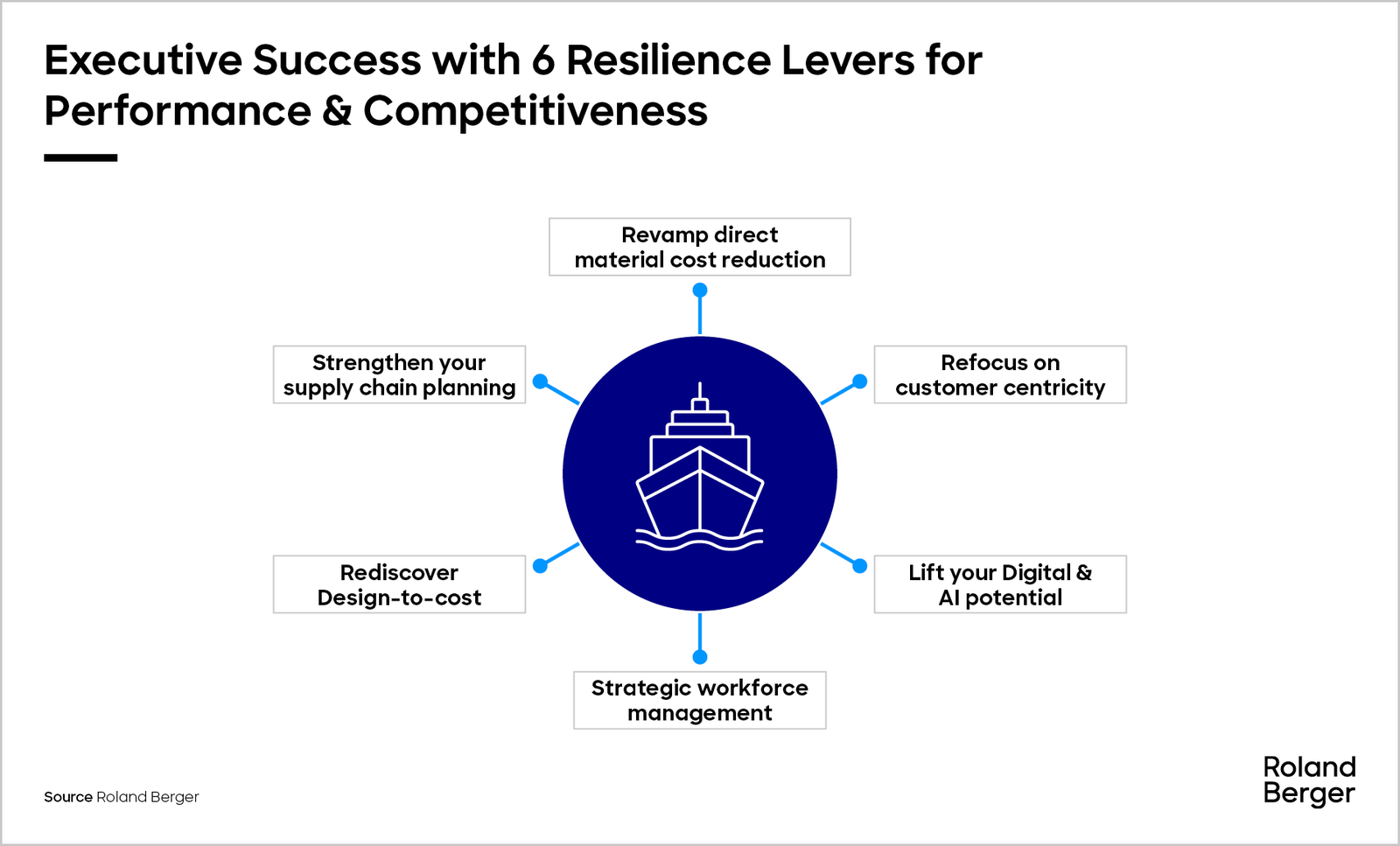
To guide this effort, we have identified six resilience levers that will help shipbuilders secure both short-term performance and long-term competitiveness.