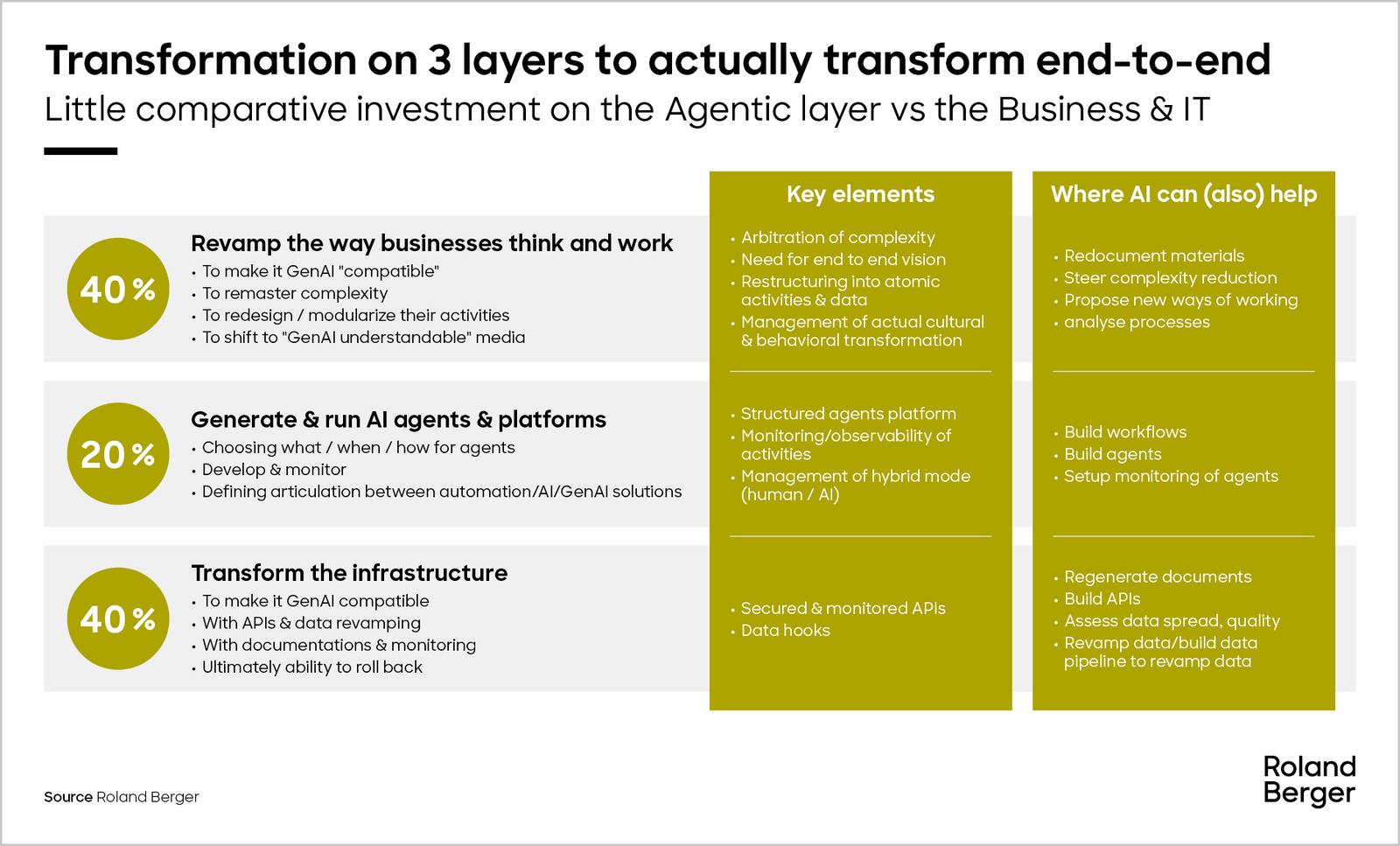
2. End-to-end process redesign
Rather than automating existing workflows, leaders redesign entire processes around AI capabilities. This approach delivers exponentially greater value than point solutions. Without proper process redesign, organizations risk automating inefficient or dysfunctional workflows — embedding problems rather than solving them.
3. Data strategy driven by use cases
Leading organizations avoid the "build it and they will come" approach to data infrastructure. Instead, they implement data strategies pulled by specific AI applications, ensuring every data investment drives measurable business value. Poor data quality and accessibility remain the primary bottleneck preventing AI initiatives from scaling — no amount of sophisticated algorithms can compensate for inadequate data foundations.
4. Governance as competitive advantage
In an era of increasing regulatory scrutiny, robust AI governance frameworks become differentiators. Organizations with strong governance can move faster and take greater risks because they have systems to manage those risks effectively. Systematic underinvestment in governance frameworks leads to scaling failures as compliance concerns halt deployment.
5. Human-AI symbiosis in operating models
The most successful implementations create new hybrid roles where humans and AI systems collaborate seamlessly. This requires rethinking job designs, performance metrics, and organizational structures. Failure to invest adequately in
change management
— often requiring more resources than the technology itself — results in user resistance and low adoption rates.
6. Partnership ecosystem orchestration
No organization can build all necessary AI capabilities internally. Success requires orchestrating complex ecosystems of technology partners while avoiding vendor lock-in. Organizations must continuously reassess make-or-buy strategies to maintain strategic control while accessing best-in-class capabilities.
7. Continuous value measurement and optimization
Transformational AI initiatives implement sophisticated measurement systems that track both technical performance and business impact. For agentic AI systems specifically, key metrics include:
- End-to-end task completion rate – measures true autonomous capability
- Share of workflows completed without human escalation – indicates real-world usability and trust
- Output reliability and trustworthiness – tracks consistency and quality
- Frequency of unsupported or incorrect statements – identifies areas requiring improvement
- Alignment between confidence levels and actual correctness – ensures the system knows what it knows