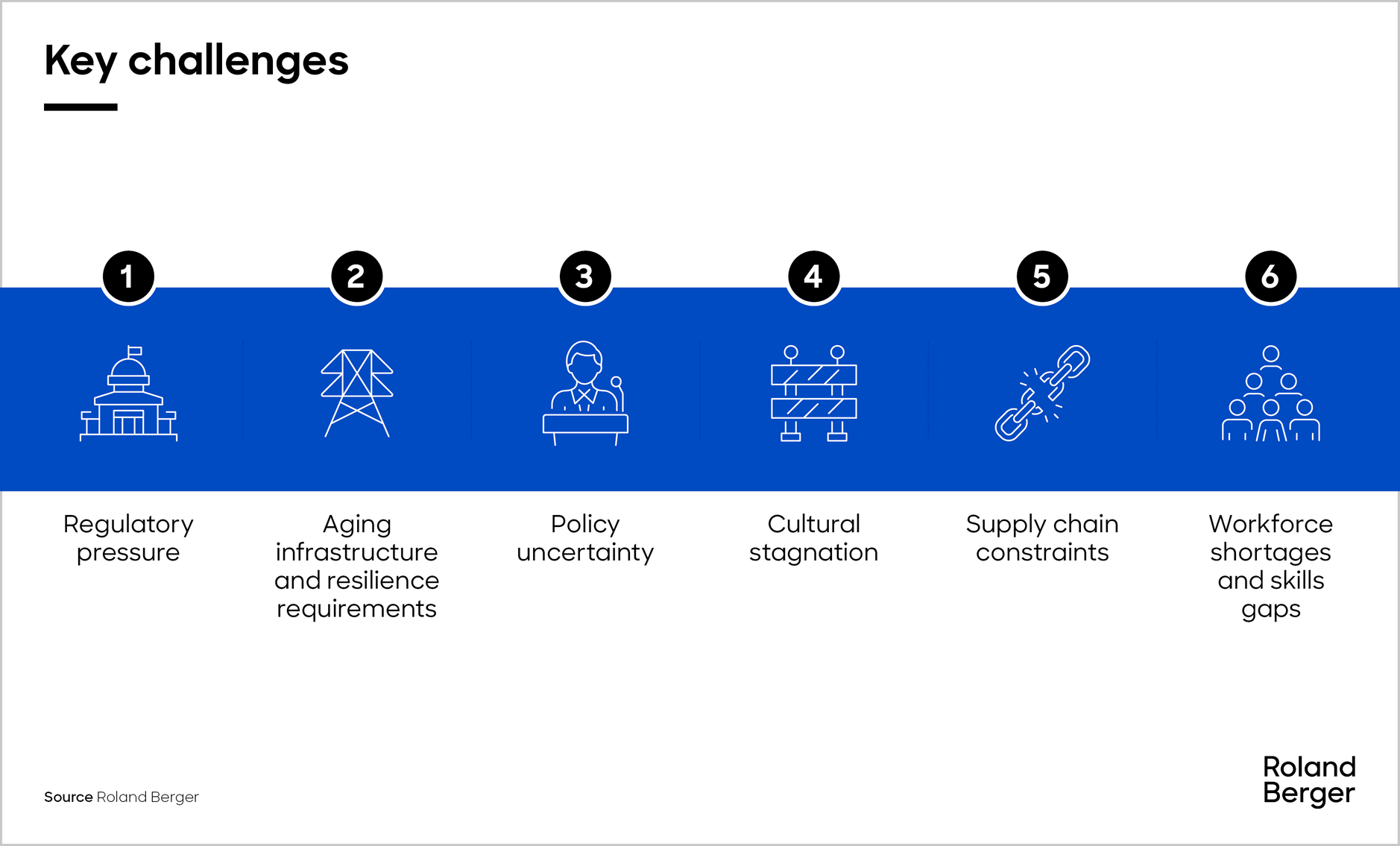
1) Regulatory pressure
The regulatory compact has shifted as
affordability
has come under scrutiny. Rising costs from infrastructure upgrades, renewable integration, resource adequacy, rider programs and emergency measures are passed directly to consumers. Rate increases have outpaced inflation, with 2025’s capital requirements expected to exceed USD 190 Bn. Unlike in the 1950s and 60s, utilities cannot rely on scale alone to preserve affordability. They need more creative solutions to shift demand and supply across time and geography to optimize assets and address the new trilemma – the regulatory balance between reliability, affordability, and decarbonization. With downward pressure on Return on Equity (ROEs), performance-based ratemaking, and rate caps, the current environment makes a ‘wait and see’ approach increasingly impractical.
2) Aging infrastructure and resilience requirements
Local grids have suffered from years of deferred investment, maintenance inefficiencies, weak data systems, and growing exposure to cyberattacks and extreme weather. Outage frequency and repair costs are rising, while
modernization
efforts are slowed by permitting delays, high capital requirements, and uneven federal support. The reliability standard of “1 day in 10 years” developed in the 1960s for centralized systems is no longer sufficient. Resilience – the ability to withstand, respond to, and recover from shocks, natural or artificial – is now the #1 strategic imperative for U.S. utilities. For example, catastrophic failures from Superstorm Sandy, Winter Storm Uri, Hurricane Maria, and Winter Storm Elliott illustrate the stakes. It is an enterprise-level risk in regions facing severe climate impacts and a universal concern for cyber threats, terrorism, and geopolitical conflicts.
3) Policy uncertainty
Volatile federal and local regulatory policy complicates investment, technology choice, and execution. Utilities long accustomed to policy stability and five-year planning horizons now face a paradox: states demand 20-year planning, while federal actions create turbulence in technology and resource selection. The Inflation Reduction Act (IRA) and the One Big Beautiful Bill Act (OBBBA) shook Integrated Resource Plans (IRPs) and projects overnight. Efforts to harden and restructure supply chains have been roiled by the current Trump Administration's tariffs and interventions in firms such as Westinghouse, lithium producers, and others. The non-durability of federal industrial policy sustains uncertainty and clouds planning for generation resources and procurement through 2030 and beyond. IRPs and their supporting supply chains must be more resilient and adaptable under this cloud while scaling infrastructure to meet the coming demand growth.
4) Cultural stagnation
One of the toughest barriers is internal. Cultural stagnation – resistiveness, gradualism, and myopia – undermines utilities’ ability to capture revenue potential, unlock efficiencies, and manage risk in a growth environment. The “can-do” muscle memory of major build-out in the 1970s and 80s has faded. There are many examples. such as: utilities in blue and purple states are often surprised by legislation and respond with “no thanks” rather than more constructive win-win approaches. The current moment requires cultural willingness not only to deploy solutions but to test and learn under a productive regulatory framework.