Overcoming obstacles to wider application
Precision fermentation still faces significant challenges to its wider application. However, these challenges are expected to see positive developments in the coming years.
We are expecting headway in
consumer acceptance and regulation
, for example. Consumers, who are becoming increasingly aware of labeling, sustainability and ethics of the products they buy, have historically shown a willingness to purchase precision fermentation-derived ingredients like rennet (cheese ingredient) and riboflavin (vitamin B2). Regional regulatory frameworks are also expected to become more unified as more and more precision fermentation products enter the global market.
Key challenges persist, though, when it comes to the cost-competitiveness of precision fermentation. Price parity with traditional production methods remains challenging due to scale limitations and process inefficiencies. Nevertheless, recent years have seen significant investments and start-up activity. Furthermore, key cost reductions across the value chain, especially in raw materials and strain development, are expected.
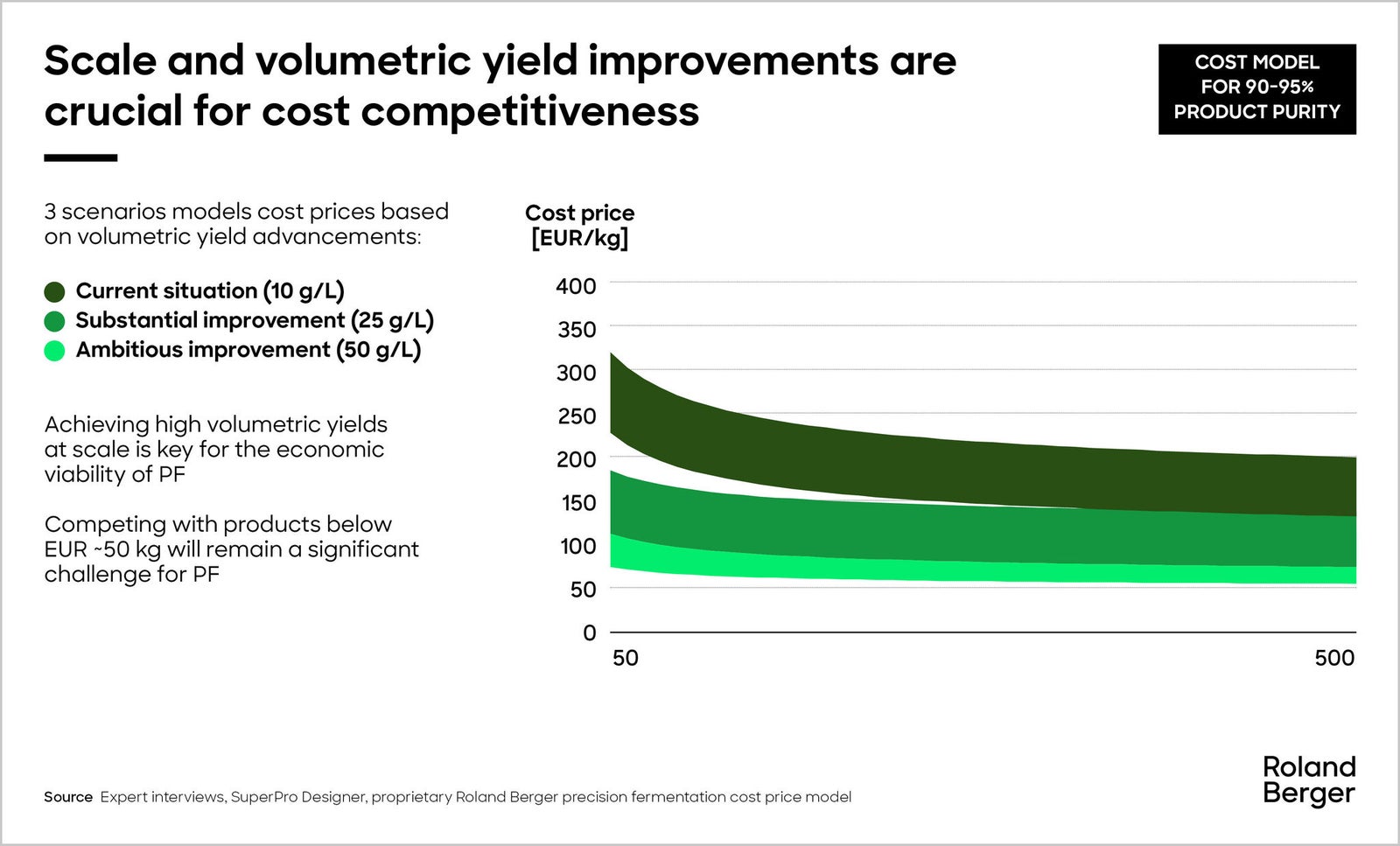
Such moves will undoubtedly help the situation, but ultimately it is scale and volumetric yield improvements that will be crucial for the economic viability of precision fermentation in the long run. At demo scale (100 m3 or less), the cost price of a precision fermentation-derived end-product is high, but the cost price drops at higher scale and from 300 m3 becomes relatively stable. It is volumetric yield, however, that promises to have the most impact on the cost-competitiveness of precision fermentation. In our modeling of a yield increase to 50 g/L, the cost price per kilogram of product drops significantly, across both CAPEX and OPEX.