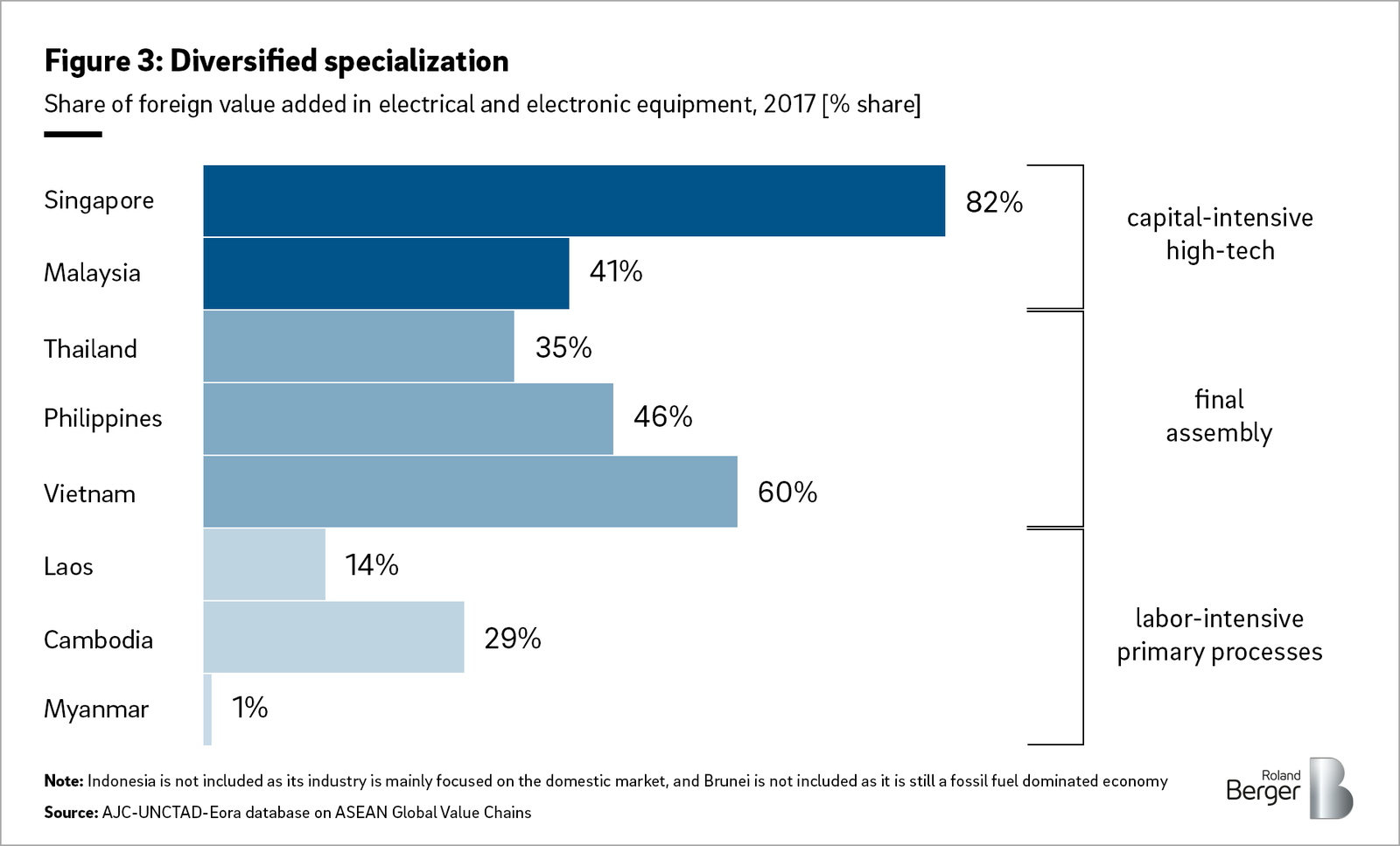

ASEAN supply chains are also deeply integrated with Northeastern Asian neighbors. Economists usually use the flying geese pattern to explain the labor division in the region, with Japan as technology leader vis-a-vis newly industrializing economies and developing countries. In maximizing each economy’s competitiveness regarding cost and technology, the frequent cross-border transportation of a good during its production life cycle in the network of multinational enterprises (MNEs) leads to vibrant regional supply chains.
In the new RBI Quarterly, we will take a deep dive into the electronics and
automobile industries
– the main drivers of the regional merchandise goods exports – to illustrate the nature and trends of the alternative Asian value chain. Although the archetype textile and clothing industry is more conspicuous due to their consumer goods character, it mainly concerns CLMV (Cambodia, Laos, Myanmar and Vietnam) and accounts only for a small portion of their exports.
Because of its strong footprint in both the electronics industry and automobile production, ASEAN will play a bigger role in the re-configuration of global value chains with the goal of increasing supply chain resilience.
Due to integrated regional division of labor, we observe expansion of Japanese, South Korean and Chinese multinational firms as strong (and rotating) leaders – akin to the flying geese paradigm. However, the industry in the region is challenged by the conundrum of FDI-led industrialization that is mainly based on the technology input and supplier chain network of multinationals instead of competitive, indigenous companies.