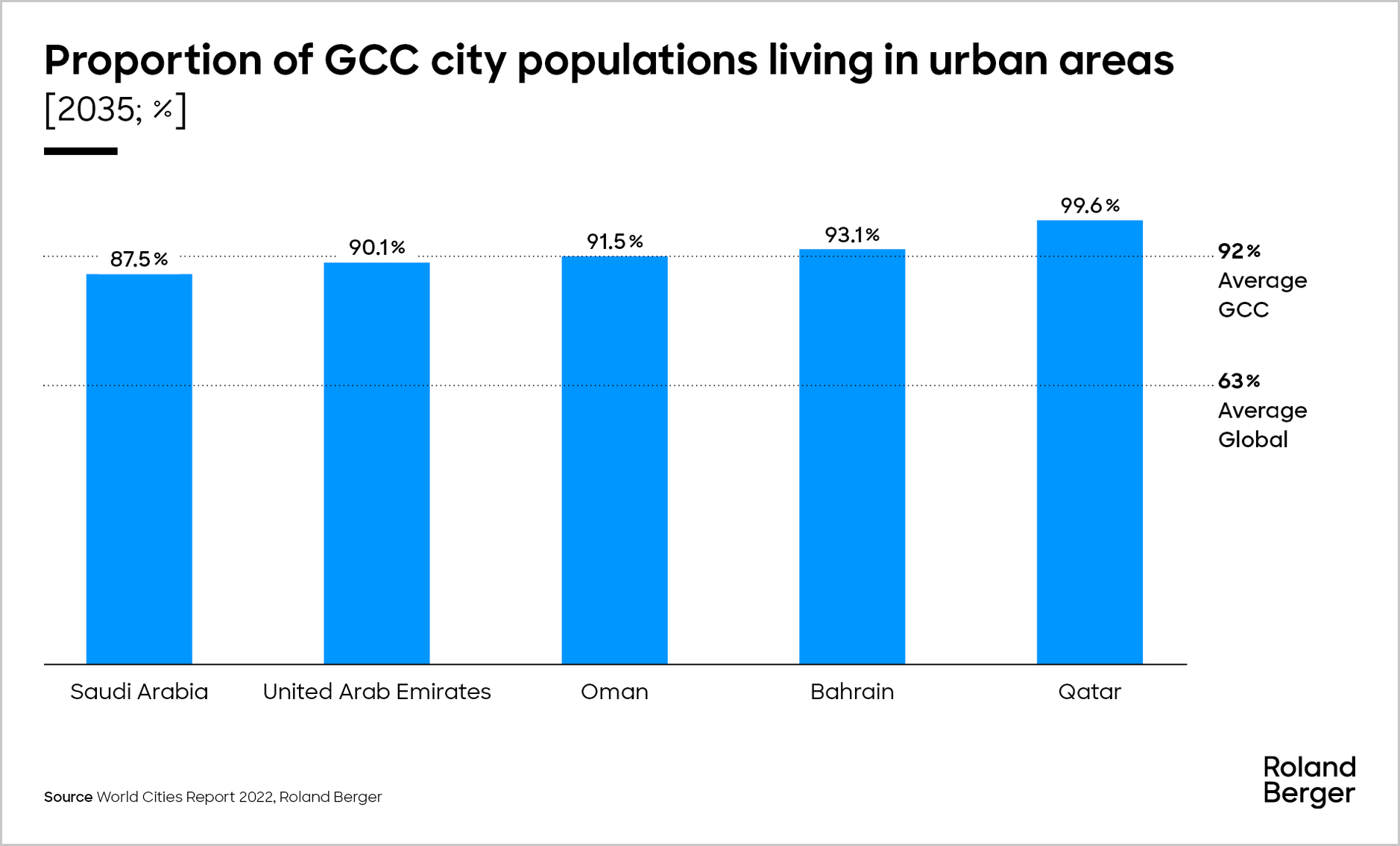
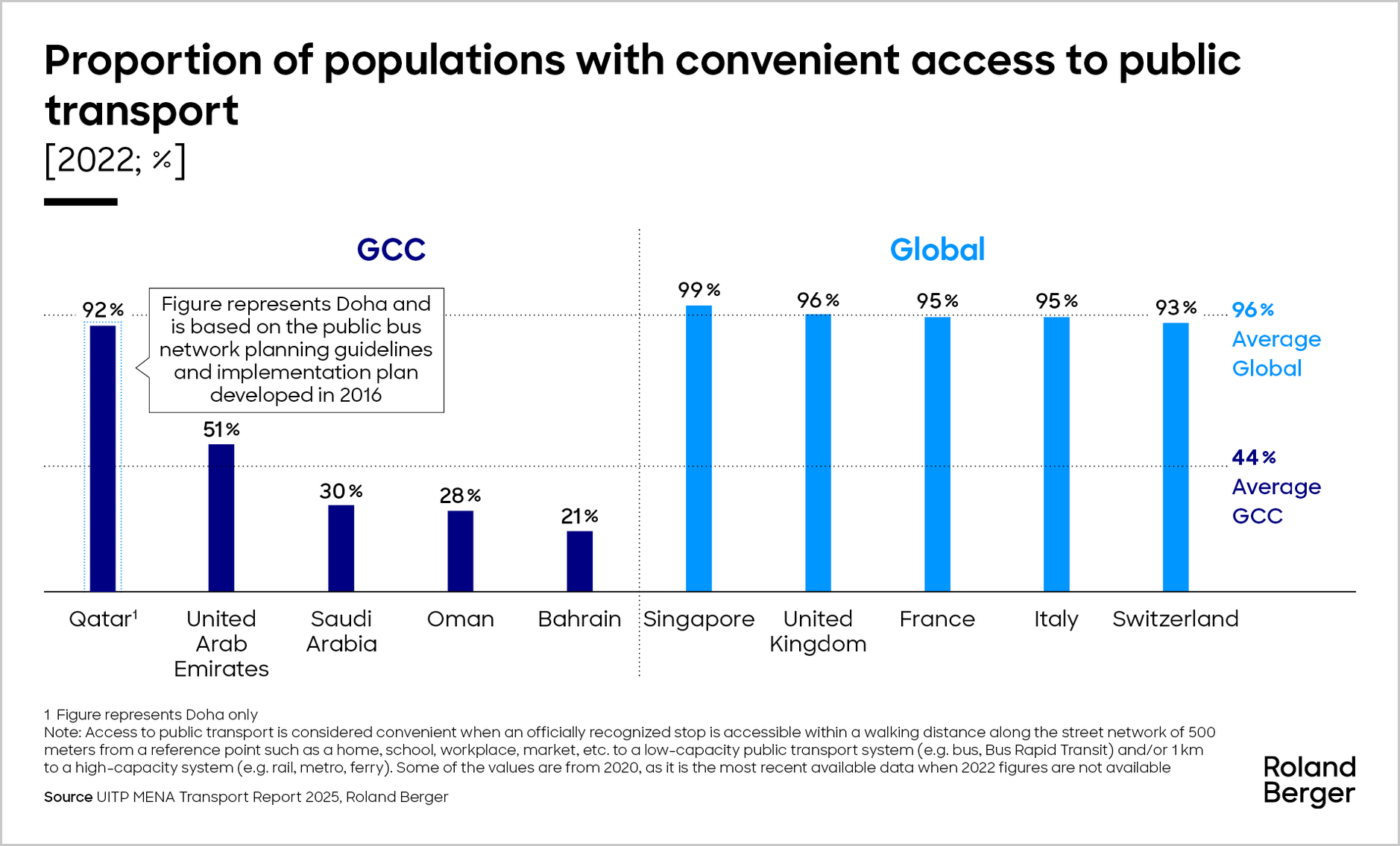
In response to the challenge, cities in the GCC have set themselves ambitious targets for developing their transportation networks. Dubai recently launched its 2040 Urban Master Plan, which aims to ensure that 55% of the population lives within 800 meters of a main public transit station by the end of the next decade. The new Transportation Master Plan for Qatar (TMPQ) also aims to increase the accessibility of educational facilities and workplaces via public transit by 50% by 2050. Additionally, Saudi Arabia recently opened the Riyadh Metro, a network of six metro routes with 85 stations and a total length of 176 km, capable of transporting 3.6 million passengers daily. The metro is making it easier for people to use public transport, with estimates showing it could cut around 250,000 private car trips each day. Complementing this, Riyadh’s BRT system will add 160 km of dedicated bus lanes, 80 routes, and over 2,800 stops, significantly expanding the reach and capacity of the city’s public transport network.
What makes TOD a sustainable approach?
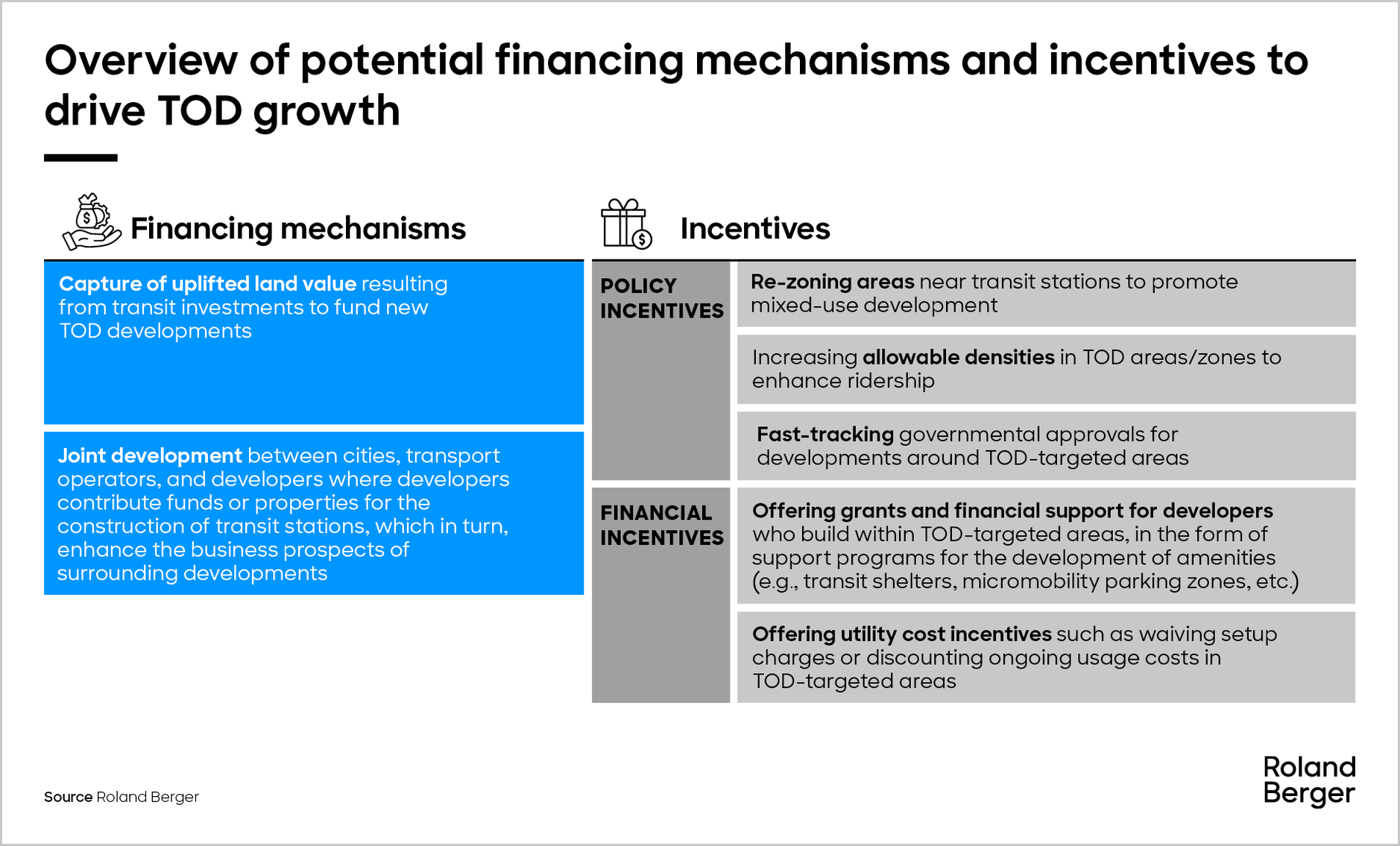
To achieve these ambitious goals, cities need to choose TOD, funding projects via public-private partnerships (PPPs) and value-capture financing. In addition, they should ensure regulatory support and the creation of financial incentives.
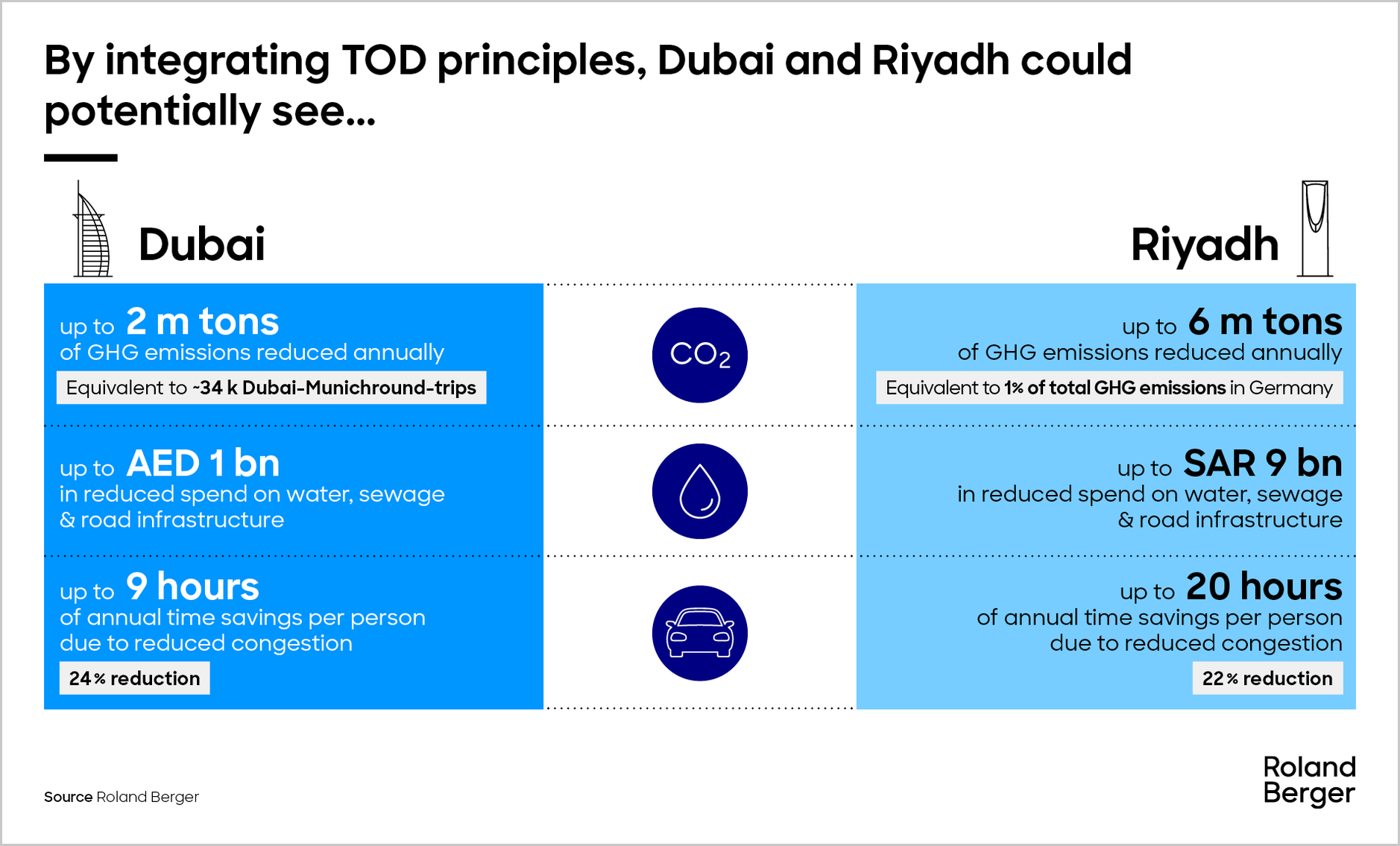
Cities benefit economically from TOD, making it a sustainable approach. Productivity improves, as goods and services are located closer to consumers and the available workforce. Additionally, TOD mitigates urban sprawl, lessening the pressure on governments to build new infrastructure such as roads, water, electricity, wastewater and drainage networks. Enhanced public transit use also reduces the use of private vehicles, decreasing the need for parking infrastructure; indeed, TOD can reduce infrastructure costs for governments by an estimated 25%.
TOD is also a game-changer for urban residents. By making public transit more attractive, it lessens people's dependence on private cars, promotes shorter commutes and cuts GHG emissions by 2.5 to 3.7 tons per year per household. It increases accessibility for lower-income households and narrows socio-economic gaps. It helps build pedestrian-centric communities around retail, entertainment and green spaces, improving safety and fostering a sense of place. And by promoting walking and cycling , it encourages healthier lifestyles and enhances residents' quality of life.
Realizing the TOD vision in the Middle East
TOD has significant potential for enhancing urban mobility and sustainability in the GCC, particularly in cities undergoing expansion or revitalization. However, successfully realizing projects based on this approach calls for close collaboration between cities, transit operators and developers. Cities play a crucial role as the enablers, developing comprehensive plans and targets, initiating supportive policies and regulations, ensuring project viability and engaging in PPPs to create incentives for development. Transit operators and developers then act as the executors, investing in transit infrastructure, developing surrounding centers and utilizing land value capture and other financing mechanisms to drive the projects.