The evolution of polymer industry disruption
Though plastics are everywhere, the global polymer industry is still relatively young. Since the first fully synthetic plastic (Bakelite) was invented in 1907 – and industrial scale expansion beginning at the start of World War II – plastics use has grown exponentially, largely due to product attributes and cost.
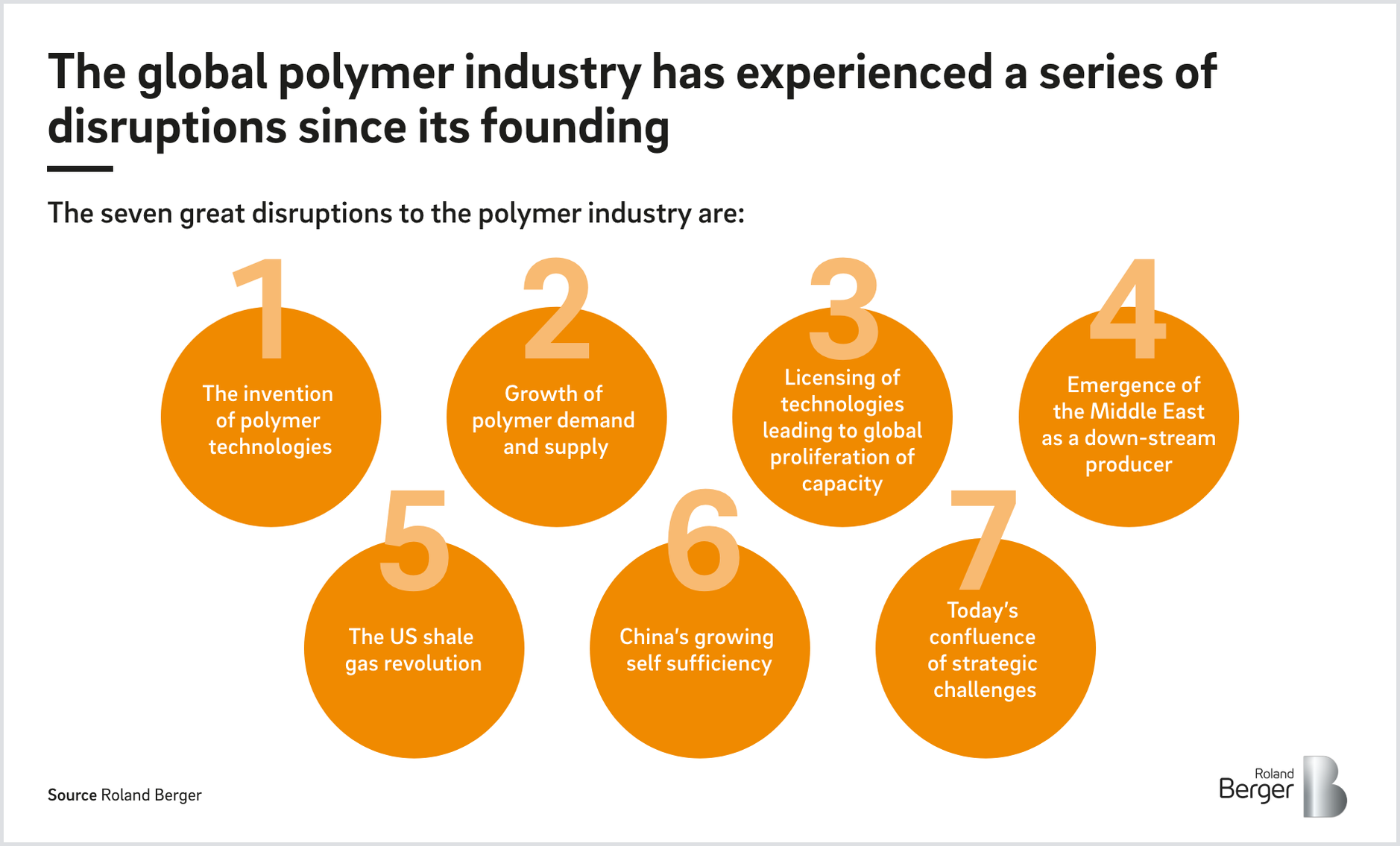
The first disruption was characterized by Technology Development, where companies able to develop new molecules and project technologies thrived, and growing demand for plastics use allowed product manufacturers to improve their product cost-value profile. Growing Demand and Supply drove the second disruption, with supply increasing to meet demand and global volume growth. The third disruption was driven by Technology Licensing, where polymer innovators began licensing technology to emerging firms around the globe, and countries outside the West were able to leverage lower costs and sell resins to more developed countries.
The fourth disruption, Middle East Downstream Production, saw the region move from oil to petrochemicals and polymers by leveraging its low-cost feedstocks, such as ethylene. The U.S. Shale Revolution (which lowered the cost of ethylene used in polymer production) was the basis for the fifth disruption; U.S. production costs thus became lower than Western Europe and Asia, bucking expected globalization trends. In the late 1990s to early 2000s, China began to strategically invest in growing its capacity across multiple industries (including polymers) which benefitted local producers but negatively impacted polymer producers dependent upon China trade, making China Self Sufficiency the sixth disruption in the global polymer industry.