Publication
Aerostructure tooling market: Automation the decisive factor

Aerostructure tooling market: Automation the decisive factor

September 27, 2018

Three market scenarios for the upcoming five years

The aerostructure tooling market - which is key in the production of new planes - is in flux. After a number of sluggish years, production rate increases, new aircraft programs and greater automation have sparked somewhat of a revival. We are optimistic that the growth dynamics will remain intact and present three scenarios for the development of the market over the next five years.

Automation is one of the key drivers of growth within the aerostructure equipment market.

Changing dynamics in the aerostructure equipment sector

"Hope on the horizon" is the third study on the aerostructure tooling market by Roland Berger. Since we published our first study in 2012, the market dynamics have changed significantly. In 2012 the production of both the A350 and the B787 was still in an early stage and the market was rather stagnant. Three years later, the production rates of the two programs had already increased, automation was picking up, the demand for eco-friendly aircraft had risen and business became more dynamic. Currently, the upbeat trend continues: The rate for legacy programs has gone up, new projects such as the B797 have started, automation is rapidly becoming more important and the service business is growing. Moreover, new competitors are entering the market, industrial expansion has increased and OEMs are promoting secondary sourcing.

Positive scenarios for an underestimated market

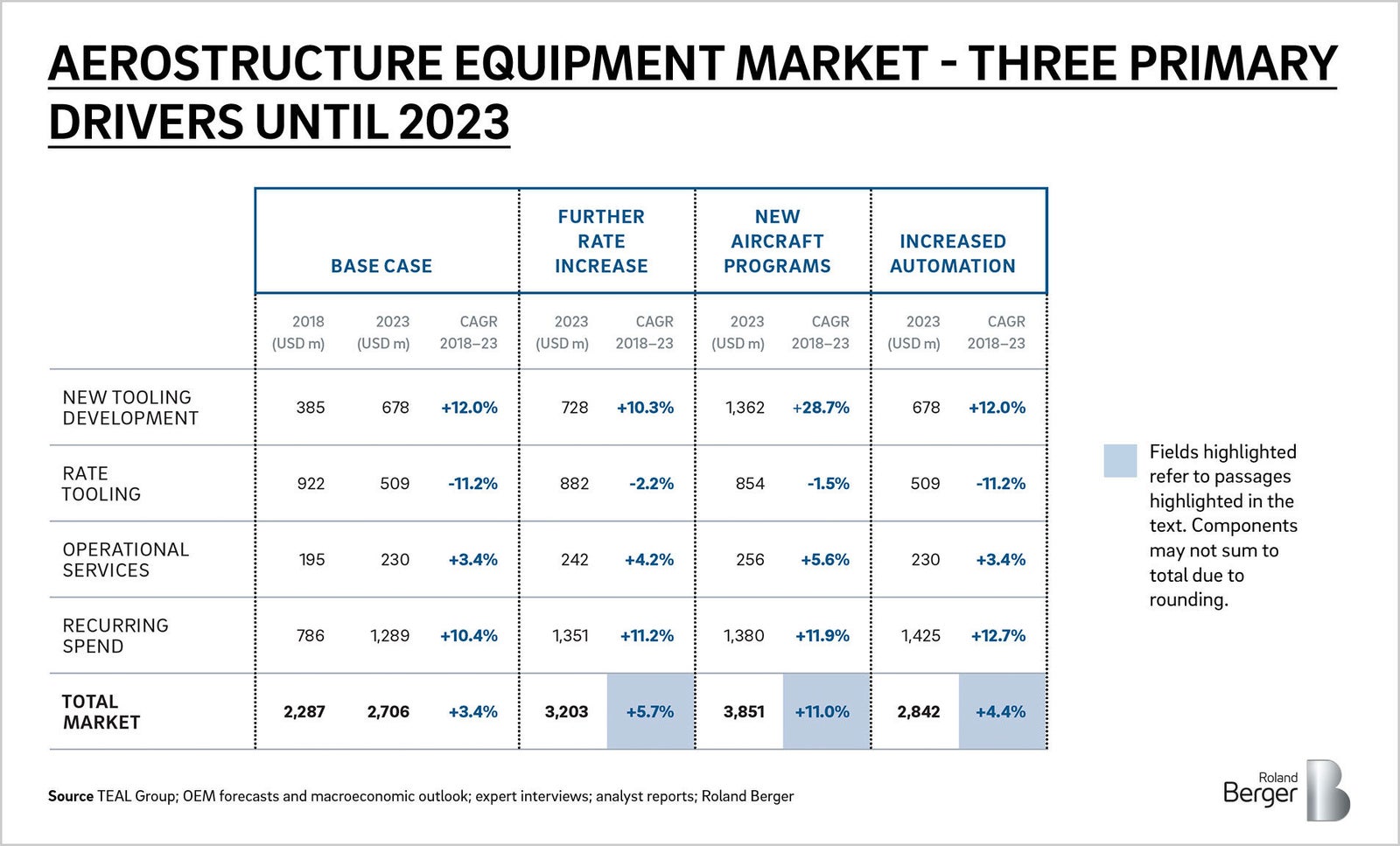
For the current study Roland Berger experts interviewed experts in nine countries. The established model of market drivers helped to assess the market. It also led to three possible scenarios for the economic developments of the industries of the next years. All of them offer a positive outlook although to varying degrees. "Everyone underestimates the market," says a CEO of a leading tool supplier. "History has shown that the market has countered all the forecast downturns."

Automation as major differentiation factor

We believe that the base scenario will most certainly be achieved, and that there's a strong case to be made for the enhanced case, assuming that the current market dynamics continue. It is our belief that further rate increases over and above the latest announced figures are likely. Underlying demand for air travel capacity is not expected to slow down. Tooling demand for new aircraft programs and production rate increases are mainly driven by OEMs' decisions, so the pivotal aspect for suppliers is likely to be automation. "There is pressure on price, but it is driven by OEMs reducing costs rather than competition in the market," states the Sales Manager of a Tier-1 company. "So, the demand for automation is strong." Investment in new production technologies could make the difference between moderate and significant market growth. Suppliers should position themselves at the forefront of automation, not just mastering the technical aspects of automation but also crafting a solid business case for convincing OEMs to buy automation enhancements.

roland-berger-study-438-aerostructure-equipment-market-dt-1.jpg
Study

Aerostructure tooling market: Automation the decisive factor
Aerostructure tooling market: Automation the decisive factor

The study "Hope on the horizon" provides an optimistic outlook for the development of the aerostructure equipment market. Suppliers should invest into automation.

Published September 2018. Available in

Further readings
All publications from this series
Load More
Dominique Gautier
Senior Partner
Paris Office, Western Europe
+33 1 5367-0341
Manfred Hader
Senior Partner
Hamburg Office, Central Europe
+49 40 37631-4327