The circular economy in practice: Cutting-edge technologies
Innovation and technology play a pivotal role in realizing the full potential of the circular economy. Augmented reality (AR) emerges as a groundbreaking tool that revolutionizes how repairs are carried out. By seamlessly blending virtual elements with the real world, AR empowers users with step-by-step visual instructions, effectively eliminating the need for traditional manuals. This transformative aspect of AR not only enhances repair efficiency but also democratizes the repair process, making it more accessible to individuals with varying levels of technical expertise.
Additive manufacturing
(3D printing), on the other hand, stands poised to possibly revolutionize production processes. Unlike traditional manufacturing methods that involve subtractive processes (cutting, drilling, etc.), 3D printing builds objects layer by layer from digital models. Various materials such as plastics, metals, ceramics, and even biomaterials are used. Traditional manufacturing often generates a substantial amount of waste as materials are cut and shaped to achieve the desired product. In contrast, 3D printing is an additive process, which means it only uses the exact amount of material needed to create the object. This reduces waste significantly.
Furthermore, from a business model point of view, a shift is challenging the traditional linear structure of product acquisition and disposal. Emerging business models like product-as-a-service and material-as-a-service are fundamentally reshaping the interaction between consumers and products, opening doors to an array of complementary services. By retaining ownership of assets and offering flexible usage options like leasing or pay-per-use agreements, companies are driving maximum utilization and encouraging eco-friendly practices.
Nevertheless, embracing the circular economy presents its share of challenges. A meticulous cost-benefit analysis brings to light that certain circular solutions might necessitate substantial upfront investment, possibly falling short of covering expenses under prevailing legislation. In fact, a majority of measures to increase sustainability in business and production models fall under the category of "high-effort/high-benefit," where the potential gains are substantial, but the investment of time and resources might be more significant. Some of these innovative processes could involve a lengthy break-even point, while others may never fully recover costs. To maximize the potential benefit of these options, companies should think further into the future while planning, in some instances, 3-5 years ahead, or even more. As the effects of climate change become more relevant, these adaptations are becoming more necessary as the incoming work force of Generation Z increases pressure along with increasing regulatory pressure.
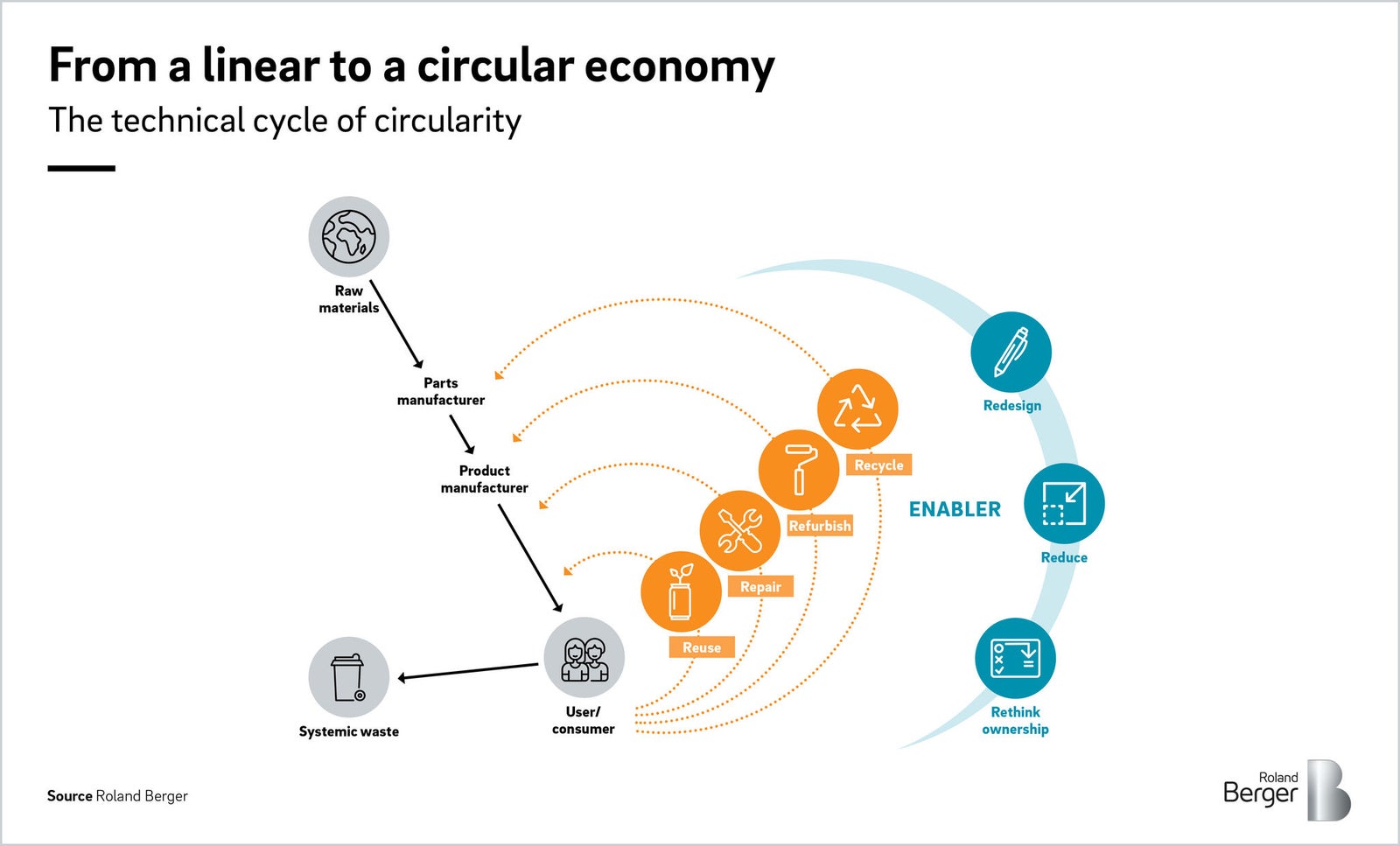
Another point to consider is that it cannot be expected that all industrial environments apply the 4 Rs on a one-size-fits-all basis. The nuances of these strategies fluctuate not only between different industries but also within individual companies. What proves most effective in one case may entail a combination of two of the Rs while in another, pure recycling might be the optimal approach. This diversity of levers calls for tailored solutions, underscoring the need for a nuanced and adaptable approach to achieve sustainable practices across the industrial landscape.
To ensure that the circular economy is integrated into the industrial sector, decision-makers must diligently follow a comprehensive checklist of tasks. This includes clearly elucidating stakeholders' expectations, providing precise instructions to design engineers, ensuring utmost transparency in procurement practices, and discovering viable, reusable solutions.