If
satellite navigation systems
were to fail, for example, the consequences would be severe. An analysis for the UK economy revealed that a disruption lasting just 24 hours would cost that nation more than EUR 1.6 billion. The damage for Germany would likely be even greater due to the country's bigger economic output. Equally as important as navigation signals from space are secure satellite communications and the supply of data provided by Earth observation satellites for both civilian and military purposes.
The space economy is closely interlinked with security policy
Space also holds essential, strategic importance for Europe's defense capabilities. Space services are by definition dual use, meaning they can always be used for both military and civilian purposes. For example, the same satellite image that a farmer uses to assess soil conditions can be used for military analysis to check whether the terrain is passable for heavy vehicles.
Private stakeholders are growing in importance
A new race has thus begun for access to space and the exploitation of this access. On a daily basis, governments and a steadily growing group of companies are testing increasingly powerful rocket systems, planning or operating large satellite constellations, revolutionizing launches, and sending more and more complex robot missions into space. Private stakeholders are growing ever more important in this power struggle, as is the close integration of the space economy with other industries. They are all players in
the new space economy
and the goal of all of them is the same: to dominate the infrastructure in space and thus secure pole position in defense and the economy for the coming decades.
A rapidly growing space market
The space market is divided into upstream and downstream. The upstream market comprises
production of the infrastructure required on Earth and in space
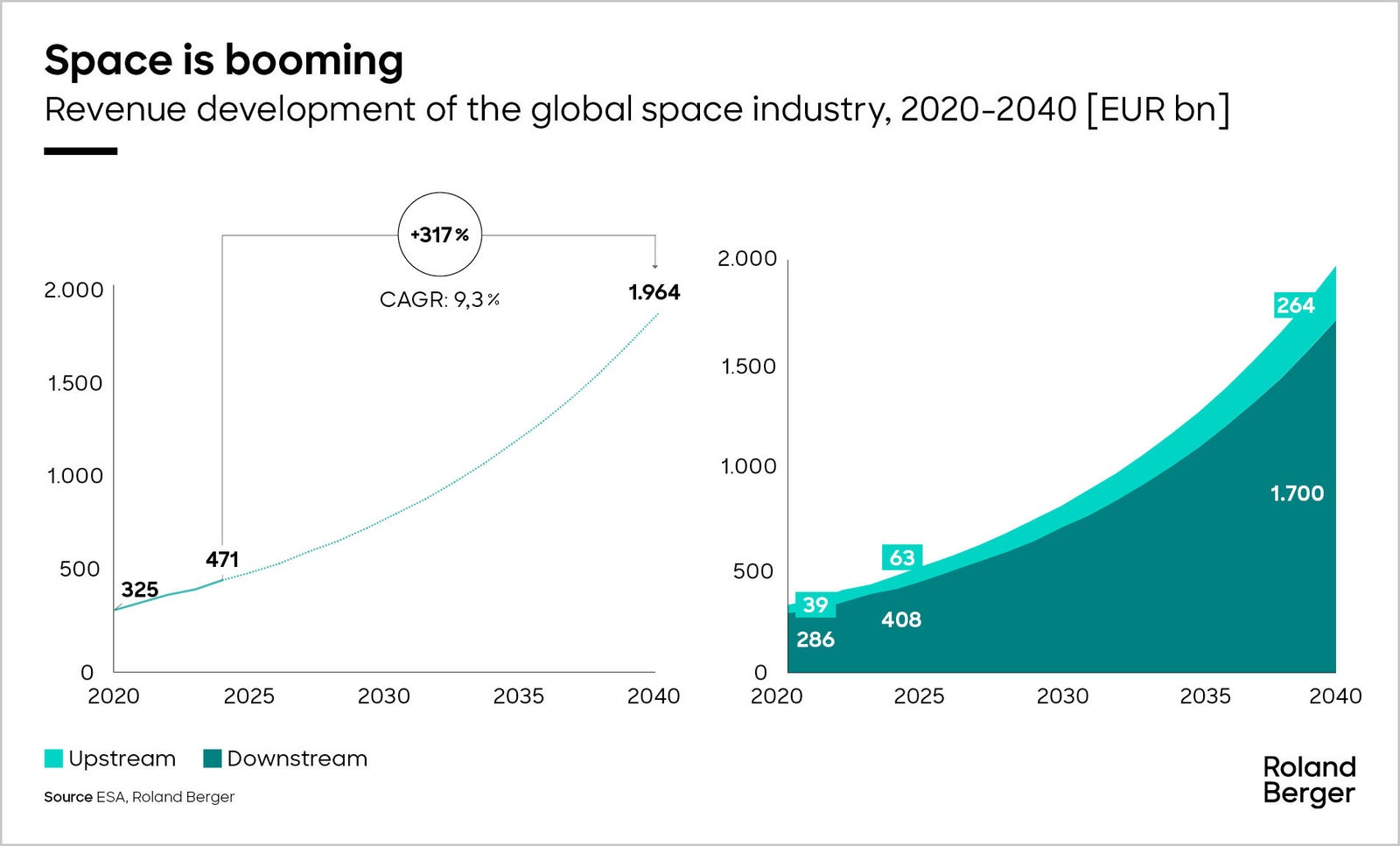
, from launch pads and rockets to satellites. The downstream market consists of space-based solutions – positioning, navigation & timing, Earth observation, and satellite communications. With a market volume of around EUR 408 billion in 2024, the downstream market was significantly larger than the upstream market, which amounted to EUR 63 billion. Based on a projected growth rate of 9.3%, the upstream and downstream markets together will account for a market volume of around EUR 2 trillion in 2040.