The case for a zero-based process redesign
Our engagement with a leading global automotive OEM – with revenues exceeding EUR 200 billion and operations in more than 30 countries – shows why incremental optimization was no longer enough. The client's processes had been improved over time, but they were still shaped by legacy systems and organizational structures rather than by the outcomes they needed to achieve.
This created a practical problem. High numbers of manual steps and approval loops, reinforced by coordination dependencies, made processes difficult to automate or redesign at scale. These issues were not simply inefficiencies in the existing process – they showed that the process logic itself needed to be rethought.
What was required was a "zero-based" redesign mindset: rather than starting from the existing process map, we started from the desired outcome, then defined the capabilities required, the activities suitable for
AI
and the points where human judgment remained critical.
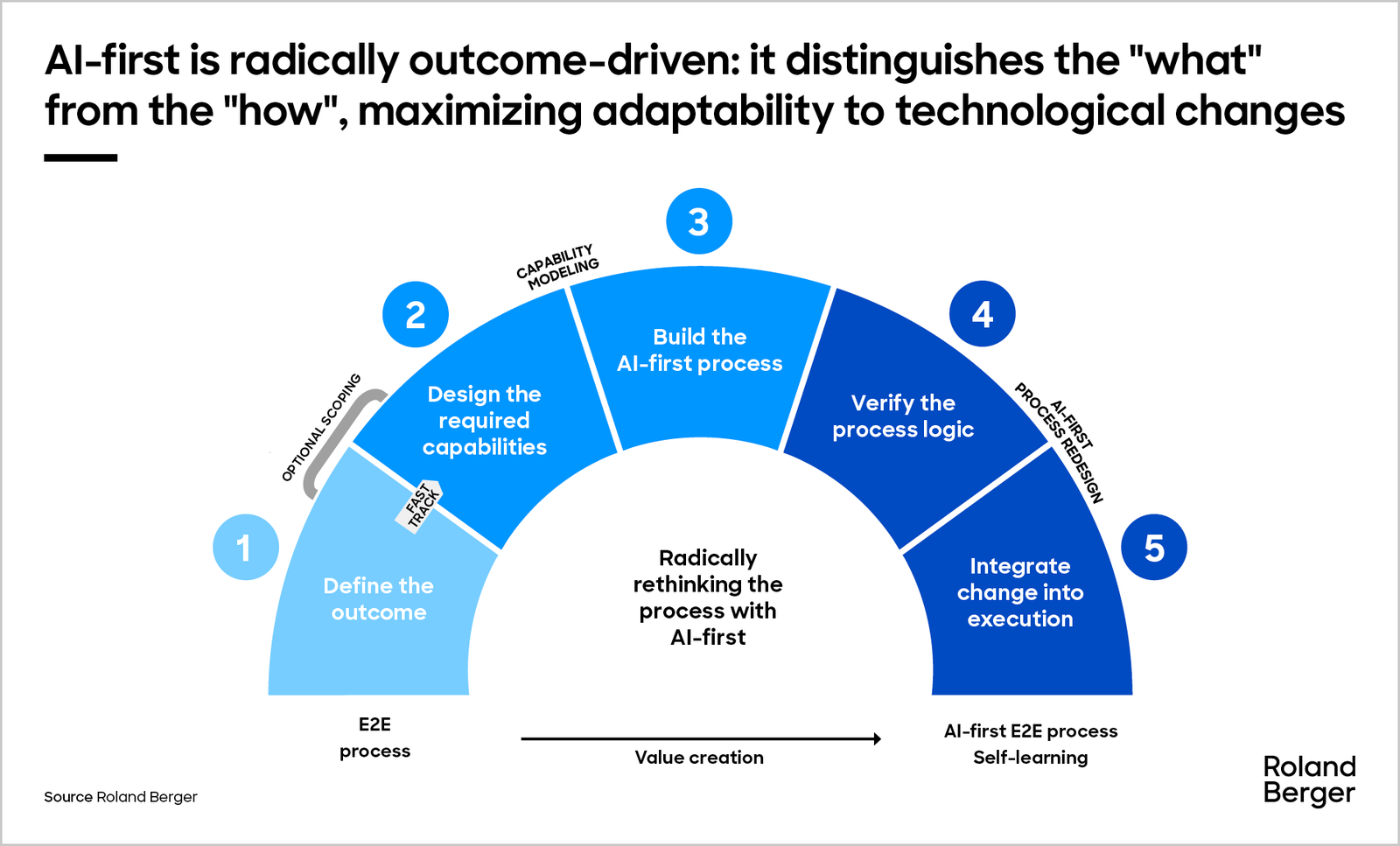
The Roland Berger five-step AI-first redesign approach
We structured the
redesign
around five steps, making the approach easier to repeat across business units while keeping it anchored in the process outcome rather than in the existing workflow:
#1 Define the outcome
The first step establishes what end-to-end success looks like. Clear outcome statements and critical success factors provide directional guidance throughout the redesign, replacing the conventional starting point – mapping what currently exists – with a deliberate focus on the business intent and what the process is ultimately supposed to achieve.
#2 Design the required capabilities
The second step translates the outcome into business capabilities and jobs to be done. This describes the required outcomes independently of existing organizational hierarchies or technology systems, making the design durable across structural change.
#3 Build the AI-first process
The third step creates an AI activity inventory: a sequenced set of activities that defines, for each step, whether it is handled by AI or by a human. An explicit
human-in-the-loop framework
governs this distinction – AI is deployed where automation is appropriate; human judgment is preserved where it is critical.
#4 Verify the process logic
The fourth step turns the redesign into a process blueprint designed for implementation. A proof-of-concept (PoC) framework supports stepwise validation before wider rollout.
#5 Integrate change into execution
The final step prepares the redesigned process for scaling across process clusters, supported by governance logic and change integration.