Data gaps and human conflict: Challenges to AI deployment
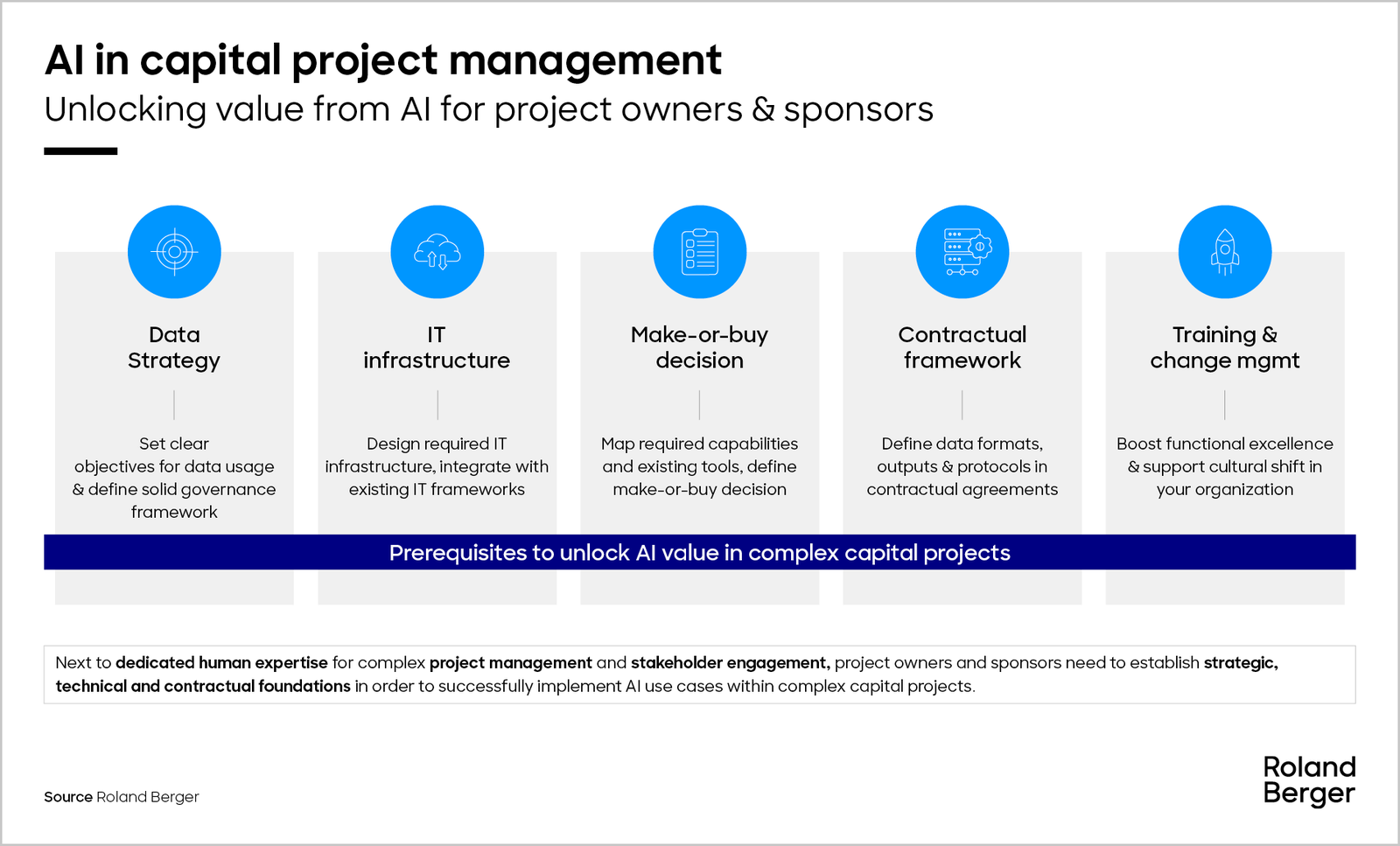
Currently, most capital projects are not set-up for efficient data usage and – if at all – only use singular, isolated AI use cases. Project owners, developers and sponsors fail to allocate time and expertise during project definition to set up AI readiness. They also lack a contractual framework for smooth and standardized data sharing across different stakeholders involved throughout the project life cycle. Equally important is the fact that many project delays occur due to misaligned stakeholder interests – conflicts that cannot be solved by
AI
alone.
So, where and how can you unlock value from AI in complex project management?
Beyond the hype: Where automation and AI will unlock value over the next two years
By embracing automation and AI, project owners, developers and sponsors can enhance their project management capabilities, drive efficiency, and ultimately realize significant cost savings in their capital projects.
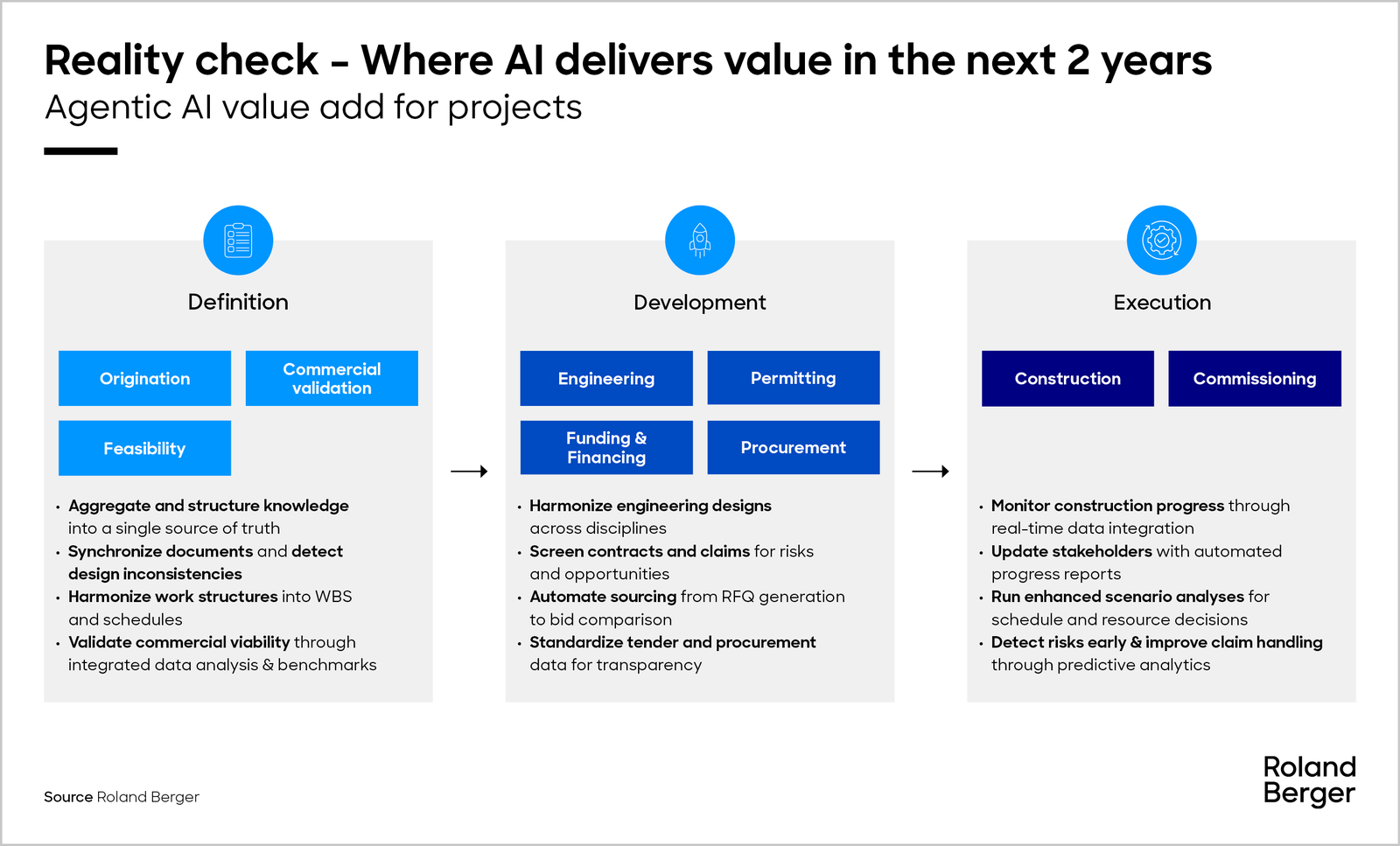
While AI agents will not replace much-needed human project management expertise, they can certainly enhance validity of project planning and scheduling. Throughout your capital project, we see several use cases that can be employed with moderate need for customization. These use cases can significantly enhance your transparency and decision making, while simultaneously reducing manual labor and human error.
Project definition and development
Ramp-up internal knowledge and structure document management: AI tools can help aggregate data, synchronize project and engineering plans (including transferring design data into time schedules), detect synchronization issues or design flaws, and enhance transparency in document management. This can significantly reduce design errors and rework.
Project execution
Mine, synchronize and structure dataThroughout project execution, your AI-enhanced knowledge base can act as your single-source-of-truth and collect, integrate and check project related-data, from progress tracking and claims to identifying documentation, and linking and merging relevant data and interfaces.
Scheduling and resource management: Implement quality checks and synchronize various schedules while integrating risk analyses. AI-driven software can help to efficiently allocate resources by analyzing historical and forecasted data to anticipate future needs.
Progress tracking, documentation and reporting: Utilize a combination of data inputs, from manual entries to image, video, and sensor data, to visualize project progress. This approach reduces manual labor and human error, accelerates data preparation, and enhances transparency for decision-making
Risk management
: Utilize machine learning algorithms to assess project risks based on historical data and current project parameters. By identifying potential pitfalls early, teams can proactively implement mitigation strategies.
Construction monitoring: Use drones or camera-equipped construction hats for site monitoring. AI applications can convert, analyze and visualize project data, i.e. for status reports. Additionally, drone and camera-based inspections can be used to identify safety hazards and enhance site supervision.
Contract and claim management: AI-based tools can selectively support in analyzing claims, responding to claims, initiating and drafting counter-claims, among other tasks, based on comprehensive access to contracts and project data such as progress, costs, invoices, contract documents, journals, and letters.
Dispute settlement: Development of holistic (end-to-end) AI-supported solutions from conflict through claim to resolution foreseen for the future.