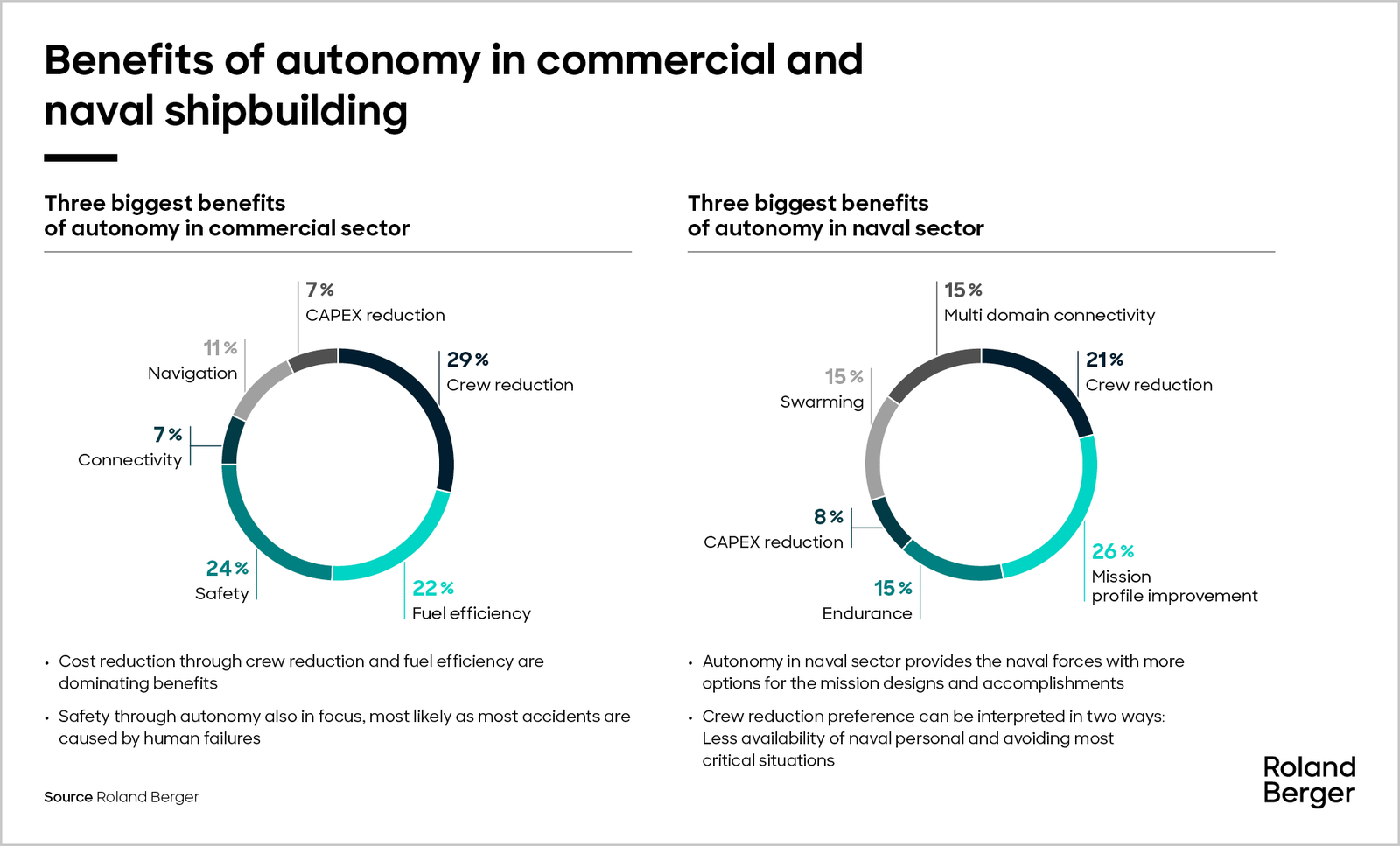
Rather than considering the economic benefits, military interest in autonomous vessels centers on operational advantages. Uncrewed vessels enable extended missions, reduce personnel exposure to dangerous situations, and provide new tactical capabilities through coordinated vessel operations. On the commercial side, autonomous systems offer potential solutions to challenges around the shortage of skilled workers and rising personnel and operational costs, including fuel consumption, while simultaneously addressing safety concerns, given that human error is a contributing factor in three-quarters of all maritime accidents.
Barriers to autonomous shipping adoption
The slower-than-expected adoption of autonomous shipping technologies is a result of systemic barriers rather than technology limitations. Connected
infrastructure
represents the most significant challenge, according to 28% of industry professionals surveyed, followed closely by regulatory uncertainty (26%), with the International Maritime Organization (IMO) not expected to issue regulations for autonomous ships until 2030. Then there is the lack of technology standardization presenting a further barrier to market penetration, cited by 21% of respondents, alongside the availability of insurance (14%), navigation support (7%) and cost transparency (5%).
Economic impact expected to be substantial
Despite slower adoption rates, the industry remains confident of future operational savings. More than 60% of survey participants anticipate significant reductions in operational expenditure (OPEX) from autonomous shipping. Indeed, 38% of respondents expect OPEX savings to exceed five percent, while 23% predict between two and five percent lower costs. A further 15% anticipate modest savings of zero to two percent, and another 15% expect no change in OPEX. Only 8% of respondents believe autonomous systems will increase operating costs.
These optimistic projections stem primarily from anticipated reductions in crew costs and fuel efficiency improvements. Crew costs typically represent 30-40% of a vessel's operating costs, making personnel reductions a significant economic driver behind the adoption of autonomous and uncrewed ships.
Promising use cases and vessel types
The survey identified specific vessel types most suited to autonomous operation, revealing practical use cases where automation offers clear advantages. Passenger ferries and patrol/security vessels were each cited by 25% of respondents as the most promising use cases, while both cargo ships and offshore support vessels were mentioned by 20%. Tankers (7%) and private yachts (2%), on the other hand, are of limited interest for automation use cases.
Cargo shipping constitutes an ideal use case for autonomous technology due to its predictable routes, standardized operations, and significant potential for crew cost reductions. Container ships and bulk carriers operating on established trade routes could benefit substantially from being remotely operated.
Ferry operations offer the controlled environments suitable for automation, with fixed routes and established infrastructure. However, regulatory approval for autonomous passenger transportation remains uncertain and will likely require extensive safety validation.
Technology investment and R&D priorities
The industry's investments in
R&D
for automation focus on the core enabling technologies essential for autonomous vessel operations. Developing navigation software is the highest priority, being the investment focus of 30% of respondents, followed by sensors and camera systems (25%) and remote control technologies (20%). Lower down the priority list come port infrastructure (11%), personnel training programs (9%), and propulsion systems (5%).
Navigation software is the most critical technology, requiring sophisticated algorithms for collision avoidance, route optimization, and responding to the weather conditions. Current systems need to integrate multiple data sources including radar, lidar, GPS, and environmental sensors. Advances in sensor technology are driving the development of autonomous capability, with the industry investing heavily in computer vision, artificial intelligence, and machine learning systems.
These technologies
enable real-time environmental awareness and automated decision-making.
The survey revealed that the majority of companies (53%) are spending between five and ten percent of their total R&D budget on applications related to autonomous shipping. With 13% spending as little as zero to five percent, another 20% of firms are investing ten to twenty percent of their R&D budget in automation. Above that level are the 7% of companies spending up to half of their R&D budget on autonomous technologies and a further 7% assigning more than half of their research budget to automation.
Global market dynamics vary by region
Europe is considered the leading continent (56%) when it comes to the development of autonomous shipping, driven by favorable regulation and the environmental pressures. Asia is next (38%), exhibiting strong advances in technology and good manufacturing capacity. The Americas (6%) demonstrate limited activity, focusing primarily on military rather than commercial applications, while the Global South currently reveals no significant level of activity.