Strategic workforce planning (SWP) is not new—organizations have used it for years to anticipate future talent needs and skill gaps. Similarly, the fundamental levers for managing workforce transformation—upskilling, hiring, staffing optimization, streamlining, and performance management—are well-established practices that companies have deployed for decades.
What has changed dramatically is the challenge itself. The unprecedented pace of technological disruption, combined with rapidly evolving skill requirements and demographic pressures, has created massive uncertainty about what the future workforce should look like. The half-life of skills has collapsed to 12-18 months, new job categories emerge faster than companies can define them, and automation potential varies significantly even within the same role.
This is where data-enabled workforce analytics fundamentally transforms strategic workforce planning. Rather than relying on broad assumptions or industry benchmarks, organizations can now conduct SWP with precision:
- Identify exactly which jobs and specific skills require upskilling versus redeployment
- Pinpoint where hiring is needed and for what emerging capabilities
- Determine which roles offer the highest automation potential and implementation feasibility
- Allocate resources strategically based on data-driven scenarios rather than intuition
- Measure and track progress with quantifiable metrics at the duty and task level
The breakthrough isn't in creating new action areas—it's in knowing precisely where and how to act. Data-driven analysis transforms familiar workforce levers into surgical tools, enabling leaders to make confident decisions despite unprecedented uncertainty.
From guesswork to precision: data-driven workforce analysis
Most organizations approach automation with broad assumptions: "AI will impact customer service." "We need to hire more data scientists." These generalizations lead to scattered investments and missed opportunities. The breakthrough comes from analyzing automation potential at the duty level—the specific tasks that make up each role.
We operate an engine that screens over 11,000 automation and AI technologies against individual job duties. This approach enables organizations to:
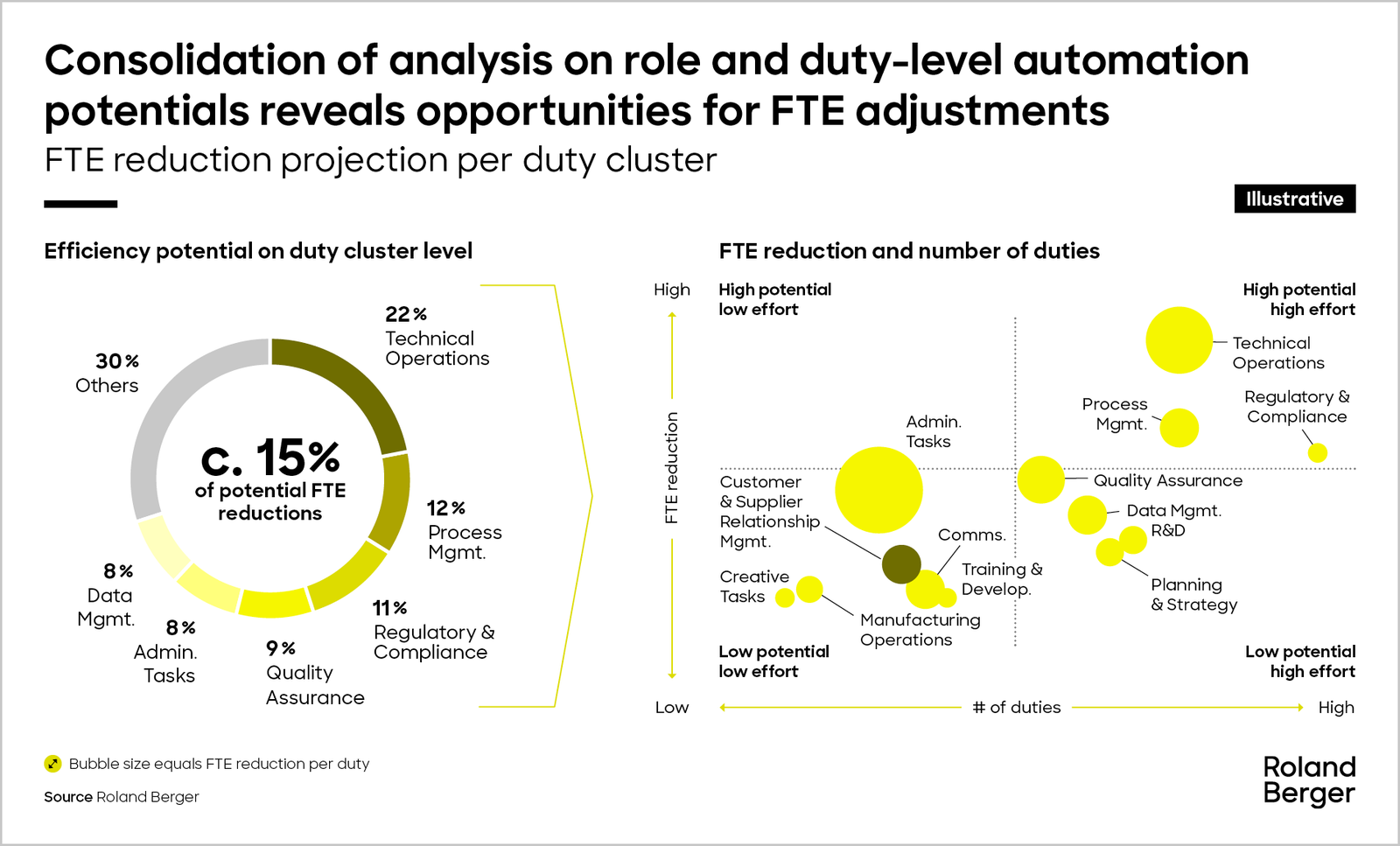
- Assess automation potential per role, identifying opportunities for FTE adjustments
- Quantify efficiency gains at the organizational level by linking employee data with job and task analysis
- Identify top technologies for investment,
integrating technology and people
decisions
For example, current analysis reveals automation potential across different roles:
- Accountants face 39% automation potential
- HR business partners face 19% automation potential
- Electrical engineers face 12% automation potential
By mapping duties and clustering them by automation potential and implementation effort, leaders can identify quick wins: clusters with high FTE reduction potential and low implementation barriers. This granular approach transforms workforce planning from art to science, enabling organizations to quantify efficiency gains, project FTE adjustments, and prioritize technology investments based on measurable impact.
The results are striking:
-
HR functions
show efficiency improvement potential of 30-50%
- IT functions show efficiency improvement potential of 30-40%
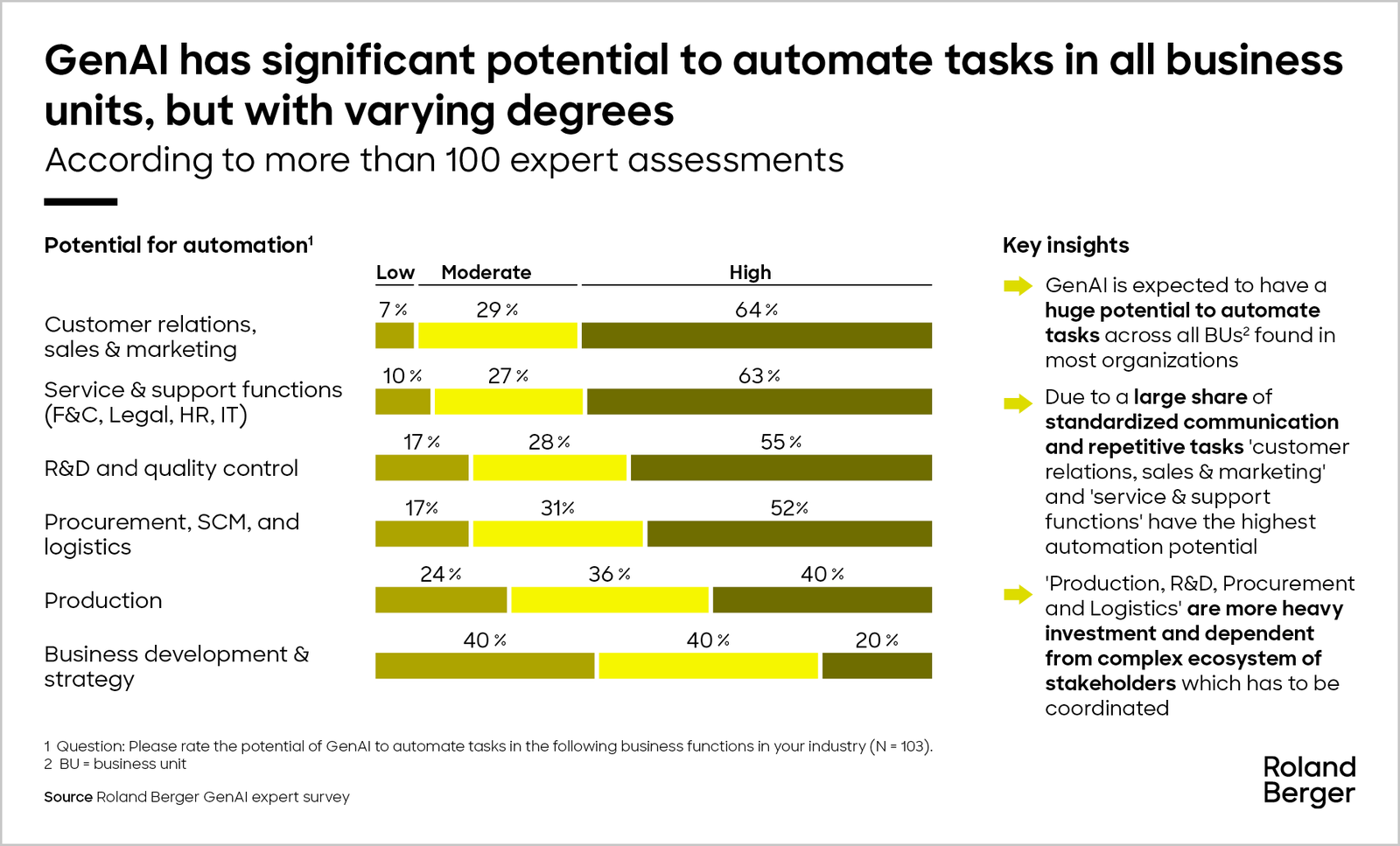
- Functions with high shares of information analysis and formalized communication, such as procurement, show gains of 15-30%
- R&D functions show gains of 15-30%
These aren't theoretical projections—they're grounded in detailed analysis of duties, tasks, and technology readiness across over 1.8 billion data points in 120 countries.