Quick Wins: Increasing Public Transport Adoption Without Heavy CAPEX
To accelerate this shift in travel behavior and maximize the value of ongoing investments, cities should pursue a set of focused, cost-effective measures that can be implemented quickly. These interventions don’t require major capital outlays but can significantly improve the overall functionality and attractiveness of the transport network—making public transit more accessible, connected, and competitive with private car use.
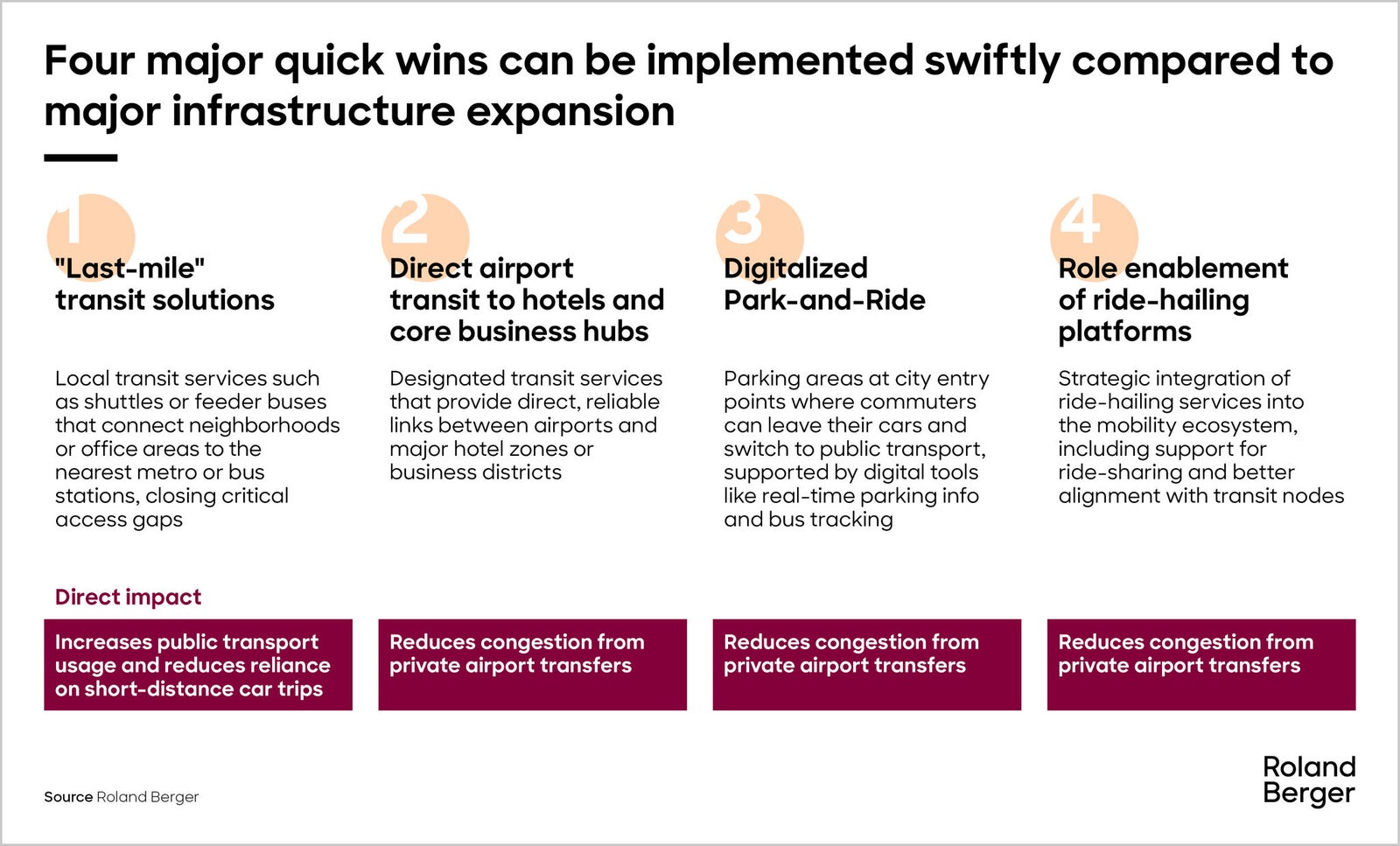
"Last Mile" Transit Solutions
Introducing feeder buses, micro buses, or shuttle services from residential areas and key business hubs (e.g., Dubai DIFC and Riyadh KAFD) to major public transportation nodes, such as metro stations, is crucial for enhancing "last mile" connectivity and making public transit more accessible. The introduction of feeder bus services in Dubai represents a step toward better integration of communities into the public transport network. While current coverage focuses on selected residential areas, there is room to enhance aspects such as vehicle availability, service frequency, and digital platform functionality. With continued improvements in planning and operations, these services can offer a viable complement to private vehicles and help alleviate urban traffic pressures.
Direct Airport Transit to Hotels and Core Business Hubs
This approach is crucial in major tourist and business centers in GCC cities, which regularly see high numbers of international travelers moving from airports to popular hotels and business hubs. Implementing such services can reduce congestion in city centers and enhance the overall travel experience, thereby boosting the city's appeal to business professionals and international visitors.
Airports like Los Angeles International Airport (LAX) and Singapore's Changi Airport provide integrated shuttle services that directly connect travelers to key hotels and business districts, effectively reducing reliance on private vehicles and easing congestion. These well-coordinated services help streamline the travel experience, ensuring smoother and more efficient urban mobility.
Digitalized Park-and-Ride
Park-and-ride can reduce urban traffic by encouraging commuters to park on the outskirts of the city and complete their journey using public transport. This solution helps manage traffic congestion, especially for long-distance commuters, by limiting the number of private vehicles entering city centers.
In the GCC, cities like Riyadh and Abu Dhabi have begun rolling out such solutions. In Riyadh, a number of park-and-ride facilities have been introduced alongside the metro and bus systems to support multimodal travel near key stations. Abu Dhabi’s system reflects this regional shift through a digitally integrated park-and-ride service, with parking facilities connected to shuttle routes serving major business and event districts. Supported by a mobile app that provides real-time parking availability, bus schedules, and route planning, it marks as a step toward integration-driven vision of urban mobility.
To further enhance this service, additional digital features could be introduced. These could include predictive parking availability, integrated payment systems, preference-based route suggestions, and ride-hailing integration for last-mile connectivity. Such improvements would make park-and-ride services more seamless and efficient, hence encouraging wider use and further reducing urban traffic congestion.
Enabling the role of ride-hailing platforms
Ride-hailing platforms have the potential to reduce traffic congestion in GCC cities, especially when integrated as a last-mile solution connecting commuters to metro and rail stations. By providing a convenient alternative to private cars, ride-hailing can help reduce the need for parking in high-density areas like KAFD in Riyadh, where parking search traffic contributes to congestion.
To support the broader integration of ride-hailing into urban mobility networks, regulatory refinements can play a role—such as enabling more collaboration between licensed taxis and platform operators, encouraging service coverage near public transport nodes, and supporting shared-ride options. These adjustments can help make ride-hailing more accessible, better utilized, and more aligned with public transport goals.