Corporate clients: Similar to cargo customers, corporate clients often have publicly announced sustainability targets, frequently with ambitious commitments for 2030-2040. In many industries – such as banking, professional services, legal, etc – flying can often represent a significant share of companies’ total emissions, meaning that any near-term meaningful action requires aviation decarbonization, generally through SAF. Roland Berger is itself a case-in-point as flying represents ~60% of our total annual CO2 emissions: to meet our ambitious SBTi targets, we follow a two-pronged approach: avoid air travel where possible, and abate remaining flight emissions through SAF procurement. By rethinking offer management, airlines can align with these customers’ decarbonization goals, creating compelling narratives that appeal to their sustainability objectives.
Leisure customers: Recent findings indicate that customers exhibit a notable willingness to pay when prompted; however, the conversion rates remain relatively low. This trend can be partially attributed to the absence of compelling offers that resonate with customers' perceptions of value. Through our comprehensive research, we have developed significant expertise in understanding what customers truly regard as valuable within the framework of sustainability. We are well-positioned to assist airlines in harnessing this knowledge to create customer-value-driven offerings, which can enhance customer satisfaction while mitigating the impact of regulatory challenges in the market.
Importantly, this approach does not solely apply to SAF, it also encompasses other sustainable goods and services as long as real action is being taken and can be proven accordingly.
De-risking to generate value throughout the SAF supply chain
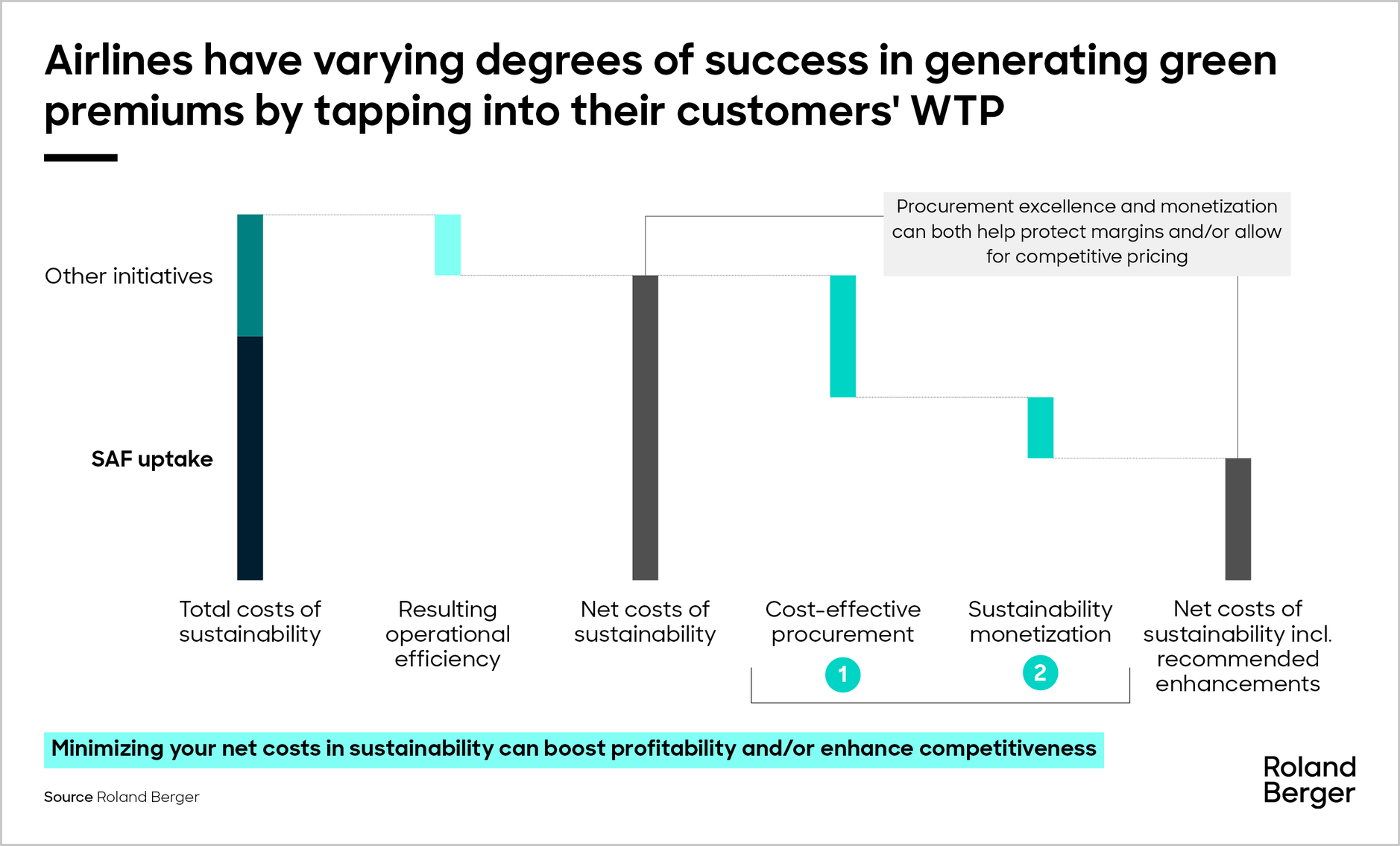
Combining together procurement and monetization strategies is key: by aligning characteristics of SAF procured with SAF certificates sold (e.g., in carbon intensity, pathways/feedstocks, volumes, costing/pricing, contract duration and terms, logistical considerations, etc), airlines can align incentives and expectations through the SAF supply chain. There is indeed a continuum of structures for agreements that is possible here in the B2B space (with cargo and corporate customers):
- From unlinked (not de-risked) deals,
- to “back-to-back” deals where airlines contract separately but in close alignment with SAF suppliers and B2B customers,
- to 3-way agreements involving the SAF supplier, airline and B2B customer,
- to full special purpose vehicles dedicated to risk management, with equity investments from all parties involved.