Government subsidies help fuel EV sales
Thailand has pursued EV adoption with greater commitment than most other Southeast Asian countries. The government is supporting e-mobility through subsidies for battery electric vehicle (BEV) purchases and tax incentives as part of its 30@30 policy. This mandates that by 2030, at least 30% of vehicles produced in Thailand must be zero-emission vehicles (ZEVs).
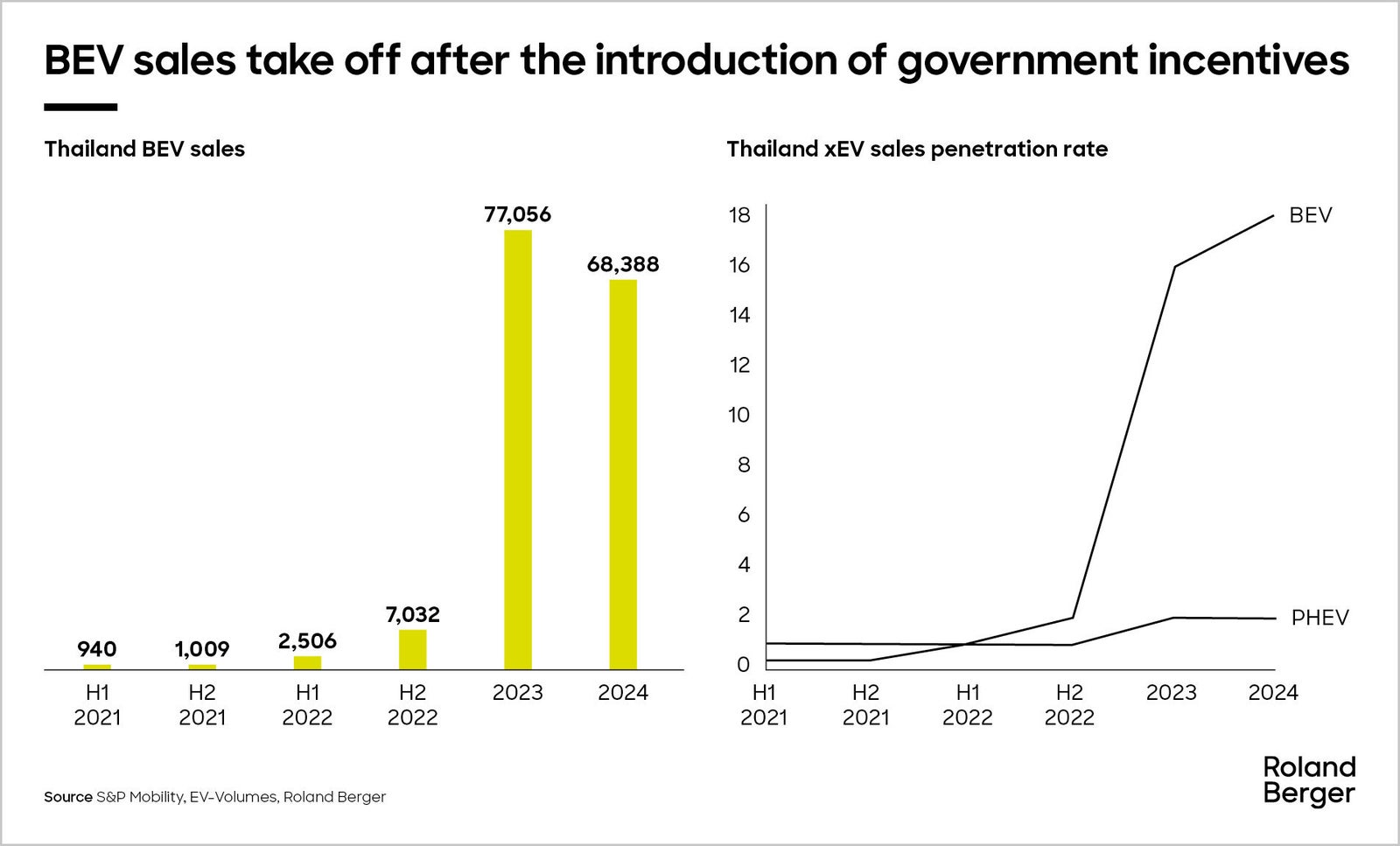
Under Thailand’s previous EV 3.0 policy, BEV importers were granted tax incentives as well as a price subsidy of up to THB 150,000 (USD 4,500) per vehicle, making them a similar price to comparable ICE cars. This resulted in a 618% CAGR in the number of new BEVs sold from 2022 to 2023.
In 2024, however, sales were affected by the introduction of Thailand's EV 3.5 policy (effective 2024-2027). The policy includes a reduction in subsidy from THB 150,000 to THB 100,000 (USD 3,000) in the first year, THB 75,000 (USD 2,300) in the second year, and THB 50,000 (USD 1,500) in the third and fourth years. Stricter loan requirements also saw greater spending restraint among consumers.
Despite the decrease in EV sales, Thailand's EV sales penetration rate actually increased slightlyin 2024, from 18% to 20%, due to lower demand for ICE cars.