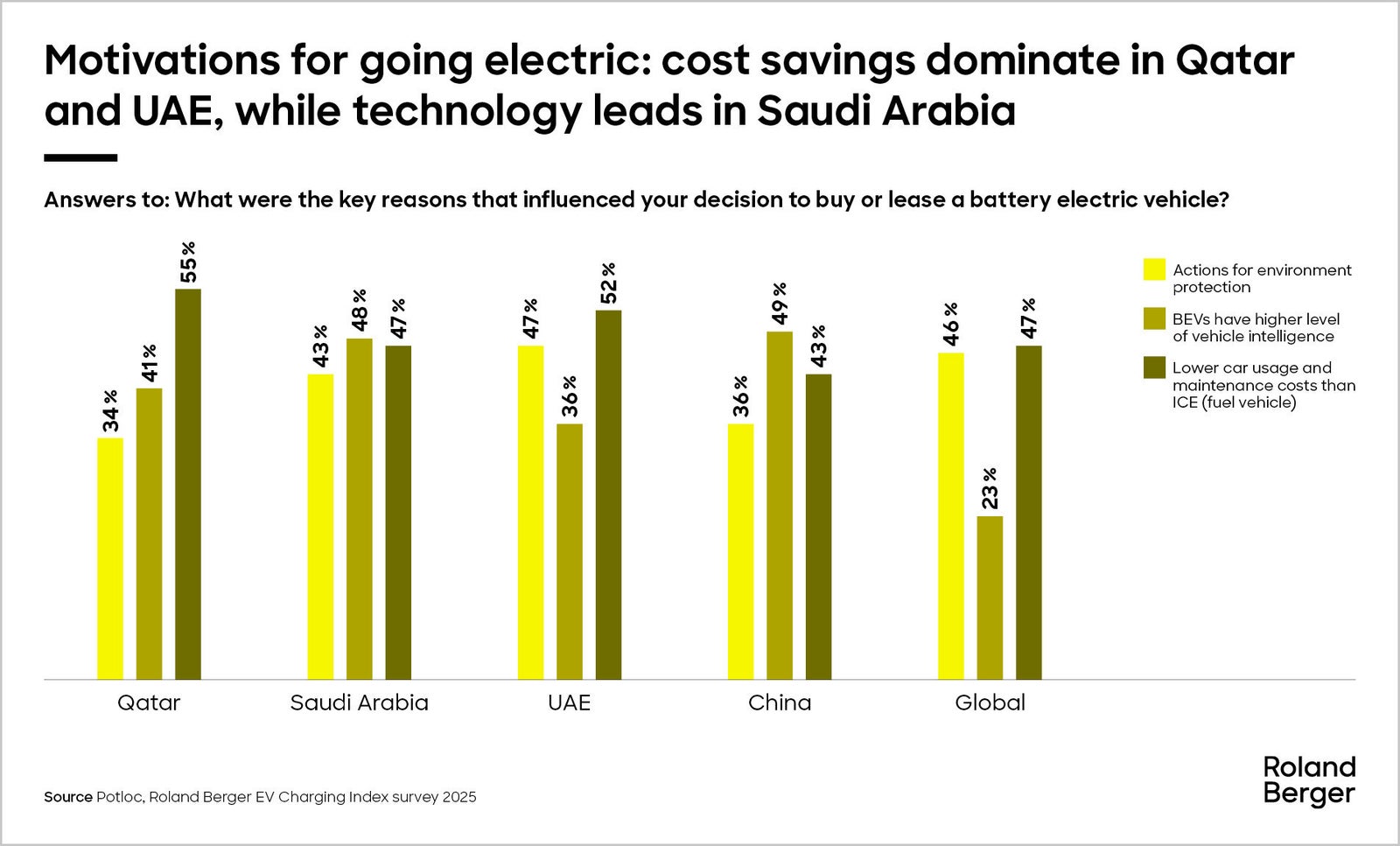
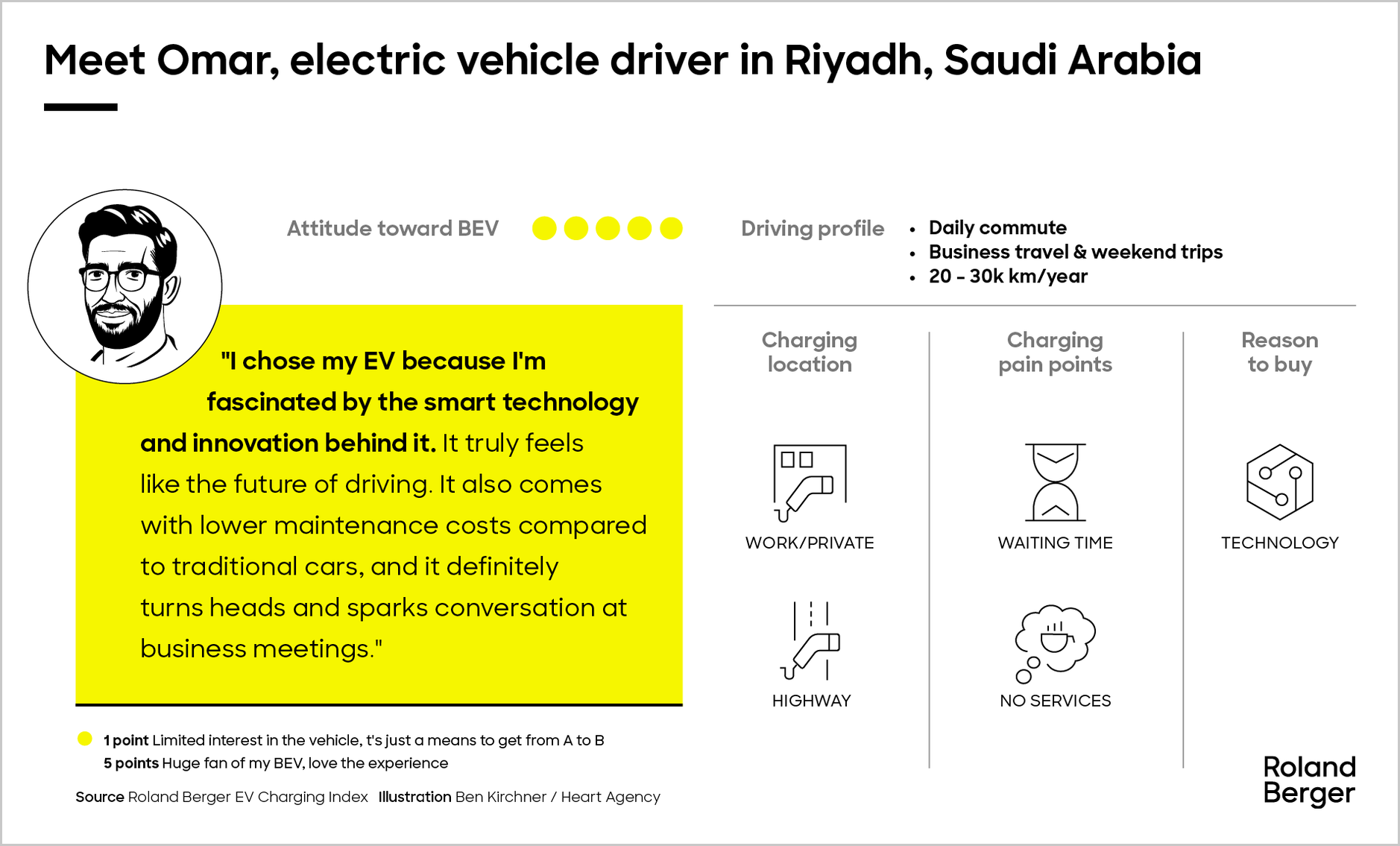
But motivations are only part of the picture; the depth of owner engagement tells us whether these early adopters are likely to influence others. GCC EV owners are more than just customers; they are enthusiastic advocates. More than three-quarters (79%) say they “love having a BEV” and take an active interest in running and charging it, with only 2% seeing it as “just a car.”
From second car to daily driver
The data challenges the assumption that EVs in the GCC are niche products. Driving patterns among BEV owners in the GCC suggest high usage and growing reliance on electric vehicles.
Nearly half of respondents use their EV daily or almost daily, aligning closely with the global average.
And one in three respondents drive more than 20,000 kilometers annually – among the highest proportions in our entire study and mirroring behavior seen in mature European markets such as the Netherlands, Norway and Germany.
Building the backbone: Infrastructure, power and policy
To sustain momentum in EV growth and further propel transition, charging infrastructure must keep pace with the region’s growth.
EV charging is central to national transformation agendas across the GCC, embedded in vision roadmaps, smart city initiatives and luxury developments, all underpinned by stable power grids capable of meeting rising demand. While the region shares a common push toward electrification, each market is advancing on its own timeline, shaped by scale, policy and investment.
The UAE currently leads in deployment, with Dubai alone having a network of over 1,270 public charging points across the Emirate, as of August 2025 according to recent press announcement by Dubai Electricity & Water Authority.
Integration into malls, hotels and residential developments bridges convenience directly into drivers’ daily lives. In the Emirate of Abu Dhabi, ADNOC has formed a partnership with TAQA aimed at opening 500 charging points in the emirate by 2028.
Saudi Arabia is building at speed through the Public Investment Fund-backed Electric Vehicle Infrastructure Company (EVIQ), targeting 5,000 chargers across 1,000 locations by 2030, as announced by Saudi Electricity Company in the press in October 2023, and currently present in Riyadh, Jeddah and Dammam. Local EV production from Lucid and Ceer supports Riyadh’s target of 30% penetration by 2030, creating a seamless ecosystem from manufacturing to charging.
Qatar is also accelerating expansion of its e-mobility ecosystem. In August 2025, the Qatar General Electricity and Water Corporation (Kahramaa) announced that the country has installed over 300 EV charge points (The Peninsula, August 2025) that are strategically distributed across residential areas, malls and public parking zones, signaling a shift from pilot deployments to a full-fledged network.
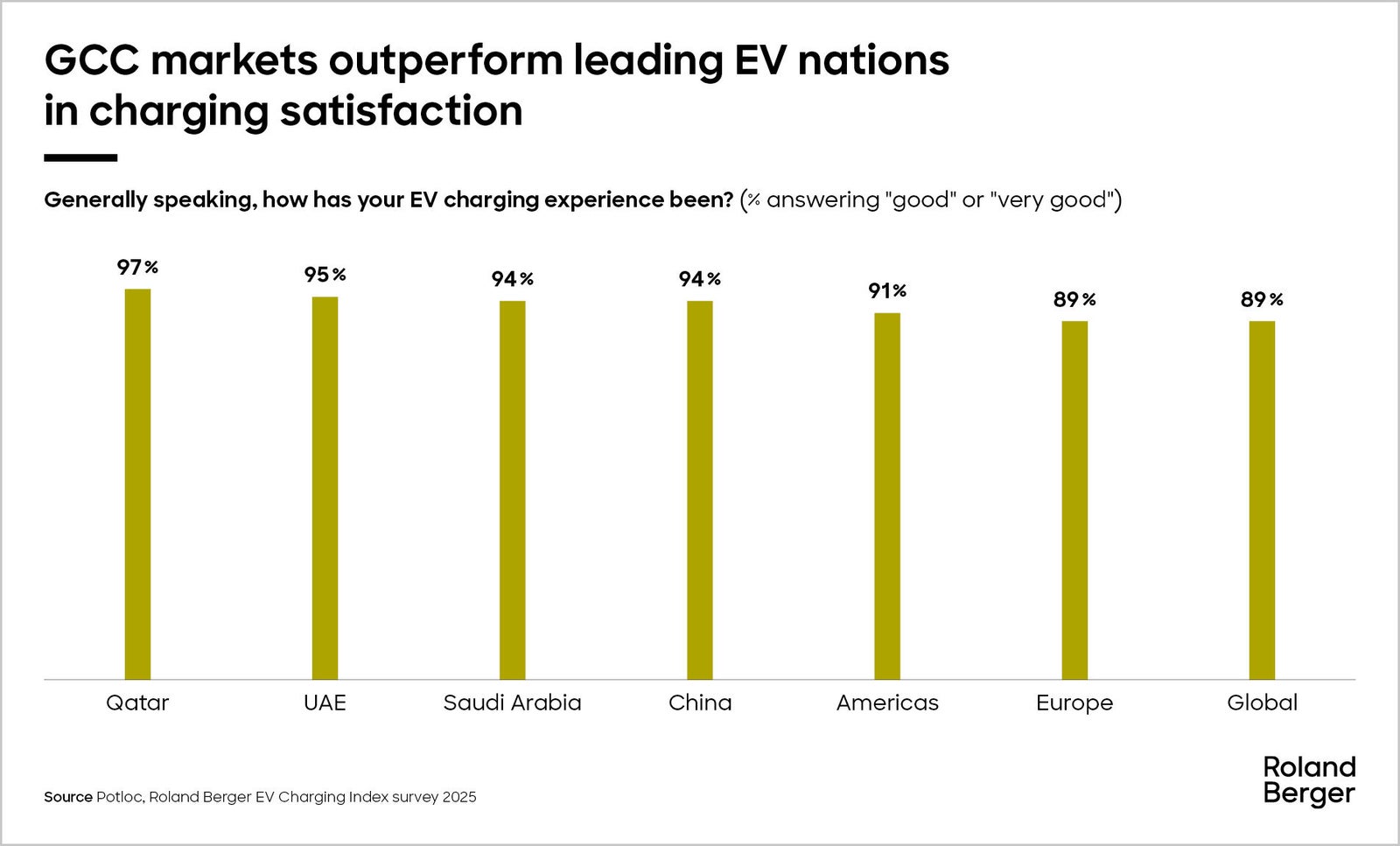
Across the GCC, public-private partnerships are now enabling the rollout of ultra-fast 150-350 kW chargers at strategic locations. Organizations like Electromin and Al-Futtaim are expanding access and helping drive the region’s world-class satisfaction scores in EV public charging.
The charging experience: Speed, access and a balance of home, shared and public charging
High home-charging penetration in Saudi Arabia, strong shared charging in UAE residential towers and Qatar’s growing fast-charging network show that the real measure of sufficiency is not just the headline number of chargers but their availability where drivers most need them.
Across the GCC, home charging accounts for around 50% of EV charging on average. Saudi Arabia leads in private home-charger ownership, with 62% of EV drivers having their own unit. The UAE is the regional hub for shared access, with 33% of EV owners using semi-private or shared chargers. Qatar sits in between, with 59% owning a private charger and 28% sharing, showing strong home coverage despite a smaller public network.
The “where” tells another story: Qatar’s EV users lean on highways (68%) and malls (50%) for their public charging, while Saudi Arabia blends highways (62%) with community parking (51%), and the UAE skews heavily toward retail centers (79%) and community lots (47%).