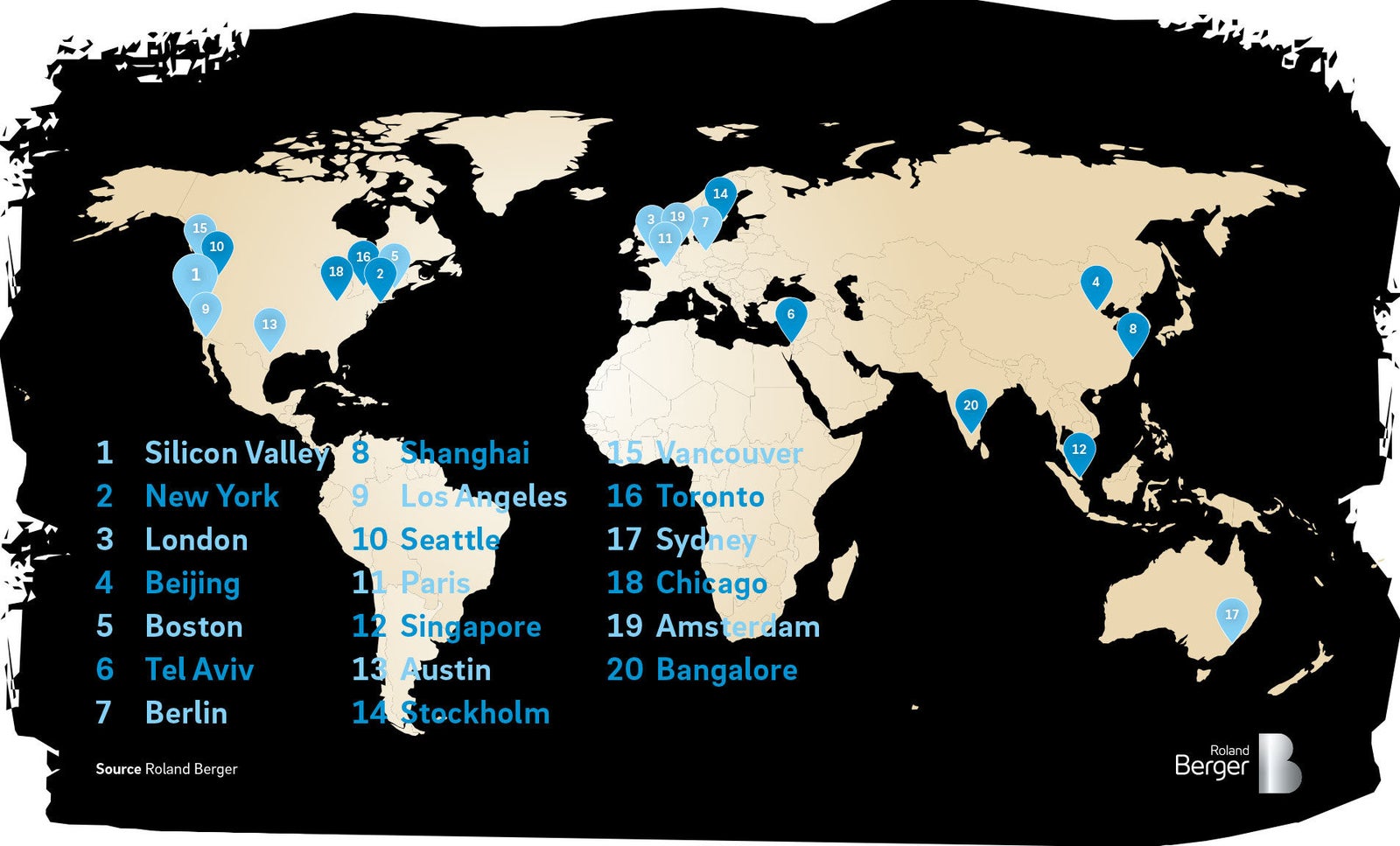
Some startup ecosystems are focused on feeding the national market, as is commonly seen in China or India. Others, due to the small size of their region, reach out globally from day one, such as the majority of startups in Tel Aviv or Stockholm. "Of course there is a set of factors that we know today that explain success and failure in startup ecosystems. Access to talent and capital,
a significant target market, a tech infrastructure among others. But the mix is
highly individual," says Thomas Funke of Frankfurt's Goethe University. "Not only are developments superfast in technology, they are also superfast when it comes to determining the conditions for innovation."
Rebecca Fannin, the head of Silicon Dragon Ventures, a news group covering the world's leading startup hubs outside the Bay Area, explains: "All you have to do is turn to the 12 largest internet financings in 2017. A remarkable 10 are in Asia." And other regions are also catching up: According to Nazar Yasin, the founder of Rise Capital, two of the top ten net IPOs are headquartered in Latin America. It seems likely that more cities and regions will follow. "In 2002, I predicted the shift from suburban 'Nerdistans' like Silicon Valley back to cities. Now San Francisco and New York have overtaken Silicon Valley proper for venture investment in high-tech," says Richard Florida. His recent CityLab Report showcased the rise of a number of clusters globally that attract investors and entrepreneurs alike. By 2018, those capital-attracting metropolitan areas amounted to 300, spanning over 60 countries.
So, how could AnnaLee Saxenian's legendary study be amended to today's realities? "I believe the same factors are still at play: the culture, the diversity, the entrepreneurial community," says Vivek Wadhwa. "But while openness and collaboration between startups in the Valley were part of the reason for its success back then, founders and their startups need to be globally connected today. This is crucial. But it has become a lot easier because of the internet and its services. The world is becoming a connected community."