2.2. Appeal to customers’ willingness to pay for sustainability
Current practices in the airline industry fall short: Pure reliance on emotional appeals
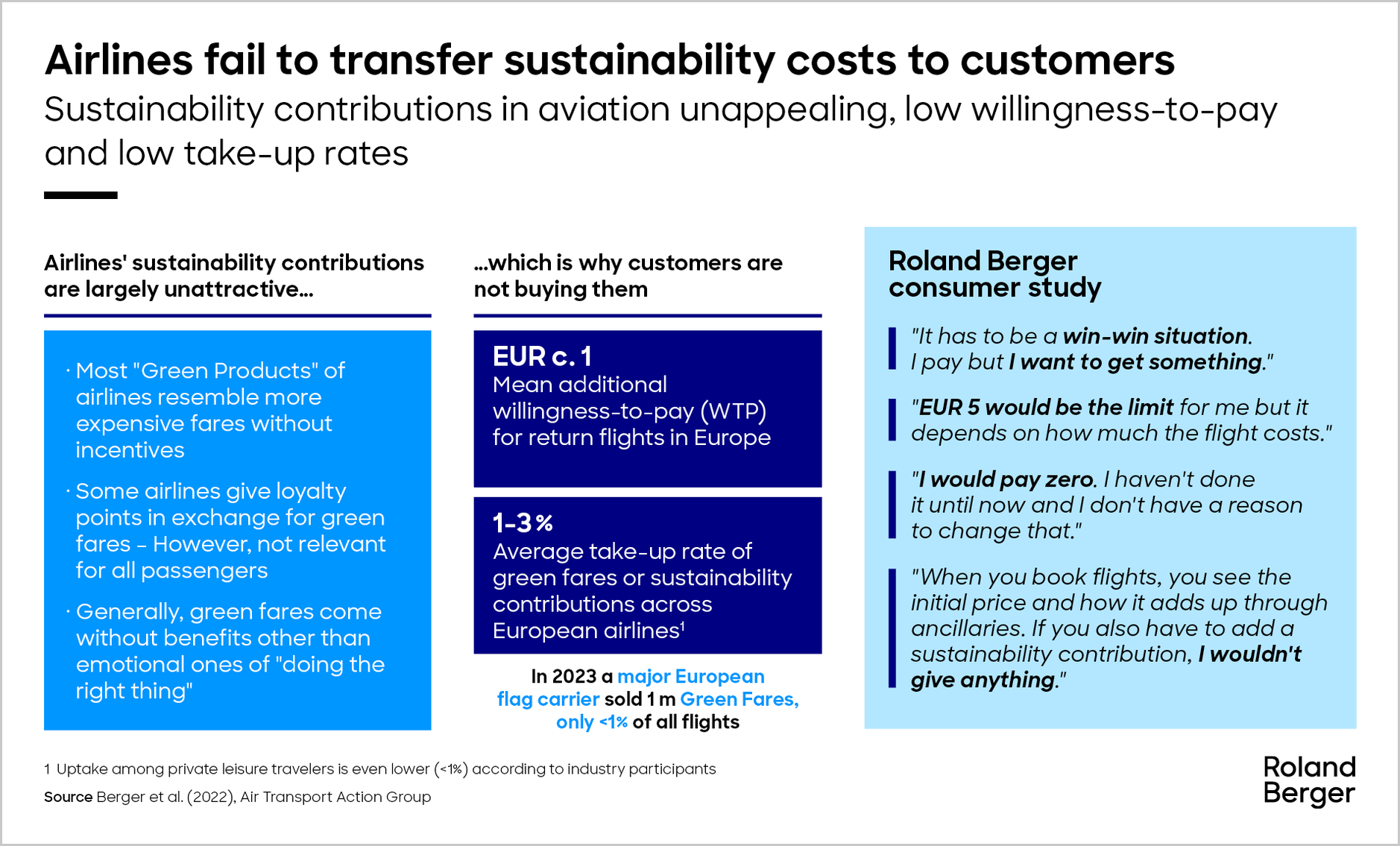
While customers’ increasing awareness of sustainability is undeniable, their actual willingness to pay for sustainable products is lagging behind. Many airlines offer customers a way to pay a voluntary contribution to mitigate the climate impact of their travels. Currently, such contribution schemes rely on customers’ urge to “do the right thing”, a purely emotional motivation. Emotional motives, however, are often outweighed by the very costs of such voluntary contributions (e.g., additional SAF purchase). Thus, despite increasing environmental awareness and concern, participation in contribution schemes remains low; a clear indicator for a significant attitude-behavior-gap in customers’ willingness to pay for sustainability.
Understanding customers’ perception of Sustainability features
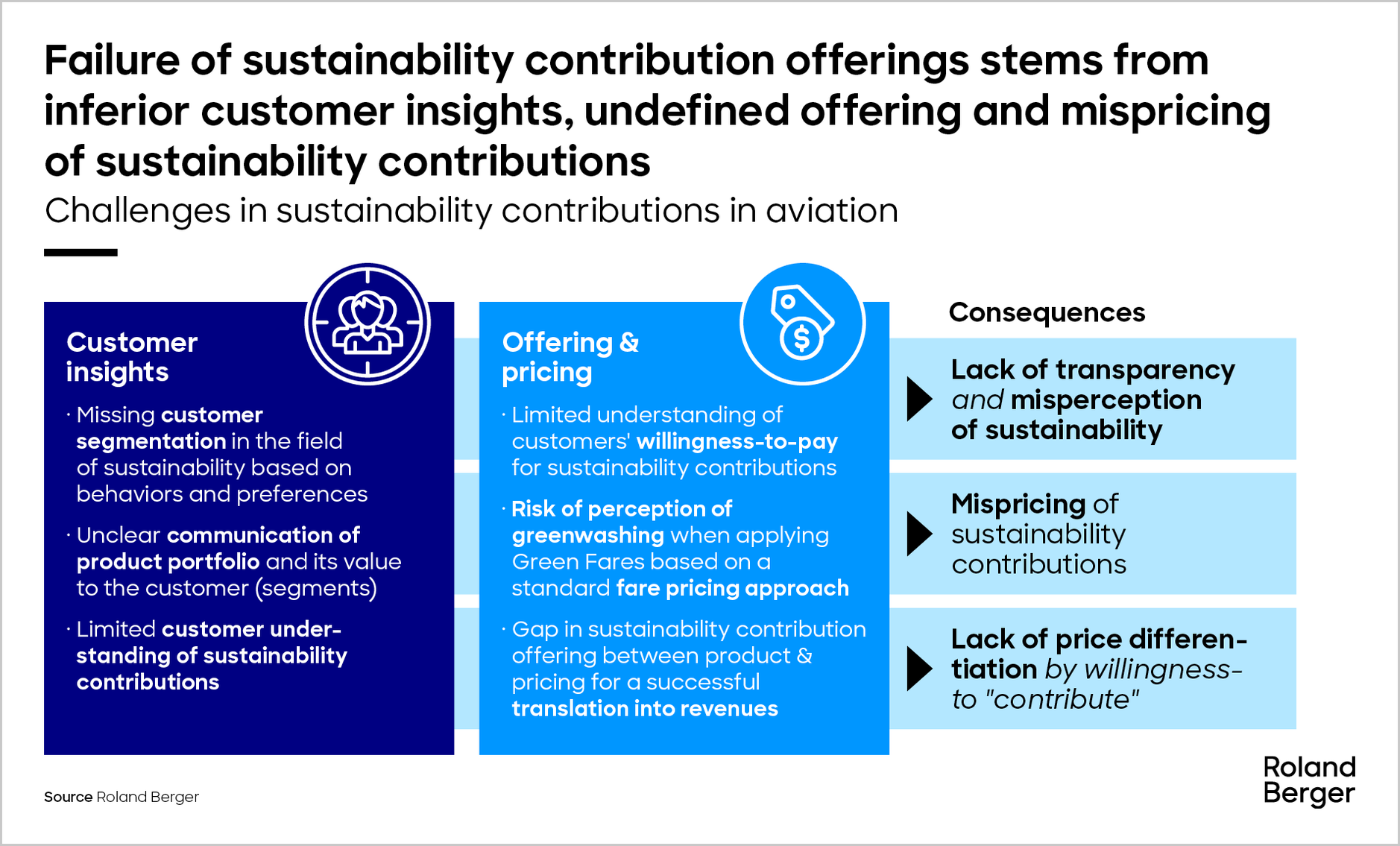
Airlines fail to realize which sustainability features (e.g., SAF-induced flights, waste reduced flights, sponsored offsetting projects) customers are willing to pay for. Additionally, companies struggle to commercialize sustainability as part of their value proposition, leaving the burden of high transformation costs with the company, damaging their bottom line. To guide corporations on their quest to identify ways to commercialize sustainable products, it is relevant to answer, among others, the following questions:
- Which sustainability features do customers perceive as most impactful in reducing emissions?
- Which sustainability features drive customers’ willingness to pay?
To identify the levers driving willingness to pay for sustainable products is at the core of the Roland Berger approach. Knowing which sustainability features customers perceive as worth paying for, companies can adjust their pricing accordingly. A gap analysis can be used to reveal underpriced products, offering revenue-up potential.