

Team Think:Act looks at how authentic leaders can effectively collaborate and inspire others to learn and adapt in a polycrisis.

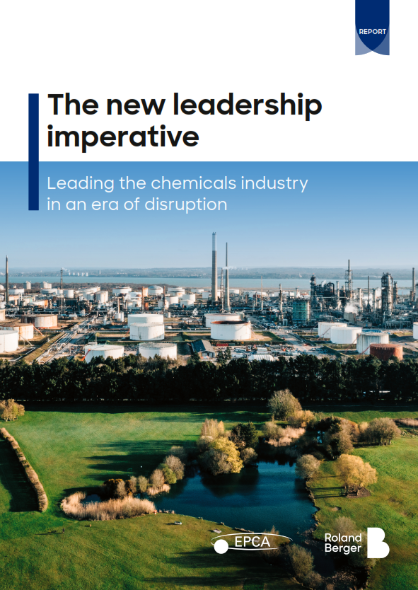
The new leadership imperative in chemicals
By Nina Feuersinger and Frank Steffen
Leading in an era of disruption
Europe’s chemical industry is entering a decade defined not by isolated disruptions, but by permanent pressure. It’s an operating environment shaped by overlapping crises, regulatory intensity, accelerating digital change, and rising expectations from employees and customers alike. The traditional leadership playbook—stable plans, hierarchical control, and linear execution—no longer holds.

In this context, leadership has emerged as a decisive differentiator. What distinguishes organizations is no longer the clarity of strategy alone, but the ability of leaders to enable action under uncertainty, sustain performance over time, and translate complexity into coordinated execution.
Based on structured interviews with senior leaders across the European chemical industry and an analysis of more than 22,000 leadership-related job postings globally, this study identifies four leadership dimensions that will shape the next decade:
- Leading others
- Leading myself
- Business orientation
- Innovation management
"Execution will always matter in Chemicals. What changes now is the leadership requirement to create alignment early — especially when certainty doesn’t exist. The capability gaps we see are not cosmetic; they limit the speed of transformation."
_person_144.png?v=1966195)
Across all four dimensions, one pattern is consistent and unmistakable: leadership expectations are rising faster than organizational capabilities are being built. Leadership development in the chemical industry must move beyond incremental refinement and address a fundamental realignment of expectations.
At the foundation lie agility, flexibility, and resilience. Where these capabilities are treated as implicit traits rather than explicit expectations, organizations risk fragility under sustained pressure.
Building on this foundation, organizations must close persistent gaps in empowerment and communication. Strategic intent is often well understood at the top, but translation into action remains uneven due to unclear decision rights, inconsistent communication practices, and leadership routines that reward escalation over ownership.
Digital literacy must be embedded as a baseline leadership capability, integrated into development programs and decision processes rather than treated as an optional add-on. At the same time, leaders across roles must be equipped to understand how their decisions shape customer experience.
Finally, organizations must look beyond current leadership cohorts. Many gaps cannot be closed by developing today’s leaders alone. Succession planning and talent development must align with future leadership requirements, emphasizing early exposure to complexity, cross-functional collaboration, and decision-making under uncertainty.
Access the complete study including detailed findings from 22,000+ job postings, comprehensive regional analysis, and a practical implementation guide for chemical industry organizations.
Niklas Niederwieser also contributed to this report.
Request the full PDF here
Register now to access the full study. Furthermore, you get regular news and updates directly in your inbox.
Further readings


_person_320.png?v=1966195)
_person_320.png?v=1966195)