

How performance culture drives results: Defining behaviors and aligning leadership to turn organizational culture into a measurable performance advantage.


Wider roles, more strategic tasks: The impact of AI and automation on creative talent
By Fabian Huhle
Insights, recommendations and how decision-makers can navigate the transition
Views in the creative industries about the impact of artificial intelligence (AI) and automation tend to fall into one of two camps – unbridled optimism or existential panic. Neither is helpful for decision-makers at media companies. What they need is hard, evidence-based answers to key questions: How are automation and AI changing jobs in the media industry? Which tasks are being eliminated, and which new ones are emerging? And what does this mean for the skills required?

This article aims to address these questions. Not through opinions or assumptions, but by analyzing real-world data to understand what is changing and how best to navigate those changes.
Together with workforce intelligence specialists TalentNeuron, we analyzed the evolution of roles and tasks of dozens of jobs at leading global streaming and media organizations (see infobox). We then focused on eight core roles across the media value chain – from idea generation through monetization – to draw up five key insights into the impact of AI and automation. These are outlined below, along with several recommendations on strategies to prepare for the transition to AI and automation.
Methodology: Our analysis and what we did
TalentNeuron’s global data includes three million job postings in 33 languages processed daily, with more than 65,000 skills in our taxonomy (Strategic Workforce Planning and Workforce Intelligence | TalentNeuron). Our analysis included data from – among others – Netflix, Walt Disney, Warner Bros, Paramount, Spotify, Roku, iQIYI, YouTube, BBC, Sky Group, Amazon Studios, Amazon MGM Studios, Paramount+, Paramount Global and BBC Studios. Around 30 of the most critical roles for media and streaming companies were assessed, followed by more than 300 of the most critical duties from that subset. Eight of the roles were chosen for the final analysis. Data was collected over a four-year period.
1. Automation is having an impact, but it’s taking over tasks, not roles
The eight roles analyzed in detail were: Campaign Manager, Video Editor, Development Producer, Line Producer, Ad Sales Manager, Content Operations Manager, Commissioning Editor, and Director of Photography. A breakdown of their total automation potential (AP) is shown below.

The infographic shows that even in the most exposed role (Campaign Manager), more than three-quarters of the work remains fundamentally human. This finding is reflected in the task analysis. The single highest automation potential for any individual task across all eight roles – found in the Ad Sales Manager’s duty of producing sales reports and forecasts – is 43.75% (18.75% AI + 25.0% BPA). This is followed by:
Ad Sales Manager: analyzing sales data and performance metrics – 40.0%
Campaign Manager: exploring emerging digital platforms – 33.2%
Video Editor: integrating AI-assisted editing workflows – 31.25%.
A consistent pattern emerges. Single tasks that are most likely to be affected by automation involve data collection, performance reporting, format conversion, metadata generation and routine editing. For example, a Campaign Manager tracking campaign performance through analytics tools has a task-level AP of 24.2%. For an Editor optimizing video for multiple platforms, the figure is 26.3%.
Tasks that are least likely to be affected by automation are those that require building and maintaining strong relationships or overseeing collaboration across teams. For example, the Ad Sales Manager’s single most important duty, accounting for 21.1% of the total role, is building and maintaining client relationships. Yet its automation potential is just 6.25%. The Director of Photography’s core duty of developing visual concepts and cinematographic strategies carries 14.5% of the role’s weight, but its AP is 8.75%. And contract negotiation for the Ad Sales Manager makes up 15.0% of the role but holds only 7.5% AP.
The takeaway is clear: Technology is absorbing the mechanical layer of every role. It is not touching the judgment, the trust or the vision.
There is another notable finding. When people say “AI is transforming media,” they are only telling half the story. In four out of eight analyzed roles, business process automation (BPA) contributes more to total automation potential than AI. For example, in the case of the Development Producer, BPA accounts for 9.9% versus AI’s 6.8%. And for the Line Producer, the result is 9.2% versus 6.7%. Thus, the tools driving everyday change are not just ChatGPT and generative AI. They are admin tools such as Asana, Monday.com, Frame.io and Trello. Often, these are already providing perhaps unglamorous but effective automation.
2. Demand for technical roles is falling but rising for creative, strategic jobs
Between 2022 and 2025, our analysis highlighted a divergence in occupational demand, shown in the infographic below.
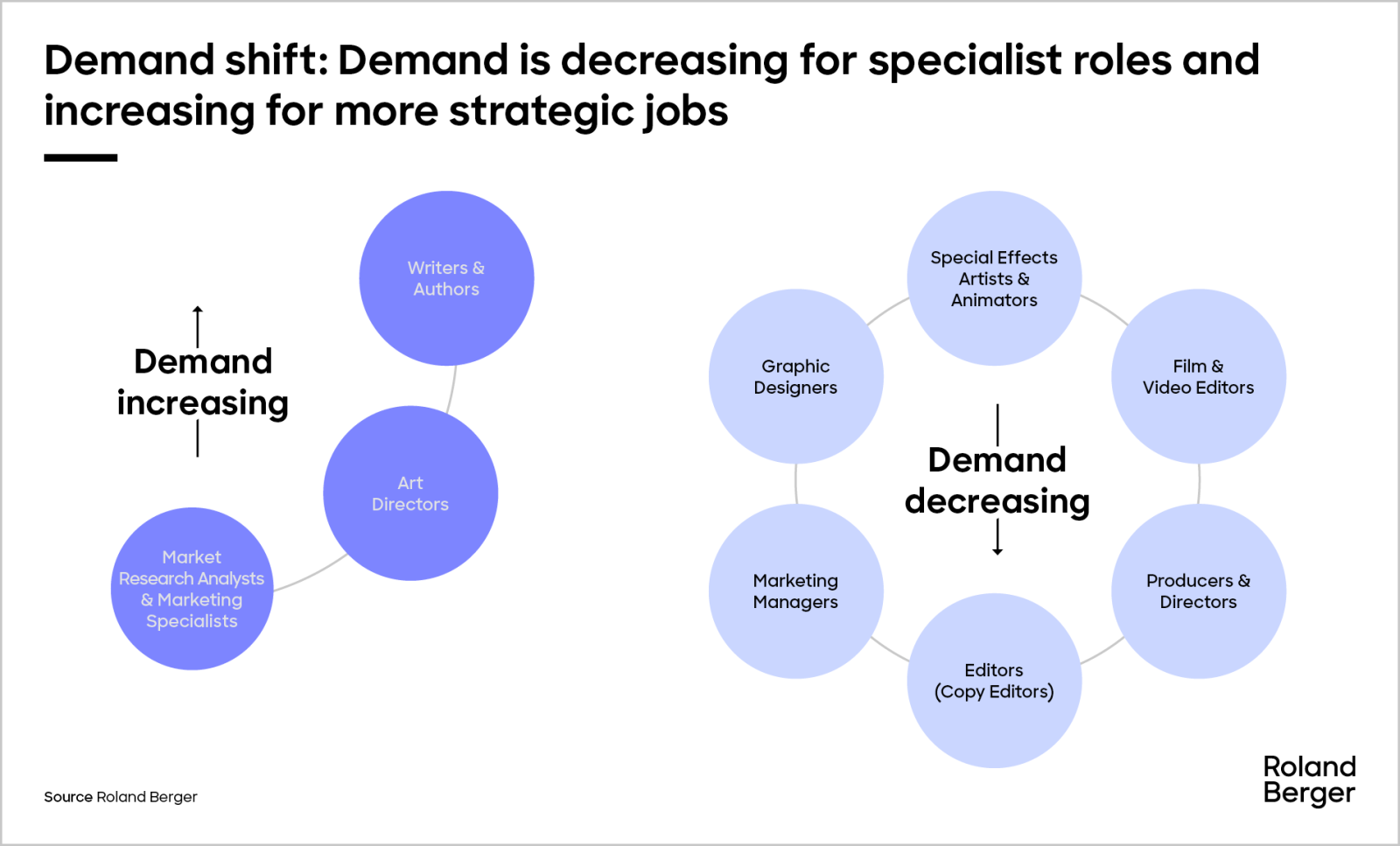
The pattern is clear. The roles that are declining are those historically defined by technical execution, while the roles that are growing are those defined by originality, strategic thinking and creative authority.
The skill evolution data reinforces this. Of the roles with decreasing demand, several show rapid skill disruptions. For example, in the past 12 months, 55% of Copy Editor skills changed, 45% of Motion Designer skills changed and 28% of Marketing Manager skills changed. These roles are not standing still; they are being restructured from the inside.
Meanwhile, the demand for Art Directors is increasing alongside a 36% skill change rate in the past 12 months. But there’s a critical difference: 32 of their 33 tracked skills are classified as increasing. Only one, copywriting, is stable. So this is a role that is growing and evolving simultaneously, not contracting.
The takeaway? When AI can generate a rough cut, color-match footage or produce ad creatives at scale, the value of manually executing those tasks drops. But the value of deciding what to create, why and for whom goes up.
3. AI is driving role compression, with multi-skilled integrators now favored over specialists
Another major impact of AI is the redistribution of specialisms within creative roles. For example, hiring data from TalentNeuron shows that Video Editor job postings now increasingly demand skills in sound design, color grading, visual effects, motion design and audio mixing – functions that were previously filled by standalone specialists like colorists and motion designers.
Skills data confirms this directly. For Video Editors, all of the skills listed above, plus chroma key and video encoding, are classified as increasing in demand. Overall, 26 of 28 tracked Video Editor skills are on the rise. Only critical thinking and time management buck the trend, being classified as stable. This is a role absorbing adjacent functions wholesale.
The issue is not one of scope creep, however. It is structural role compression. As AI handles the routine components of adjacent specialist roles, the remaining creative judgment consolidates into fewer, broader positions. And note the irony: 31 out of 31 Motion Designer skills are increasing in demand, yet demand for the actual role is decreasing. In short, the skills survive; the standalone role does not. The skills migrate into roles like Video Editor and Art Director.
The same role compression pattern is seen among Campaign Managers. The data flags the following as growing skills for this role: data analysis, AI, machine learning, social media analytics and SQL databases. But a decade ago, these belonged to dedicated analyst positions. Today, they are considered baseline expectations for a campaign role that has 23.1% automation potential.
The takeaway from this is that the professionals who thrive will not be narrow specialists. Rather, they will be multi-skilled integrators who can operate across what used to be separate job descriptions.
4. Across the value chain, the shift caused by AI is consistent – human roles are becoming more strategic
AI’s impact can be felt right across the media value chain, from idea generation through monetization. And at every stage, the direction is the same – execution moves to machines; supervision, quality judgment and strategic framing move to humans. Below are some examples from each value chain stage.
The key takeaway? Every role in the value chain is becoming more supervisory and more strategic.
5. The skills that matter most in creative roles are almost all increasing in demand
As part of our analysis, we tracked skill trajectories across the eight mapped roles. The proportion of skills that are increasing in demand is striking, as shown in the infographic below.
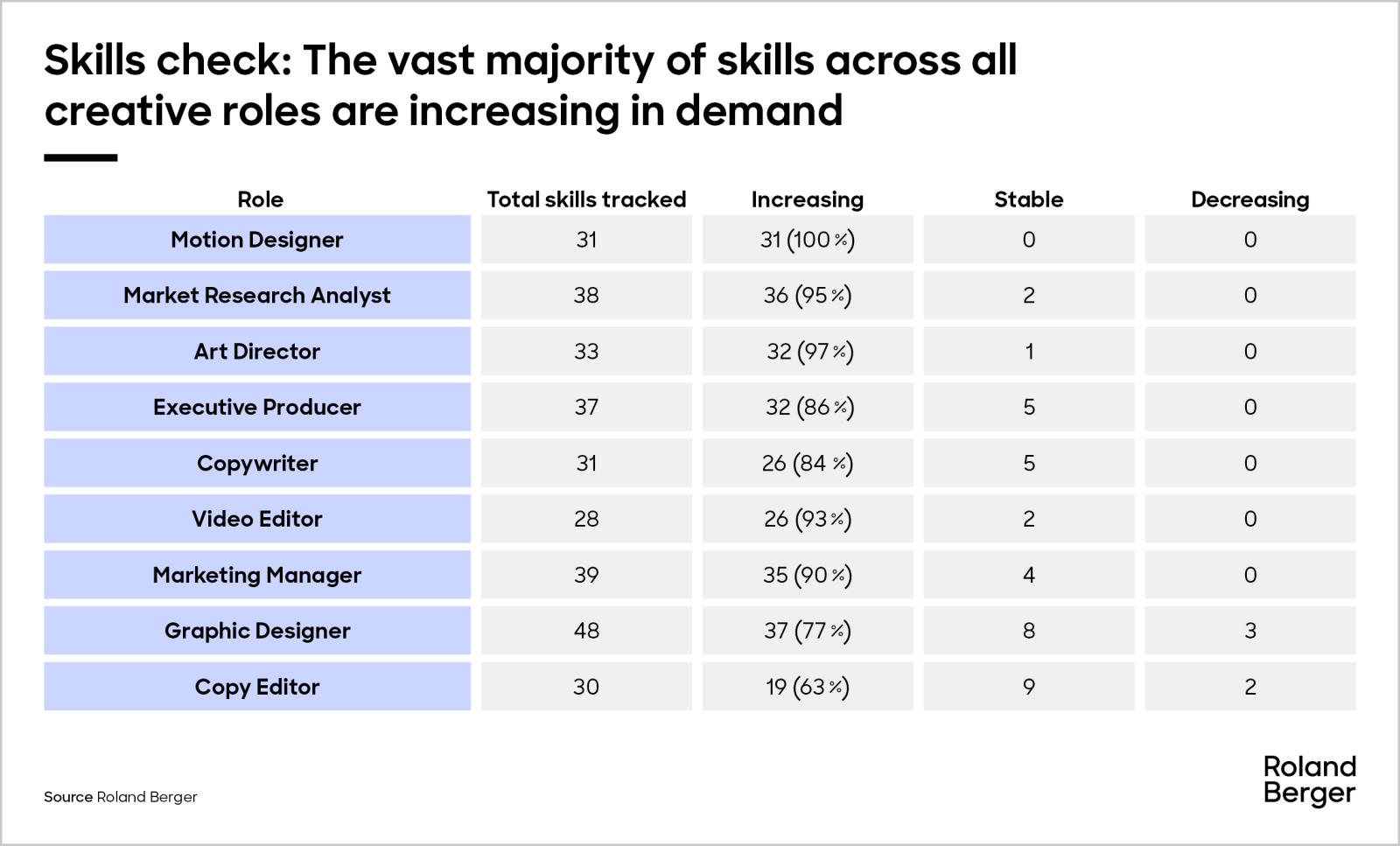
In several of these roles, all core skills are classified as increasing in demand. For example:
Market Research Analyst: AI, machine learning, Python, R, SQL, Big Data analytics, behavioral analytics and data visualization are all increasing.
Video Editors: AI, DaVinci Resolve, color grading, motion design, sound design, visual effects and storytelling are all increasing.
Critically, the skills that are rising in demand are not just technical. Collaboration skills are classified as increasing in every single role in the skills dataset. Creativity is increasing across all roles where it is tracked. Problem solving is increasing for Art Directors, Copywriters, Graphic Designers, Market Research Analysts, Motion Designers, Video Editors and Executive Producers. And adaptability is increasing for Video Editors, Graphic Designers, Market Research Analysts and Executive Producers.
The data gives us a clear takeaway: The market is not asking professionals to choose between technical and human skills. It is asking them to combine both. The premium goes to those who can use an AI tool and then make a judgment call that the tool cannot.
Recommendations for decision-makers
So, what do these insights and takeaways mean for leaders in the creative industry? What do they need to do to smooth the transition toward AI and automation, and how can they address emerging skills gaps, for example? Below we outline three calls to action.
1. Don’t think of automation as a tool to reduce roles – think of it as a reallocation of priorities and tasks:
The data does not support a narrative of mass displacement – across eight roles, the highest total automation potential is 23.1%. Rather, it supports a narrative of task migration. The question is not whether a role survives. It is whether an individual is spending time on the parts of their role that will still matter in three years. For example, if a Campaign Manager is spending most of their day tracking analytics dashboards, a task that has an automation potential of 24.2%, a large part of their role is likely to change soon. But if they are spending their time on strategic hypothesis building and
cross-team collaboration,
they are on the right side of the shift.
2. Invest deliberately in the skills the data says are rising in demand:
Across the roles we tracked, between 63% and 100% of skills are classified as increasing in demand. These include analytical fluency, AI tool proficiency, cross-platform expertise and the soft skills of collaboration, adaptability and creative leadership. The professionals who combine these will define the next generation of media leadership. And pay attention to the compression signal: Specialist roles are declining in favor of multi-skilled integrators who can operate across what used to be separate job descriptions, so focus on hiring these.
3. Know where to target AI and automation:
In a world where AI can generate a hundred options in seconds, the scarce resource is the person who knows which one to choose, and why. The data is unambiguous: The tasks with the lowest automation potential, consistently below 10%, are those requiring creative vision, relationship trust and strategic context. The tasks with the highest, above 25%, are those involving data processing and technical execution. So, absorb and cultivate this finding – focus AI and automation efforts on the more mechanical tasks and thereby free up human time for the more creative, strategic and higher value add tasks.
After all, the media industry is not facing a crisis. It is facing a transition. And transitions reward the prepared.
For more information, or to discuss any aspects of our findings, please get in touch with one of our experts. We look forward to hearing from you.
Sign up for our newsletter
Register now to receive insights on People and Organizations and discover how to create a future-proof, high-performing organization that thrives on agility, resilience, and turning today’s disruptions into tomorrow’s opportunities.
Further readings


