

New generative AI-powered pricing tools promise faster results, better decisions and maximized returns. Roland Berger outlines the benefits, use cases and two key examples.


The AI-infused Supplier Risk Radar
Why forward-looking risk intelligence is becoming the new baseline for supply chain resilience and supplier risk management
Supply chains are under growing pressure. Disruptions across geopolitical, economic and operational dimensions have exposed how fragile traditional risk management approaches really are. Yet most organizations continue to rely on periodic financial reviews, fragmented data silos and manual monitoring that identifies problems only after they have materialized.

In the automotive and industrial sectors, where supply networks span hundreds of critical relationships, the complexity has outpaced what conventional processes can handle. An undetected supplier failure can cascade through production lines, delay launches and erode margins across entire business units. The window for effective mitigation is often already closed by the time a traditional risk review surfaces the problem.
Roland Berger’s AI-infused Supplier Risk Radar was built to close this gap: a system that augments human judgment with continuous, AI-driven surveillance to detect emerging risks before they become crises.
The intelligence gap in supplier risk management
Today’s procurement and risk teams are surrounded by more data than ever, from financial filings and commodity indices to news feeds and internal performance metrics. Yet the actionable intelligence they derive from it remains incomplete. The core problem is not a lack of information but the inability to synthesize it at the speed and scale that modern supply chains demand.
Three structural weaknesses define the current state of supplier risk identification across most organizations:
- Late and fragmented risk detection: Risks are identified too late, and insights remain scattered across disconnected systems that lack consolidation.
- Manual, time-consuming processes: Large amounts of unstructured data and manual workflows slow decision-making to a pace that cannot keep up with rapidly evolving conditions.
- Reactive, poorly integrated approach: Silo-thinking with a lack of focus on proactive prevention hinders efficient risk management.
The result is a system that consistently lags behind events. The Risk Radar was designed to fundamentally change this dynamic.
A new paradigm: Continuous AI surveillance at scale
The Supplier Risk Radar takes a fundamentally different approach to risk management, built around continuous, automated surveillance rather than periodic manual review. At its core, the system deploys specialized AI agents that crawl, analyze and interpret a broad spectrum of external and internal data sources to maintain a living risk profile for each supplier in the network.
The result is a system that generates fully automated weekly risk reports covering more than 600 suppliers. Each report includes forward-looking risk forecasts, impact assessments, early warning signals and recommended mitigation actions.
How the system works
The Risk Radar operates through three integrated AI-powered workflows. The diagram below illustrates the end-to-end process from data ingestion through analysis to actionable reporting.

What distinguishes this from conventional monitoring tools is the degree of automation and adaptability. The system accepts customizable input formats and handles data from any supply chain stakeholder, whether suppliers, OEMs or financial partners. Additional tools and data sources, both internal and external, can be integrated into the workflow at any point. Risk thresholds, reporting frequency and alert triggers are all configurable, so the system adapts to each organization’s data landscape rather than imposing a rigid framework.
In addition, the AI agents do not simply aggregate data. They crawl, analyze and interpret high-quality sources, continuously updating and maintaining current risk profiles. This continuous cycle of analysis is what transforms supplier risk management from a periodic review exercise into an always-on operational capability.
Multi-dimensional risk scoring: seeing the full picture
Traditional supplier risk assessment typically relies on a single dimension, usually financial health. The Risk Radar breaks this pattern by combining three distinct scoring dimensions into an integrated risk profile.
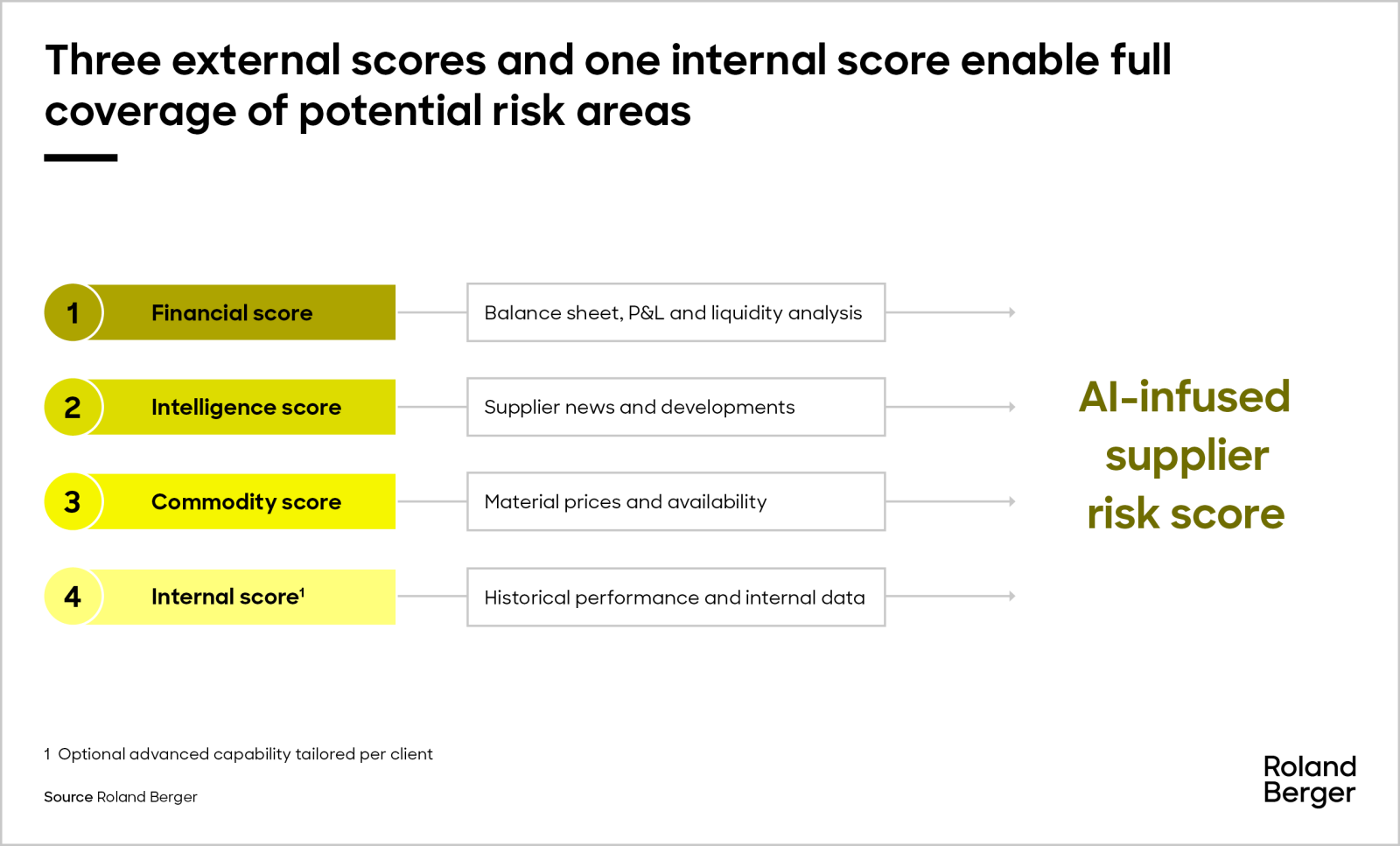
The financial score evaluates each supplier’s financial strength based on liquidity, leverage, margins, cash generation and revenue trends. It draws on 12 firm-specific KPIs, each benchmarked against calibrated thresholds that flag concerns around growth stagnation, low operational efficiency, excessive leverage or insufficient cash flow. This provides a nuanced view of financial resilience rather than a simple binary assessment.
The intelligence score captures a different layer entirely. It indicates how recent supplier developments may disrupt or improve supply continuity, drawing on AI-crawled news about firm-specific risks: uncertain future signals, site or operational changes, layoffs, product recalls and other events that affect stability. This is the qualitative dimension that turns a backward-looking financial snapshot into a forward-looking assessment.
The commodity score adds the third dimension by capturing each supplier’s specific vulnerability to conditions affecting the availability, cost, compliance or logistics of critical materials. It reflects how commodity price changes in metals and other inputs flow through to each supplier’s operations, providing early warning of cost pressures before they manifest as delivery failures.
Together, these three dimensions produce a 360-degree risk report with detailed forward-looking analysis, potential implications and concrete recommendations. The power of the approach lies in identifying suppliers whose combination of financial fragility, operational turbulence and commodity exposure places them at elevated risk, even when no single indicator in isolation would raise alarm. For procurement teams and leadership, this means receiving intelligence that is directly actionable, grounded in data and designed to support timely decisions on supplier engagement and risk mitigation.
From insight to action: building a proactive risk culture
"The automotive industry must shift from reacting to disruptions to preventing them. AI-powered early warning systems are now essential."

Intelligence without action is merely interesting. The Risk Radar is designed not just to identify risks but to accelerate the organizational response. Automated early warning signals feed directly into a fast-track response process for critical supplier cases, enabling OEMs, OES and financing partners to proactively engage on supplier risk developments before they escalate. This shifts the operating model from reacting to disruptions that have already occurred to intervening while corrective action is still possible.
The system’s roadmap extends well beyond its current capabilities. Advanced enhancements, tailored and developed based on specific client requirements, include the integration of client internal data such as historical supplier shortfalls to improve the accuracy of risk scoring, analysis of the complete supplier network to identify how risks from one supplier propagate across the broader supply chain and augmentation with social media sentiment and analyst reports to strengthen market-based risk signals. A longitudinal database will continuously store the crawled supplier news and intelligence signals, enabling the system to track how each supplier's qualitative risk profile shifts over time and to surface emerging trends from these state changes, moving the analysis from point-in-time snapshots to risk trajectories.
Crucially, the Risk Radar also leverages Roland Berger’s proprietary knowledge base, including vertically integrated industry data, domain expertise from past projects and due diligence reports. This grounds the AI-generated signals in the strategic realities of specific industries and markets, adding a layer of contextual intelligence that purely algorithmic systems cannot replicate.
A partnership model for implementation
Roland Berger provides in-house AI capabilities on solution design and proof-of-concept development, combined with tailored infrastructure and technology partnerships. The implementation approach is structured in three phases designed to deliver value at every stage.
The first phase focuses on project setup and solution design: jointly scoping goals, reviewing internal and external data sources and access conditions, confirming legal and compliance requirements and defining the workflow logic, risk categories and reporting parameters that will shape the system’s output. The second phase moves into proof-of-concept engineering. Roland Berger develops effective PoCs in sandbox environments using no/low-code platforms, rapidly demonstrating value. Test users from relevant client teams are onboarded, and structured feedback is collected to refine the system. The third phase prepares the production environment with required approvals, finalizes security protocols and scales the solution across the organization, with support for identifying and choosing the most suitable technology partners for the MVP.
This phased approach ensures the Risk Radar is not imposed as a generic product but calibrated to the specific contours of each client’s supplier landscape and risk management priorities. It reflects a deliberate philosophy: start focused, demonstrate value early and scale with confidence.
What sets Roland Berger apart in this space is the combination of deep supplier ecosystem knowledge across automotive and industrial value chains, hands-on restructuring and operational excellence experience that transforms risk management into competitive advantage and partnerships with leading AI technology providers that enable rapid deployment of production-ready solutions.
Sign up for our newsletter
Further readings


_person_320.png?v=1966195)

