

How European industrial manufacturers can navigate geopolitical shifts, AI disruption, and rivalry between China and the US to stay competitive.

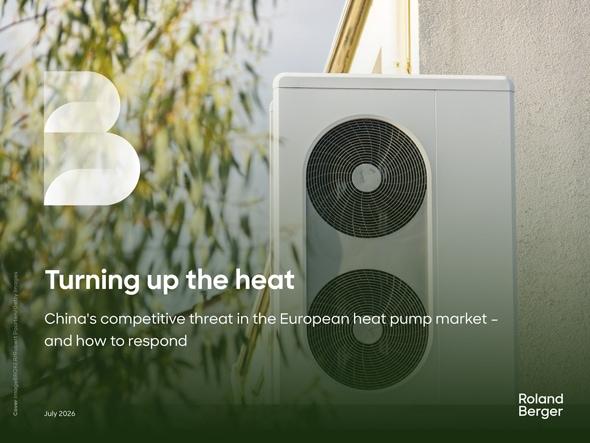
Europe’s heat pump challenge
The competitive threat from China and how European OEMs can respond
Emboldened by past successes in renewable technologies, Chinese players are rapidly moving in on the European heat pump market. European OEMs must respond quickly or face irrelevance. But with the window of opportunity narrowing fast, what should they do? Our new study outlines an approach that builds strength and competitiveness across the heat pump value chain.

It wasn’t long ago that Europe was leading the way in photovoltaic and wind power. Not anymore. Chinese players quickly recognized the growth opportunities on offer and rapidly achieved market dominance in these and other related technology markets. Now they have fixed their sights on heat pumps.
China has recently identified clean heating as a strategic priority, and is using its successful renewables model as a blueprint to aggressively scale up its heat pump operations both domestically and globally. With Chinese OEMs already present in Europe’s heat pump market, holding a 20-35% cost advantage, as well as improving channel access and technological knowhow in core residential segments, this aggressive new positioning puts European players under significant pressure. The question is, how do they respond?
Our new publication “Turning up the heat: China’s competitive threat in the European heat pump market – and how to respond” offers a way forward. It outlines the threats facing European heat pump OEMs, looks at the key risks they need to mitigate, assesses Europe’s potential structural advantages and outlines an approach that enables OEMs to act before Chinese scale, cost and channel advantages become too hard to offset.
The threat from China
Heat pumps are a clear focus of China’s latest five-year plan (FYP), its 15th such initiative. FYPs aim to deliver strategic priorities – such as 4-5% GDP growth – by identifying and investing in growth sectors, setting strict roadmaps and timelines for each. The 15th FYP positions heat pumps within a broader industrial strategy focused on domestic scale-up, cost competitiveness and global expansion. The full report outlines exactly what the policy focus is and how the 15th FYP builds on heat pump commitments made in the 14th FYP.

"European OEMs must rethink their portfolios and shift resources away from commoditizing high-volume products toward more defensible segments."

China’s shift into heat pumps is placing three simultaneous pressures on European OEMs, each reinforcing the others:
Margin erosion: Residential air-source heat pumps (ASHPs) are the key margin pressure point. European OEMs currently generate most of their volume in this segment, but Chinese competitors are entering with significantly lower cost structures. They must therefore decide whether to defend their market share at unsustainable margins or cede volume and move further upmarket.
Technology parity: European OEMs currently maintain their pricing power through a technology premium in areas such as low GWP (global warming potential) refrigerant systems, advanced system integration capabilities and high-temperature industrial applications. However, the 15th FYP specifically targets these areas, threatening not just rapid technological parity, but parity at a lower cost as Chinese OEMs combine R&D knowhow with stringent cost-out models.
Emerging market competition: European OEMs have viewed Eastern Europe, Southeast Asia and the Middle East and North Africa as key mid-term growth regions that compliment traditional European core markets, albeit paired with significant market volatility. Yet Chinese competitors are already securing positions in these markets through Belt and Road-linked HVAC infrastructure programs.
Compounding these threats to European OEMs are two key risks – a lack of European Union (EU) regulatory protection and supply chain dependency. With regards the former, regulations, such as anti-dumping measures, HFC quotas and energy labelling requirements, offer temporary relief but do not change the underlying competitive or structural cost dynamics. Chinese OEMs will further penetrate the European market with EU-compliant offerings, increasingly localized production footprints and strengthened distribution access, fundamentally changing the competitive landscape.
Regarding supply chain dependency, the FYP’s focus on manufacturing strength, technological self-reliance and supply-chain resilience increases the risk that Chinese suppliers will prioritize domestic customers when capacity is tight. This could mean higher continuity risk, less favourable terms and weaker influence over future product roadmaps for European OEMs that are sourcing items such as compressors or power electronics from China. Political factors, such as trade restrictions and potential escalation over Taiwan, increase the risk of disruption in globally concentrated supply chains.
Strategic responses
So, what can European OEMs do to mitigate the risks posed by Chinese rivals? A key response advocated in the full report is for European players to move resources away from commoditizing high-volume products, such as ASHPs, toward more defensible segments, such as low GWP refrigerant architectures and high-temperature retrofit solutions. The report also proposes rationalizing product lines and shifting toward life-cycle solutions.
Further responses are centered on exploiting European’s existing and potential structural advantages. For example, European players’ established installer channels are their primary defensive asset, one that China cannot replicate through pricing alone. They must be carefully nurtured as Chinese OEMs are already making inroads and threatening Europeans’ built-in advantage. In addition, software, controls and grid integration are set to become an important competitive differentiator in heat pumps. For European OEMs, the key implication is timing: companies that build platform capabilities early will be better positioned to shape customer expectations, regulatory compliance features and utility interfaces before these become standardized. More details about both responses are available in the full report.
Lastly, the report outlines a strategic approach for European OEMs to fight back against Chinese rivals. It recommends rapidly executing a sequenced response across the full value chain, starting with R&D all the way through to services, before Chinese scale, cost and channel advantages become harder to offset. Narrowing the efficiency gap is of particular importance, as is strengthening focus, speed, security of supply and installer loyalty.
For more details, download a copy of the full report or contact one of our experts. We look forward to hearing from you.
Request the full PDF here
Sign up now to access the full study. You will also receive regular news and updates, delivered straight to your inbox.
Further readings


_person_320.png?v=1966195)
