

Roland Berger’s Automotive Aftermarket Pulse 2024 shows independent shops are thriving amid changing consumer preferences.

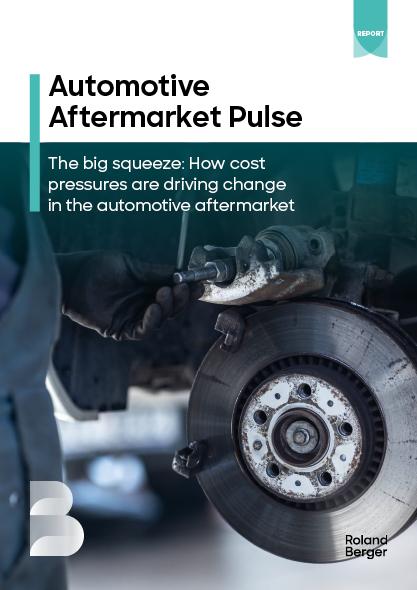
Automotive Aftermarket Pulse 2025
By Neury Freitas and Maximilian Wegner
As cost pressures grow, the global automotive aftermarket looks for a competitive edge
Vehicle sales remain stalled, electrification adoption is slower than expected, and global supply chains are under strain. Amid this turbulence, the automotive aftermarket has been a bright spot – but 2025 signals a shift. Our latest Automotive Aftermarket Pulse report, based on surveys of 600 workshops and 6,000 consumers across 13 major markets, reveals how price sensitivity, digitalization, and convenience are reshaping the industry.

"This year, we found that independent workshops are increasingly offering convenience services like pick-up and drop-off to attract new customer segments such as fleets."

Price pressure and changing preferences
Roland Berger’s Aftermarket Pulse Report 2025 findings show that price pressure is accelerating the shift toward non-branded parts. Today, 57% of consumers prefer Independent Aftermarket (IAM) parts over Original Equipment (OE) brands, a rise of 14 percentage points compared to 2024. Private-label parts are gaining traction, particularly in rural areas and for consumers with older vehicles who are considered the most cost-sensitive segment, while workshops are increasingly installing non-branded parts to meet consumer expectations and improve margins. Independent repair shops continue to gain ground, especially in the United States and Brazil, while OE channels grow in China – underscoring the need for regionally tailored strategies.
Online purchasing is another area of transformation. While consumer enthusiasm for buying parts online has cooled slightly, B2B adoption is surging. More than 60% of workshops in mature markets now source significant volumes online, and further growth is expected. Price remains a key driver, but delivery reliability, flexible payment options, and strong support are emerging as decisive factors for success.

Electrification and ADAS capabilities
Electrification and advanced driver assistance systems (ADAS) are creating new capability requirements. Basic battery electric vehicle (BEV) maintenance is becoming a baseline expectation, but ADAS capabilities are lagging behind. Nearly half of workshops reported turning down ADAS-related repairs in 2025 due to equipment costs and knowledge gaps. Suppliers and distributors have a window of opportunity to provide tools, training, and support to secure workshop loyalty.
"The automotive aftermarket in Western markets faces rising price pressure, with 57% of consumers now choosing IAM parts – up 14 points from 2024."

Sustainability also remains a priority, but cost is a barrier. While consumers and workshops express interest in remanufactured and recycled parts, 72% of consumers are unwilling to pay a premium. Cost-effective green solutions will be critical to winning mainstream adoption.
The next big differentiator: Convenience
With price competition largely exhausted, convenience is emerging as the next big differentiator. Urban workshops are leading the way with services such as pick-up and drop-off, and even “ghost service” offerings where vehicles are collected, repaired, and returned without consumer involvement. EMEA markets are ahead in adoption, while China shows strong openness to mobile and premium convenience services. Over 40% of workshops surveyed have yet to make convenience a priority, signaling significant untapped potential.

What’s next
The automotive aftermarket is entering a new era defined by price pressure, digitalization, and customer experience. Players that adapt quickly – by offering value-tier products, enabling online B2B readiness, investing in BEV and ADAS capabilities, and innovating around convenience – will secure a competitive edge.
Download the full report to learn about the factors shaping the next era of the automotive aftermarket.
Request the full PDF here
Register now to access the full study and learn how rising cost pressures, shifting consumer behavior, and evolving repair needs are reshaping the global automotive aftermarket. Furthermore, you get regular news and updates directly in your inbox.
Further readings


