Turning policy ambition into viable projects in the Middle East and beyond
Tariff design for utility services across the Middle East has long grappled with a core tension: keeping services affordable for consumers while ensuring they remain financially viable for operators and attractive to investors. Utilities deliver essential services such as electricity, water and gas among other sectors, which shape public welfare and competitiveness, making affordability a political and social priority. At the same time, these services are capital-intensive and require predictable returns to justify upfront financing and continued private participation. If tariffs are set too low, utilities struggle to maintain quality or expand networks; if set too high, public resistance and underutilization can follow. The regulatory task is clear: recover costs, drive productivity and protect vulnerable customers. This is particularly important in emerging markets where infrastructure gaps are large and budgets are often constrained.
Keeping utility services affordable for consumers while ensuring they remain financially viable for operators and attractive to investors.
Historically, tariff setting often relied on simple project-by-project discounted cashflow calculations. Without a standardized framework, each tariff became a negotiation shaped by case-specific assumptions, with limited attention to cost allocation across customer segments or broader policy goals. This ad hoc approach masked cross-subsidies and produced tariff volatility as cost estimates or financing conditions shifted. The absence of clear, rules-based cost-recovery mechanisms introduced regulatory risk that raised capital costs and weakened investor appetite.
These shortcomings created a trust gap between consumers, operators and regulators. Consumers, lacking transparency on cost structures and efficiency standards, often viewed price increases as unfair, especially when not paired with service improvements. Operators faced uncertain recognition and timing of prudent capital expenditures in the tariff base, delaying recovery and complicating fundraising. Incentives fell out of alignment: Users questioned value, and investors doubted timely and fair returns. The result was slower infrastructure build-out and lower confidence in regulatory frameworks.
Today, the urgency for effective tariff frameworks is even greater. Across the Middle East, governments face accelerating infrastructure and service demands driven by rapid economic diversification, industrial expansion and population growth. Meeting this surge requires unprecedented levels of investment and delivery capacity. To mobilize the necessary capital and ensure projects keep pace with national development goals, tariff systems must provide clear, predictable, and bankable conditions that attract investors and enable the timely rollout of new infrastructure and services.
But regulation never stands still – and nor do the models behind it. Over time, regulators evolved through three broad approaches for tariff setting. The first was cost-of-service regulation, where tariffs were set to recover the utility's actual or forecast operating costs, depreciation and a reasonable return on capital. This model, used widely in early regulatory regimes, provided strong financial certainty for operators but weak incentives for efficiency, as costs were largely passed on to consumers.
To address this, many regulators introduced incentive-based regulation, which set a ceiling on either the average price or total revenue, often adjusted by inflation minus an efficiency factor. Within this framework, utilities kept part of any cost savings achieved below the cap, strengthening incentives to reduce inefficiencies while maintaining service standards. In this model, the Regulated Asset Base (RAB) framework often served as the foundation for calculating allowed returns and depreciation.
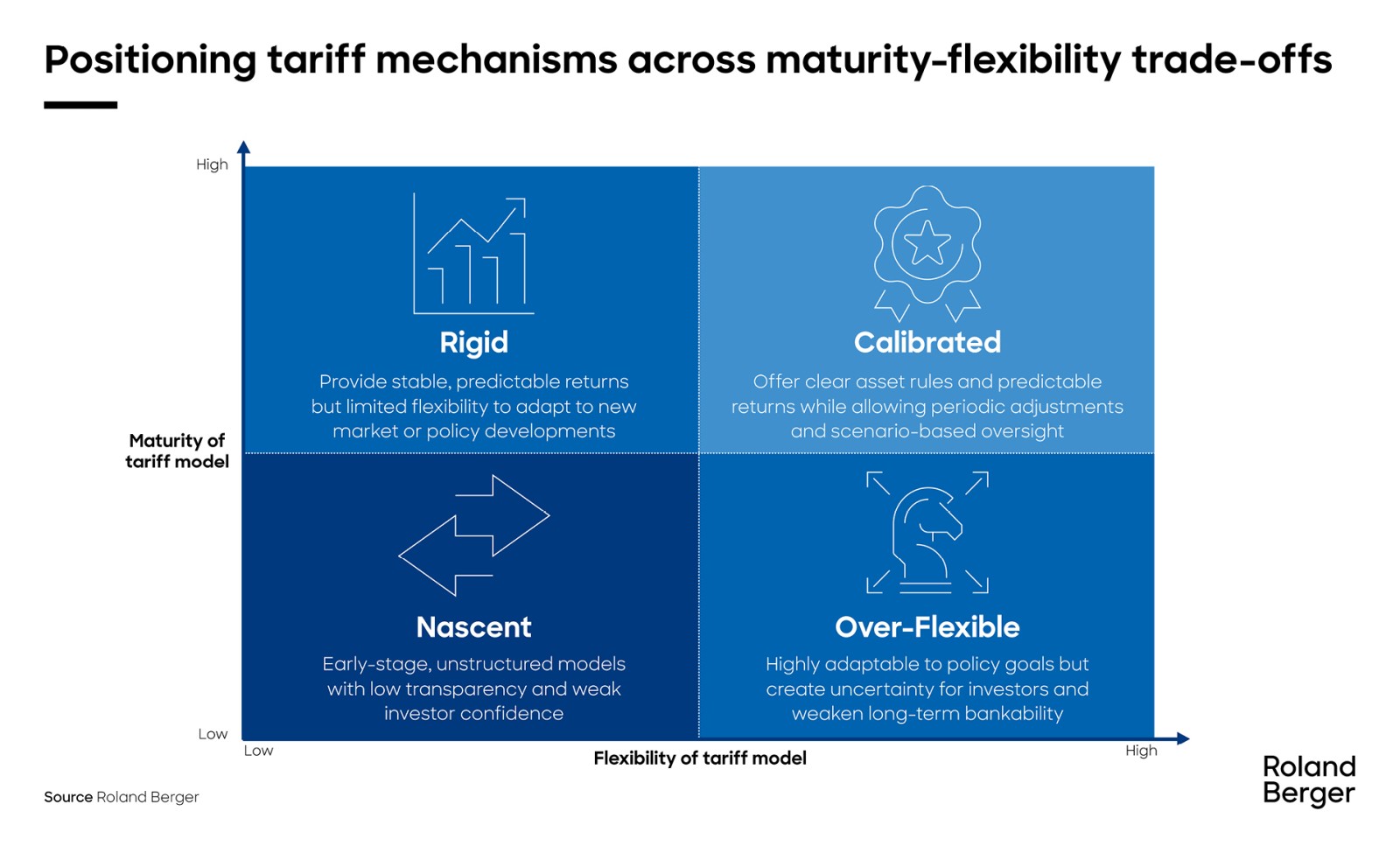
Positioning tariff mechanisms across maturity-flexibility trade-offs
Making rule-based tariff models work in the Middle East
In mature sectors, such as electricity and water, the challenge is to refine existing frameworks to reflect evolving policy priorities, such as decarbonization, digitalization and resilience. In emerging sectors, such as district cooling, waste management or electric vehicle charging, the challenge is to design new frameworks that can attract investment, support innovation and manage risk in the absence of established benchmarks.
The value of scenario thinking in tariff design
Scenario thinking is increasingly valuable in tariff design. By modeling different demand, cost and policy scenarios, regulators and operators can stress-test tariff frameworks and make informed decisions about risk allocation, investment timing and subsidy needs. This approach helps to balance the interests of consumers, operators and governments, and to ensure that tariff frameworks remain robust in the face of uncertainty.
The path forward for tariff setting in the Middle East involves a shift towards more transparent, rules-based and adaptive frameworks. This includes greater use of benchmarking, performance incentives and periodic reviews to align tariffs with evolving policy goals and market conditions. It also requires stronger stakeholder engagement and communication to build trust and support for necessary reforms.
Download our latest report to explore the full analysis and discover how transparent, adaptive pricing frameworks can balance affordability, drive investment, and support sustainable infrastructure growth across the Middle East.
Download the full pdf
Study
Designing pricing frameworks that enable investment
A comprehensive guide to tariff setting for utility services in the Middle East, highlighting the balance between affordability, financial viability, and investment attraction. The report outlines historical challenges, regulatory evolution, and Roland Berger’s holistic, scenario-based approach to designing effective, transparent, and investable tariff frameworks.




![{[downloads[language].preview]}](https://www.rolandberger.com/publications/publication_image/25_2486_WEB_Tarrif_setting_in_middle_east_download_preview.png)