

Assess your company’s sovereignty across three key pillars: industrial, technological, and financial. Identify actionable levers and strengthen your strategic autonomy.


Managing the short- and long-term effects of Strait of Hormuz tensions
What’s the impact of the Strait of Hormuz on global supply and what should companies do now?
No one knows the future of this war – but some macroeconomic consequences are already predictable.

The ongoing conflict involving the United States, Israel, and Iran comes with two main uncertainties: the objectives of the United States and Israel, and the military strength and political stability of Iran’s government. As a result, future developments remain unpredictable and the timeline and outcome of the war are currently unknown.
Despite these uncertainties, some macroeconomic consequences can already be identified and assessed. This is the objective of the following analysis.
The issue extends beyond energy; the entire global supply chain is affected.
The closure of the Strait of Hormuz is currently restricting the global supply of energy and various industrial materials. It is one of the world’s most important maritime chokepoints, through which around 30% of global seaborne oil trade and roughly 20% of liquefied natural gas (LNG) flows each day. Key regional producers such as Saudi Arabia, the UAE, Qatar, Iran, and others rely heavily on this route to supply international markets. In addition to energy, the Gulf region is a major exporter of numerous industrial inputs, including sulfur, urea, polyethylene, helium, and aluminum. A disruption in this corridor will therefore not only tighten global energy markets but also constrain the availability of key materials essential for a wide range of industries.

"Even if disruptions in the Strait of Hormuz were resolved tomorrow, companies must continue to respond proactively, as the effects are long-lasting and a return to normal operations will not be immediate. A structured and forward-looking mitigation strategy remains essential."

The vulnerability of global markets: There is no second-best solution
One key challenge is the limited ability to offset disrupted trade flows. Current pipelines can reroute only about 15–20% of the oil usually shipped by sea, which does not fully compensate for maritime disruptions. At the same time, there are no meaningful strategic reserves or scalable alternatives for many chemicals and critical materials. Damage to energy infrastructure and curtailed production will therefore likely have lasting effects on global supply, even beyond the immediate duration of the conflict.
For many products such as LNG, fertilizers, petrochemicals, and critical materials, there is insufficient bypass infrastructure, limited reserves, and no short-term substitutes. While limited pipeline capacity exists, it can offset only a small portion of the disrupted volumes.
As a result, supply shortages would emerge quickly across multiple sectors, with particularly acute effects in Asia. Some commodities might be partially substituted or offset by increased production elsewhere, but these adjustments are constrained and often slow, leading to delays, regional price increases, and significant imbalances in global supply. Petrochemicals and critical materials are particularly vulnerable, with downstream effects on industries such as plastics, packaging, and electronics.


A containment strategy is not available
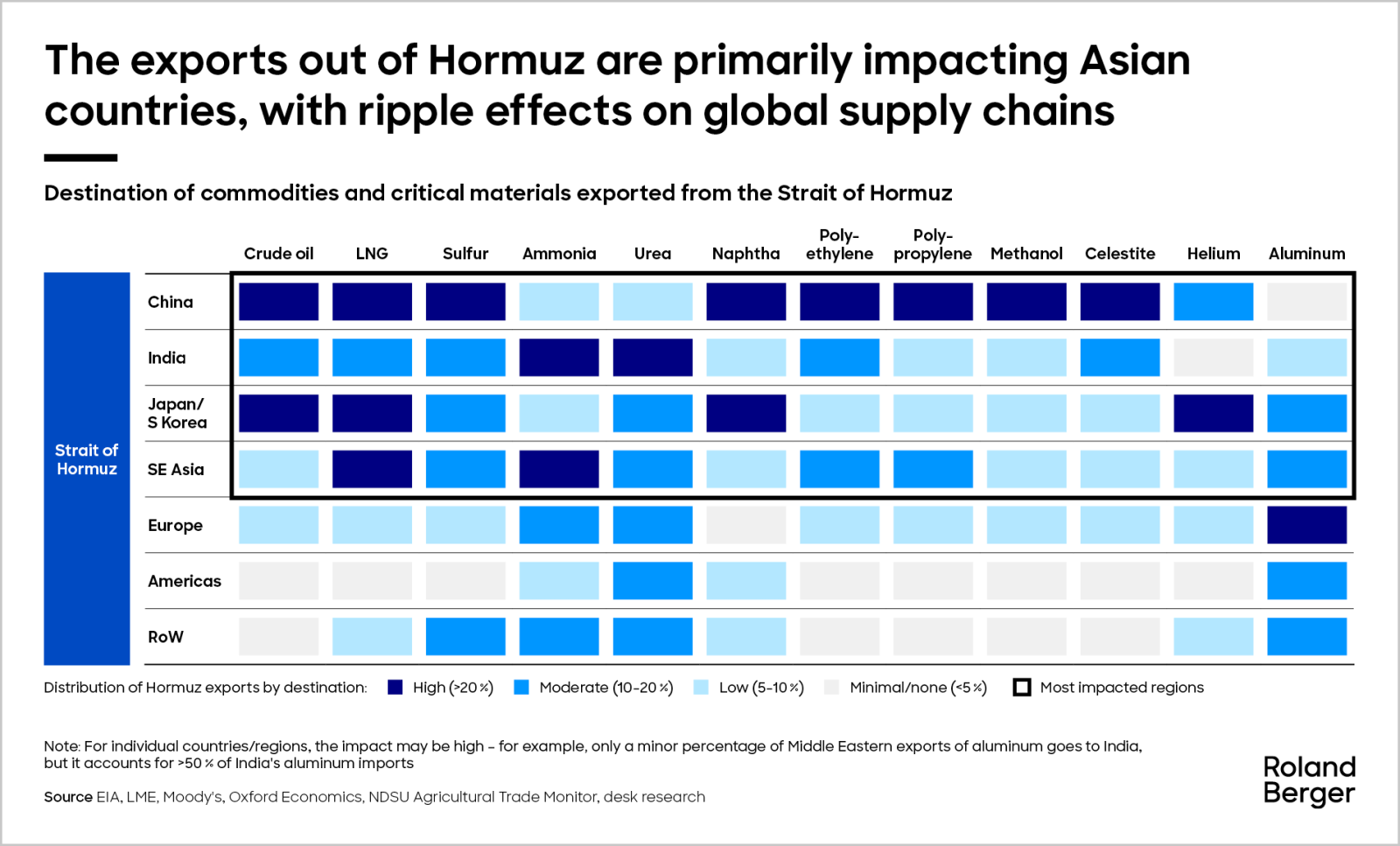
Asian economies, the main recipients of Gulf exports like crude oil, LNG, and industrial materials, are most affected by supply disruptions in the Strait of Hormuz. Countries such as China, India, Japan, and South Korea are particularly dependent on these imports. However, the effects are not limited to these regions. Due to the interconnected nature of global trade, disruptions in upstream supply chains in Asia quickly propagate across industries and geographies, creating ripple effects that extend far beyond the initial point of impact.
There’s no outsourcing of risks in a globalized world
Even regions like Europe and the Americas, which have less direct reliance on imports from the Strait of Hormuz, are indirectly impacted through complex, multi-stage global value chains. Raw materials exported from the Gulf may be processed in Asia into intermediate goods, which are then shipped to other regions and incorporated into finished products. As a result, shortages in primary inputs can cascade through multiple production stages, ultimately leading to disruptions in downstream industries worldwide. This interconnected system allows supply constraints in one region to rapidly cause component shortages and production challenges on a global stage.

"In the immediate term, companies should identify supply chain vulnerabilities, secure critical materials, and increase safety stocks where risks are highest. They should also reserve transport capacity, consider emergency logistics, and activate contractual safeguards to manage rising costs."

In summary, the conflict is not only an energy issue but a systemic supply chain shock. Limited substitution options and the strategic role of the Strait of Hormuz create significant vulnerabilities in many sectors.
What does that mean for companies?
As a result, companies need to respond proactively to the ongoing disruption by adopting a structured and forward-looking mitigation strategy. In the immediate term, the priority is to identify vulnerabilities within supply chains, secure access to critical materials, and build up or increase safety stocks where risks are highest. Companies should also take operational measures such as reserving transport capacity in advance, exploring emergency logistics options, and activating contractual safeguards, including mechanisms to pass on rising costs. They should also assess structural resilience by qualifying alternative or regional suppliers, evaluating supplier financial stability, and redesigning supply networks for more redundancy and stronger inventory buffers. Looking ahead, continuous monitoring becomes essential: companies must closely track developments in energy and commodity prices, supplier capacity constraints, lead times, logistics conditions, and signs of financial stress across their supplier base. Taken together, these actions enable firms not only to manage immediate disruptions but also to strengthen their resilience in the face of a potentially prolonged period of instability.
Sign up for our newsletter
Further readings


