2026 market outlook
Sentiment among prefab players remains positive. For 2026, producers anticipate increasing output by 34%,
building
more than 19,000 housing units. This confidence is broadly shared, as roughly 90% of respondents indicate that they expect higher production levels in 2026 compared to 2025. However, historical data suggests that forecasts often overestimate production, leading to a more conservative adjusted projection of 16,100 units in 2026, a 10% increase from 2025. Even on this adjusted view, there remains significant headroom. The corrected projection corresponds to roughly 45% capacity utilization, similar to 2024, against an estimated sector capacity of close to 35,000 units.
Notable statistics in 2025
The majority of prefab players indicate that prefab housing is cheaper than traditional construction, with the majority of respondents stating it is 10–20% cheaper. Furthermore, prefab is increasingly used for apartments (across low-rise, mid-rise, as well as high-rise ), with apartments now representing the majority of prefab housing. Prefab also offers a high degree of flexibility in facade finishing and overall design.
Key observations include:
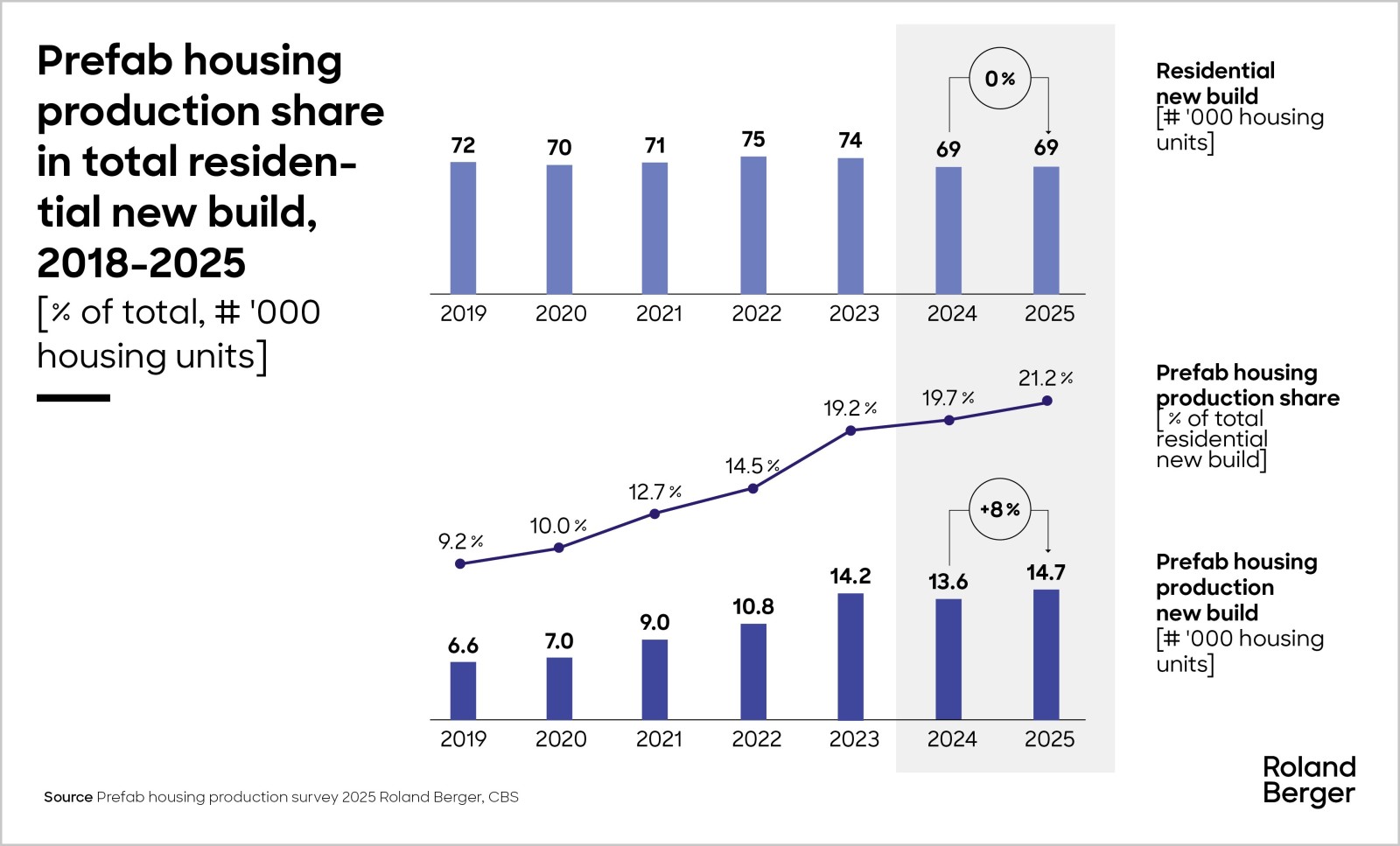
- Renewed growth in prefab’s share of residential construction in 2025 following a plateau in 2024 - Both the penetration of prefab within the total market and the absolute number of prefab homes increased over the past year, while total residential construction declined.
- In contrast to certain perceptions, apartments constitute the majority of prefab homes.
- Also in contrast to certain perceptions, prefab is also relevant for the inner city areas, with inner- and outer-city projects being relatively equally split.
- Majority of prefab homes are tied to permanent building permits.
- Biobased becomes prominent, with biobased concepts accounting for 30% of prefab homes in 2025 overall and several smaller players already delivering 100% biobased prefab output.
Conclusion
Residential prefab players broadly agree that prefab should account for 50% of all new residential
construction
by 2030, and potentially up to 80% in the longer term. At the current pace, however, prefab’s share is projected to reach only 30–40% by 2030, falling short of the target.
Despite this gap, players remain optimistic. Prefab offers clear benefits in cost and speed, while increasingly meeting market demand through a growing share of apartments and flexible facade and design options. Current production capacity among players is sufficient to support further growth. Achieving the 2030 target will require collective effort and coordination across the sector, supported by government and stakeholder initiatives.
The Prefab Homes Radar will continue to track these developments, providing insights into how the sector advances.




![{[downloads[language].preview]}](https://www.rolandberger.com/publications/publication_image/Roland_Berger_26_2024_Prefab_Homes_Radar_2025_cover_download_preview.jpg)


