Why AI deployment is outpacing value realization – and how organizations can close the gap
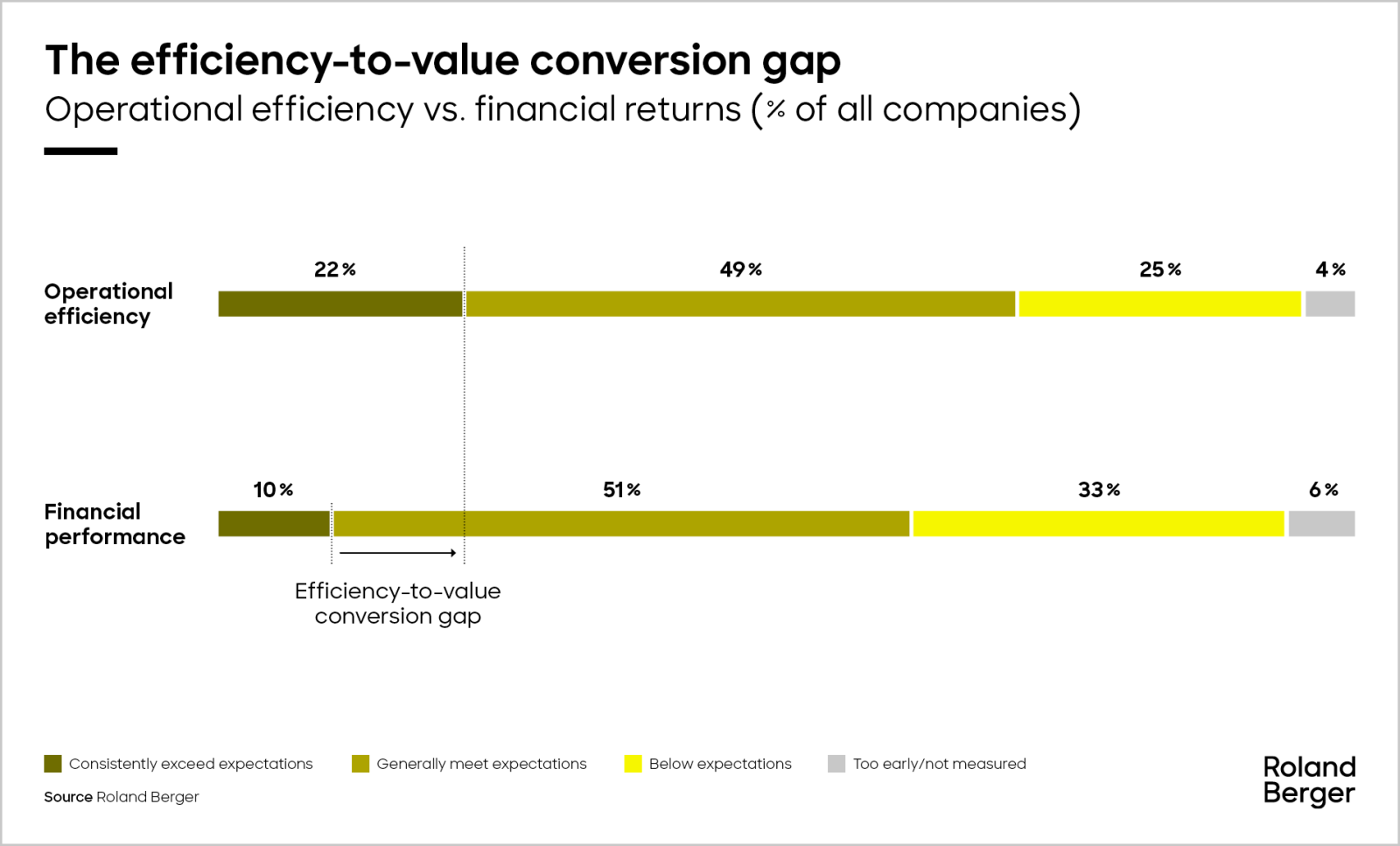
AI has never moved faster inside organizations – yet for most, it has never paid off less. Investment in artificial intelligence is surging, but almost 90 percent of firms report returns lagging spending. In practice, AI reaches production faster than financial breakeven, so costs rise long before value appears. To understand the gap, Roland Berger’s AI Lab surveyed 203 senior executives across industries and geographies. The finding is stark: only about ten percent consistently capture meaningful impact. These “Industrializers” treat AI as an industrial capability to be engineered, not pilots to be launched. The study shows why so many organizations remain stuck in profitless prosperity – and what it takes to close the AI value gap.
You can't buy AI transformation, you must engineer it — discover how leading companies turn AI into durable value
In just a few short years, AI has moved from experimentation to the core of enterprise operations, with organizations across industries scaling both generative and agentic AI into live business environments. Executive engagement is now near-universal, with 99 percent reporting formal leadership involvement. Most organizations have already moved
agentic AI
beyond planning.
As adoption scaled, it followed a buy-heavy path. Almost 40 percent rely primarily on off-the-shelf solutions, while only a small minority build mainly in-house. This approach has helped accelerate deployment, but it has also limited the development of internal capabilities that compound over time. In short, companies have learned to make AI work, but they have not yet learned how to make AI pay.
This imbalance is reflected in uneven outcomes. Although commitment to AI is now high, budgets and deployment speed are no longer reliable predictors of success. Our analysis groups companies into four segments, led by a small elite of Industrializers that consistently convert AI activity into value. Around ten percent of firms fall into this category, while much larger shares are either Stalled, matching ambition and spend but not returns, or Observers, piloting without scaling. These patterns cut across geographies, industries and company sizes. Crucially, the data shows that speed alone does not drive success; Industrializers make AI outcomes predictable, while others struggle to turn operational progress into financial impact.
Root causes of the AI value gap
"The Industrializer Code inverts the question from 'What can AI do for us?' to 'What can we engineer with AI at scale?'"
Uneven AI outcomes persist because many organizations are still flying blind on measurement and steering. Stalled companies move fast, but they watch the wrong dashboard. Instead of continuously steering value, they rely on one-off assessments, intuition or sprawling KPIs that blur priorities and prevent trade-offs. Industrializers take a different approach. They focus on a small set of value-critical metrics, accept that autonomy must sometimes outweigh perfect accuracy, and back judgment with data. As a result, launching AI is no longer a gamble, but a reliable indicator of future value.
The second root cause is a hollow operating model and
technology architecture.
Many organizations have bought the Ferrari of modern AI infrastructure, but are running it on the go-kart engine of shallow integration. Wrappers accelerate early progress, but collapse under operational load.
Industrializers rewire rather than wrap, embedding AI directly into data, workflows and governance. They do not spend more or move faster. They operate differently — and that difference enables sustained value.
The Industrializer code
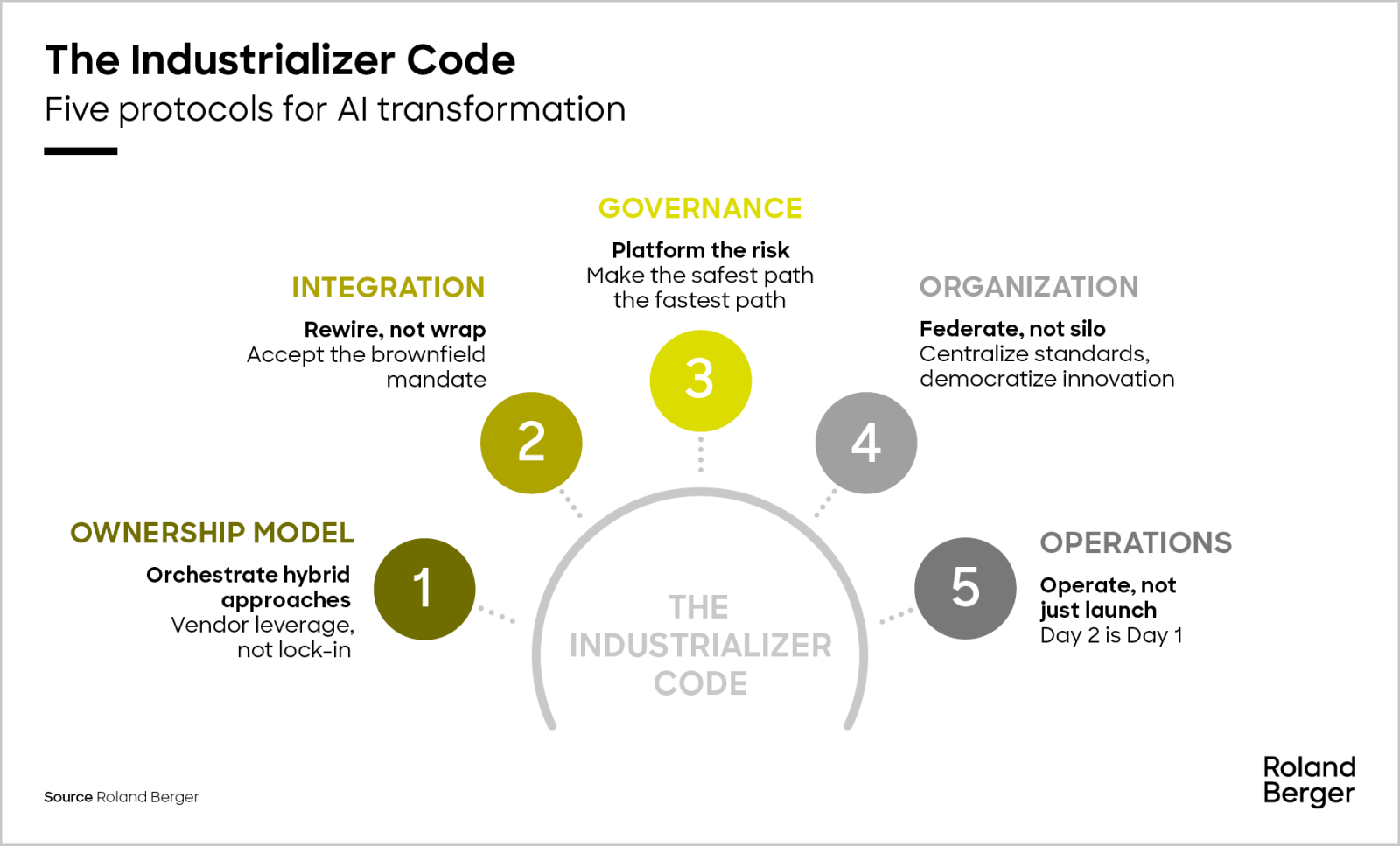
Why does the AI value gap persist? Not because organizations lack ambition, capital or access to technology, but because most still treat AI as a series of projects to be bought rather than as a capability to be engineered. A small minority has broken out of this pattern. These Industrializers do not spend more or move faster than their peers – they have changed how AI is run. Across the data, a consistent set of operating principles explains how they convert AI activity into durable value.
At the core of what we call “The Industrializer Code” is a shift in how AI is owned and executed. Industrializers retain control while working with partners and integrate AI deeply into existing systems rather than wrapping them. Governance is embedded directly into platforms, which removes friction after go-live. Innovation is federated through common standards, allowing teams to build without fragmenting the architecture. Instead, they treat deployment as the beginning of the work, investing in ongoing operation and improvement. It is precisely this that allows AI performance to scale and compound over time.
"AI has reached the boardroom and the front line at the same time. The real differentiator is no longer who deploys AI fastest, but who builds the discipline to convert it into measurable, repeatable value."
The decisive barrier to AI success has shifted – and leadership is now the constraint. Technology readiness is no longer the binding limitation, and access to capital is rarely the limiting factor. What holds many organizations back is a lack of engineering discipline in how AI is governed and operated at scale. Success now depends less on which tools are adopted and more on whether the operating model has adapted to run AI as a system rather than manage it as a collection of projects.
This shift has direct implications for leadership. AI industrialization cannot be delegated to a single function or driven through isolated initiatives. As Industrializers continue to compound their advantage, the gap between them and the rest will widen into a durable competitive divide. Crossing that divide requires a deliberate change in focus, moving away from exploration toward operations and from launching pilots toward running systems in production.
For the CEO, the mandate is to orchestrate rather than innovate. The task is not to champion individual use cases, but to create the conditions for systemic value. That requires changing what is rewarded. Innovation theater must give way to impact that compounds across the enterprise, supported by a federated operating model that centralizes standards while allowing innovation to scale beyond silos.
For technology and finance leaders, the mandate is equally clear. CTOs and CIOs must build infrastructure that makes the right behavior easy, embedding governance into platforms rather than enforcing it through committees. CFOs must fund shared capabilities instead of isolated projects, shifting capital toward platforms that scale and compound over time. Industrializers understand that individual initiatives may fail, but a well-designed system improves with use over time.
Engineering value in an AI-first world
Why are almost ninety percent of firms underperforming despite record levels of AI investment? The answer is uncomfortable. The market has not stalled for lack of ambition, budget or access to technology. It has stalled because many organizations have misunderstood what the task really is. While AI deployment has accelerated, most still approach it as a set of projects to be launched and optimized in isolation.
A small minority has taken a different path. These Industrializers treat AI as a standard industrial capability, designed to be engineered, governed and run at scale. What separates them is not the models they buy, but the machine they build around those models. They wire AI into the enterprise, align speed to production with speed to value and focus on operating systems rather than celebrating launches.
As we move into 2026, this distinction will matter more, not less. The AI value gap is widening, and it will harden into a lasting competitive disadvantage for those that fail to adapt. You cannot buy your way out of this
transformation
– you have to engineer your way through it.
Request the full PDF here
Register now to access the full study. Furthermore, you get regular news and updates directly in your inbox.
Thank you for registering your interest. If you have not yet confirmed your email address with us you will receive an email shortly requesting you to do so. Once confirmed, you will receive the requested content directly via email.