

Manufacturer innovations are boosting eSIM adoption in mobile and IoT devices, impacting telecom operators. Discover future developments.


Travel eSIM: From roaming to digital
How is eSIM reshaping travel connectivity?
International travel is rebounding, and travelers are demanding seamless, affordable, and digital-first connectivity. The embedded SIM (eSIM) is revolutionizing the telco industry, making switching providers easier and cheaper, and enabling travelers to stay connected across borders without the hassle of physical SIM cards or unpredictable roaming fees. Industry leaders and private equity investors must understand how eSIM is fundamentally changing the market’s economics and the way connectivity is distributed.

Market context:
Global travel eSIM activations are expected to grow from ~46M in 2023 to ~930M by 2030 (~54% CAGR).
The addressable market value is projected to expand ~8× to ~USD 7.8bn by 2030, driven by surging activation volumes despite declining ARPU (Average Revenue per User).
B2B2C channels (super-apps, fintech, OTAs, airlines) are capturing the majority of incremental volume, with embedded distribution becoming the dominant growth lever.
"Early signs of consolidation are already visible, including selective mergers and acquisitions, strategic divestments, and accelerated capital raising. They are all suggesting that the window for advantaged entry is narrowing."

The new era of travel connectivity
For years, international travelers faced a fragmented connectivity experience: expensive roaming, inconvenient local SIM purchases, or reliance on Wi-Fi. eSIM technology changes this equation.
For users, it removes friction by enabling remote download and activation of mobile connectivity - no physical cards, no in-store visits, no dependence on traditional roaming.
For providers, this eliminates the need for physical SIM manufacturing, inventory, and retail distribution, fundamentally changing the market's economics.
The rebound in global travel, combined with greater price transparency and a growing base of digitally native consumers, is reinforcing this trend. Connectivity is increasingly purchased before departure (alongside flights, hotels, and insurance), rather than as a last-minute decision on arrival.
Market development
Global travel eSIM activations are forecasted to grow at approximately 54% CAGR by 2030, with the total addressable market expected to expand roughly eightfold.
As travel becomes more affordable and mobile data more essential, the traveler base is also expected to grow more than double from 2023 to 2030.
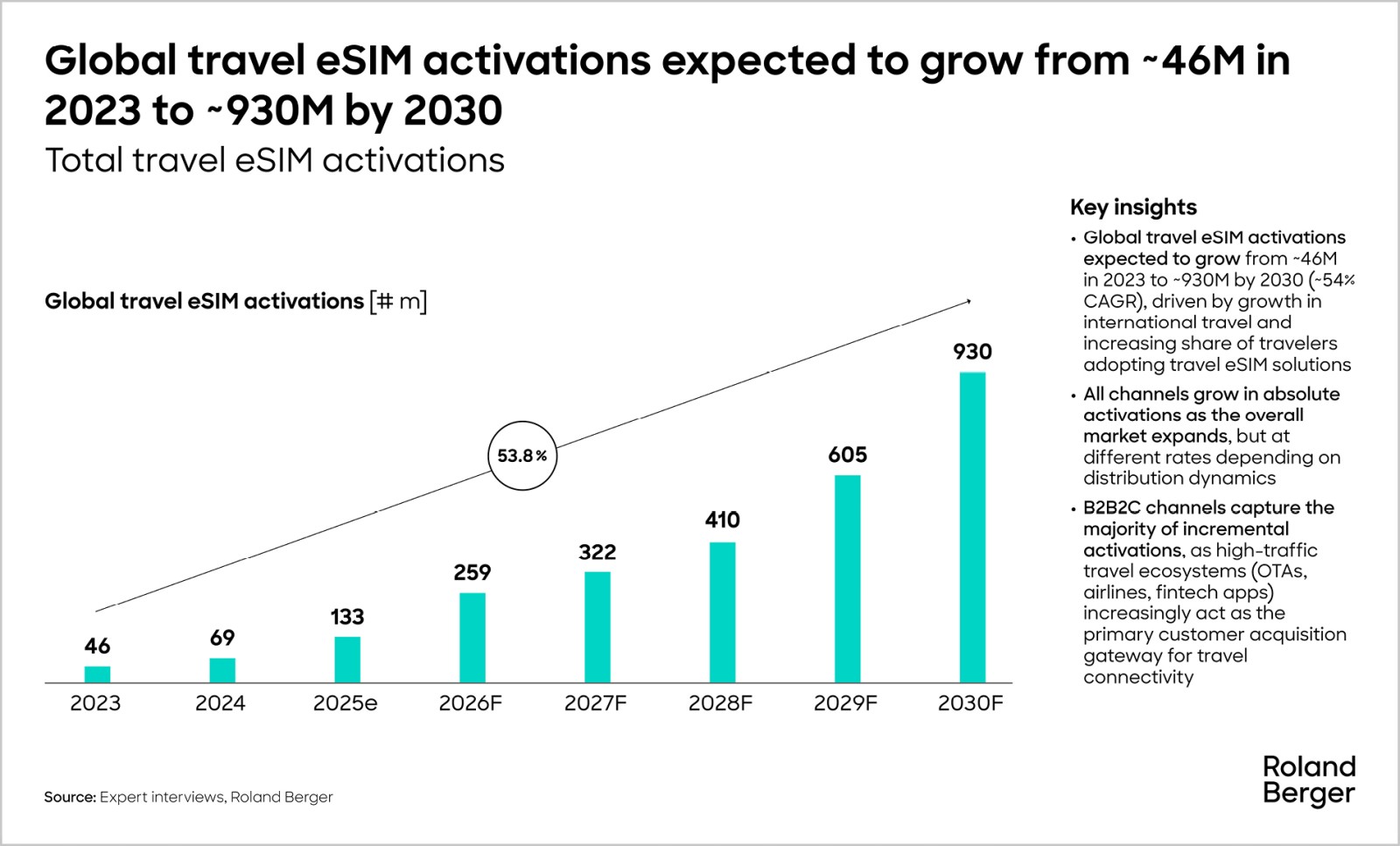
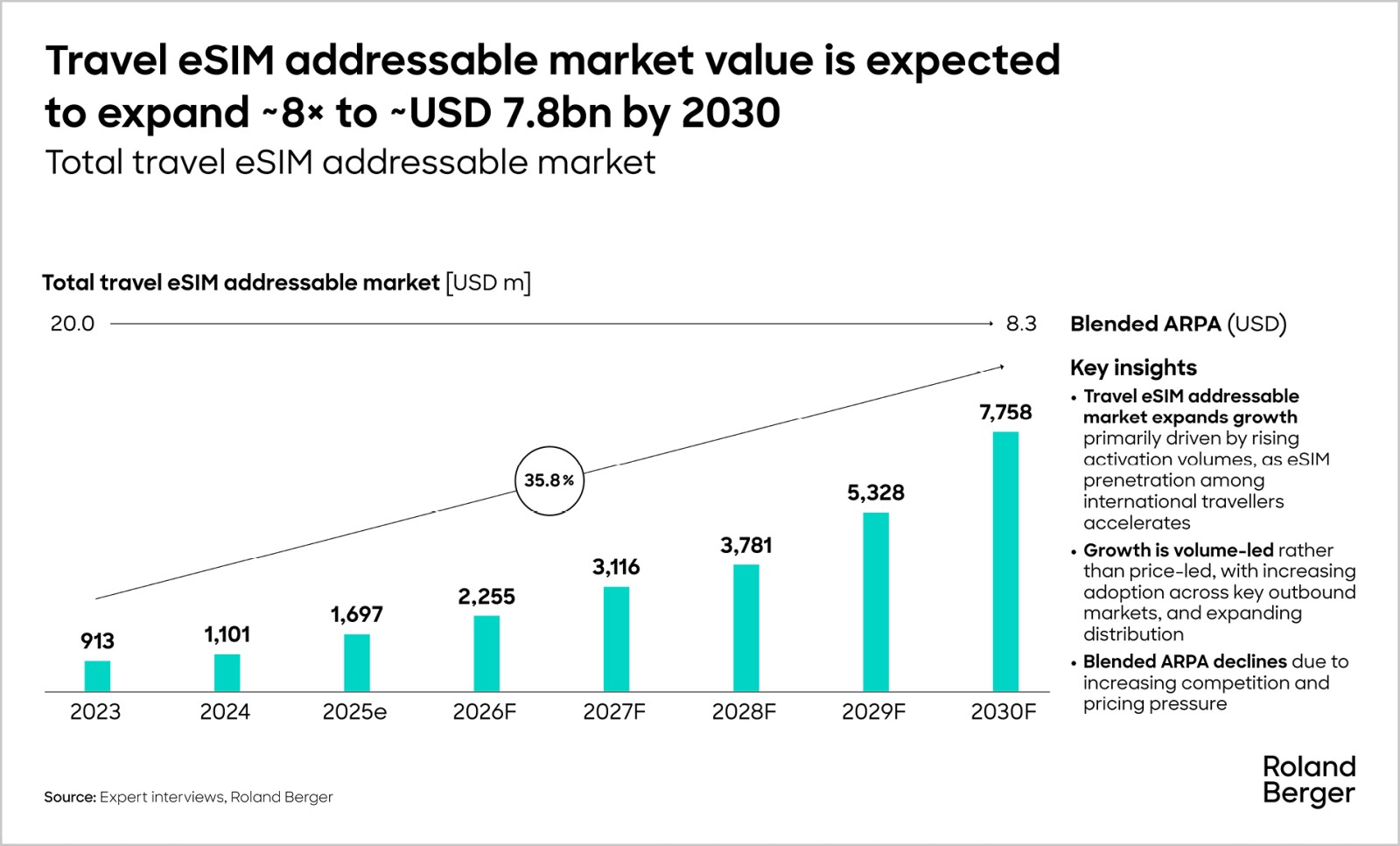
This growth reflects both substitution and expansion. Beyond replacing existing connectivity solutions, eSIM is expanding the addressable market by serving users who previously avoided roaming due to cost or complexity, or depended on alternatives such as physical portable Wi-Fi devices.
Competitive landscape
Five player types shape the market: global D2C (direct-to-consumer) brands, regional D2C brands, B2B2C (business-to-business-to-consumer) enablement platforms, full-stack MVNEs (Mobile Virtual Network Enabler), and MNO-owned propositions.
B2B2C is emerging as a dominant channel, offering eSIM solutions through digital platforms like OTAs, airlines, super apps and fintech & neobanks.
Compared to direct-to-consumer (D2C) channels, embedded B2B2C distribution benefits from lower customer acquisition costs, more predictable demand, and structurally stickier relationships.
B2B2C channels are expected to capture approximately 45% of travel eSIM activations by 2030, underscoring their role as the primary driver of incremental market growth.

Geographic concentration
Global travel demand and, by extension, the travel eSIM opportunity, are concentrated across a few high-volume international corridors.
Within this landscape, Asia emerges as a critical driver of growth. Travel flows linked to China/Greater China (Taiwan, Macau, and Hong Kong) and Southeast Asia combine scale with strong underlying demand fundamentals, including tourism, business travel, and diaspora movements.
For instance, China's outbound travel alone is projected to present a substantial opportunity for travel eSIMs, with a market size of approximately USD 656 million by 2030.
A significant portion of this demand is concentrated on regional routes, particularly to Greater China and Southeast Asia, which together account for a large share of outbound volumes.
_image_caption_w1280.jpg?v=1934877)
Changing unit economics
Unit economics in the travel eSIM market are changing fast. While prices—and therefore margins—are under pressure, scale is emerging as a critical determinant of long-term competitiveness.
Larger players benefit from stronger bargaining power with Mobile Network Operators, enabling more favorable wholesale pricing and improved unit economics.
The market is beginning to transition from a "land-grab" phase toward an early stage of consolidation, with leading players raising capital and expanding aggressively to consolidate their positions.

Monetization beyond core connectivity
While a travel eSIM is fundamentally a data connectivity product, its longer-term value-creation potential extends well beyond the sale of mobile data.
As competition intensifies and pricing pressure on core data plans increases, leading players are expanding into adjacent revenue streams, leveraging their direct customer relationships, digital distribution capabilities, and real-time contextual data.
Our full article explores these dynamics in depth, offering actionable insights for investors and industry leaders in the new era of travel connectivity.
Request the full PDF here
Sign up now to access the full study. You will also receive regular news and updates, delivered straight to your inbox.
Further readings


