Publication
Unlocking the circular packaging market in the GCC

Unlocking the circular packaging market in the GCC

January 14, 2026

Current market dynamics and policy levers

Packaging waste in the GCC is growing rapidly, with 9 million tonnes of packaging waste generated annually and only 10% recycled. Rising consumption and gaps in waste management make systemic change urgent. Global regulations such as the EU’s PPWR and the UAE’s EPR framework are setting stricter standards, making circular packaging a necessity rather than an option. Circularity can deliver environmental benefits, reduce landfill dependency, and create economic value, but progress is uneven and slow.

Rising consumption and gaps in waste management make systemic change urgent.

Innovation is advancing upstream: FMCG brands and manufacturers are shifting to mono-materials, paper-based solutions and lightweight PET, while R&D in bio-polymers and coatings is accelerating. Still, adoption is facing hurdles: lack of harmonized standards, high costs of sustainable materials and uncertainty around emerging EPR frameworks. Virgin plastics remain cheaper than recycled alternatives, and feedstock scarcity – especially for food-grade streams – is limiting progress.

Downstream, consumer willingness is evident, but enabling systems lag. Local waste operations still struggle to separate materials effectively, causing contamination. To convert intent into action, awareness and education will be crucial, but they must be reinforced with sorting infrastructure and incentives that combine convenience with tangible rewards for users.

Designing for circularity: Standards, materials and policy

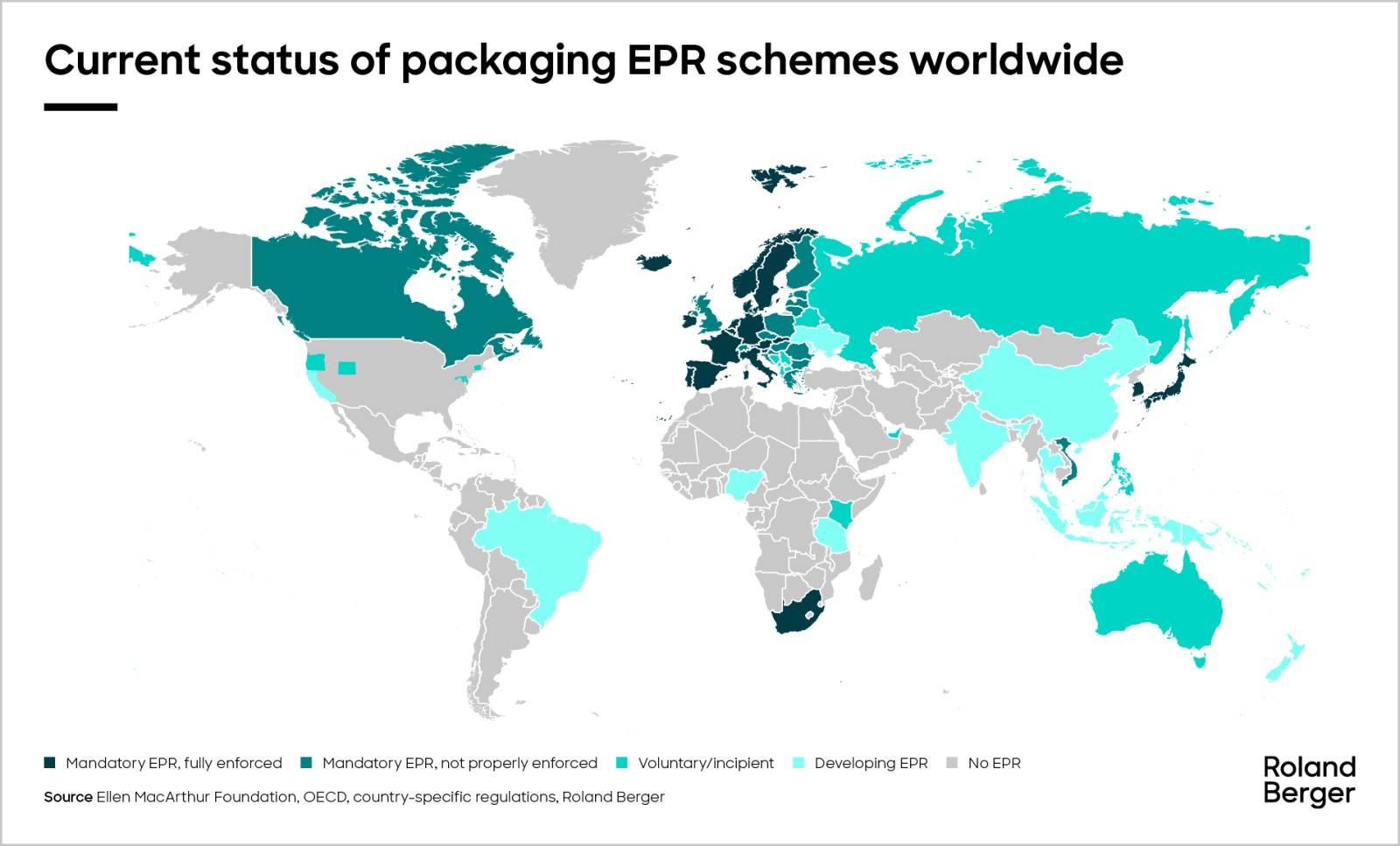
For governments and companies operating in the region, the question is no longer whether to embrace circular packaging , but how fast, and at what cost. Global sustainability regulations are tightening: the EU's PPWR, effective in 2025, mandates recyclability and minimum recycled content, while EPR schemes are spreading worldwide, including in the UAE, where the first EPR pilot launched in 2025 and a full framework is
planned for 2026.

Upstream progress on circular packaging is real, with global FMCG brands leading the charge and cascading innovation across the region. Nestlé reported that over 86% of its packaging is now designed for recycling, with Gulf operations held to the same standard. Similarly, Mars has reportedly redesigned more than 12,000 packaging components and shifted thousands of stock-keeping units (SKUs) toward mono-materials and paper-based solutions and is piloting alternatives for flexible packaging with improved recyclability.

Regional players are stepping up too. Hotpack, a UAE-headquartered global packaging company with operations in over 100 countries, claims that 97% of its 4,000+ SKUs are recyclable or environmentally friendly. The company is investing in lightweight, fully recyclable PET formats (such as its proprietary H-PET) and in infinitely recyclable products, while retrofitting existing filling lines to ease adoption for brand owners.

Despite this momentum, several barriers are slowing progress. The absence of harmonized design standards across the GCC creates uncertainty and limits scalability for brands and manufacturers. Costs also remain a major hurdle: sustainable materials such as mono-material films, biodegradable polymers, and advanced coatings are significantly more expensive than virgin plastics, making adoption commercially challenging.

Evolving regulatory frameworks, like EPR in the UAE and the recent launch of the regional waste management master plans in Saudi Arabia in November 2025, add to the uncertainty. The UAE launched the first EPR pilot in 2025 for packaging, electronics and batteries and has a full framework planned for 2026. The remaining Gulf states are far from operationalizing EPR, with most still at the discussion stage. Lessons from Europe show that robust EPR governance – clear frameworks, mandatory participation and strong enforcement – can deliver material recovery rates above 80%, as seen in Belgium and Germany.

"Packaging goes circular when three things line up: recoverable design, integrated infrastructure, and regulations that change behaviors and tilt margins toward profit."
André Sleiman
Director
Riyadh Office, Middle East

Closing the loop: Collection, sorting, and consumer behavior

Downstream, consumer willingness to embrace circular packaging is evident across the region. However, to turn intent into action, governments and mass-market retailers must introduce systems and nudges that enable behavioral change. Where incentives such as cashback or loyalty rewards are meaningful, engagement rises. Uptake also grows when recycling is convenient, carries a sense of value, and taps into the 'cool factor'.

Awareness is essential, but it is not enough. Educational initiatives involving public campaigns and school curricula reaching thousands of students, have succeeded in raising knowledge and willingness to recycle, but also exposed an uncomfortable truth: without the necessary waste management infrastructure, individual willingness rarely translates into long-lasting behavioral change.

The cost of inaction - and the way forward

According to the Gulf Petrochemicals and Chemicals Association (GPCA), the plastics recycling market in the GCC could generate approximately 50,000 jobs and USD 6 billion annually across the value chain – covering collection fees, materials recovery facility (MRF) revenues, recyclate sales and local conversion margins – if recycling rates increase from 10% to 40%. This figure reflects only the plastics segment, which accounts for roughly 15-20% of all packaging materials, indicating that the broader circular packaging market holds even greater potential for economic growth and sustainability in the region.

The GCC has already shown that bold measures can deliver rapid results. Abu Dhabi's single-use plastic bag ban in 2022 is proof: within two years, 364 million bags were eliminated, saving 2,400 tonnes of plastic and cutting greenhouse gas emissions equivalent to 130,000 cars off the road. Similar bans on Styrofoam achieved a 97% compliance rate among retailers. These examples underscore the power of decisive regulation.

Creating economic pull is essential to scale circular packaging. EPR schemes with clear cost-sharing mechanisms and eco-modulated fees — where better-designed packs pay less — must be paired with recycled-content requirements for high-impact packaging formats, starting with PET bottles and HDPE containers. These measures will anchor demand for recycled materials and justify investments and upgrades to infrastructure.

Ambition must be matched by operational capacity. Investment is needed in integrated waste management and treatment systems that connect collection, sorting and reprocessing, with upgrades rolled out in step with regulatory milestones. Reducing contamination and improving capture rates through a well-enforced multi-bin system will ensure that more packaging waste is recycled locally, rather than exported.

Transparent data and regular reporting must be linked to real performance, not just promises, ensuring that policies remain adjusted to the evolving technology and market realities. Performance-based contracts with standardized reporting metrics on collection, contamination and recovery rates should become the norm. Dubai Municipality's digital waste tracking system offers a useful model, providing real-time data on collection and recovery to guide enforcement and investment decisions.

Download the full report for exclusive insights into the GCC circular packaging market, including the latest trends, regulations, and opportunities. See how leading brands are driving innovation and discover actionable strategies for advancing circularity across the region.

Download the full pdf
Study

Unlocking the circular packaging market in the GCC

{[downloads[language].preview]}

Unlock insights into the circular packaging market in the GCC with this Roland Berger report. Explore trends in recycling, regulatory frameworks, sustainable materials, and economic opportunities, alongside case studies and policy recommendations for advancing circularity in the region.

Published January 2026. Available in
Sign up for our newsletter

Further readings
Load More