

How AI-first process design reshapes company processes from the ground up


AI searches in online news article publishing
How generative AI is disrupting publishers' business model – and strategies to adapt
AI-produced news summaries are becoming an increasingly popular feature on online search engines. When users inquire about recent developments on a specific topic, they are presented with a concise summary tailored to their content and language preferences. While this approach benefits casual news readers by providing essential information without requiring them to visit the original news websites, it poses significant challenges for publishers who lose direct website traffic, audience relationships, valuable user data, brand visibility, potential advertising and subscription revenue when people access news exclusively through AI platforms.
Key success factors for publishers
Optimize selected content for AI visibility while keeping deeper analysis, investigations, and archives behind controlled access.
Develop personalized AI news assistants that summarize, explain, and guide users through complex topics.
Monetize subscriptions, licensing, professional intelligence services, archive products, and premium personalized briefings.
The technology is fundamentally transforming how consumers discover, access, and engage with news produced by online article-based publishers – those that publish original journalism in textual form on their own digital platforms. Generative AI (GenAI) is becoming a new gateway between online article-based publishers and their audiences, breaking the all-important revenue-driving link between them.
"Publishers risk becoming invisible suppliers of information – traditional SEO, rigid paywalls, and article engagement are an insufficient response."

As a result, the competitive environment for online article-based news publishers is being redefined. Publishers must now compete for visibility, trust, and audience conversion within AI-mediated environments that they cannot fully control. They must adapt fast – but how? This publication analyses how generative AI is reshaping the consumer journey for online article-based publishers in terms of discovery (how audiences find news) and interaction (how they engage with and interpret news). It assesses the risks and opportunities of both and lays out clear ways to optimize discovery through differentiation and strategies to monetize the results.
How GenAI is disrupting publishers' current model
The old model of online article-based news publishers was simple and effective. Readers found content through search engines, social referrals, or publisher-owned entry points such as homepages, newsletters, and app notifications (discovery). They then clicked through to the publisher's website and interacted with it, generating monetization opportunities, such as advertising and subscriptions. Search engine optimization (SEO) therefore became a core business capability.
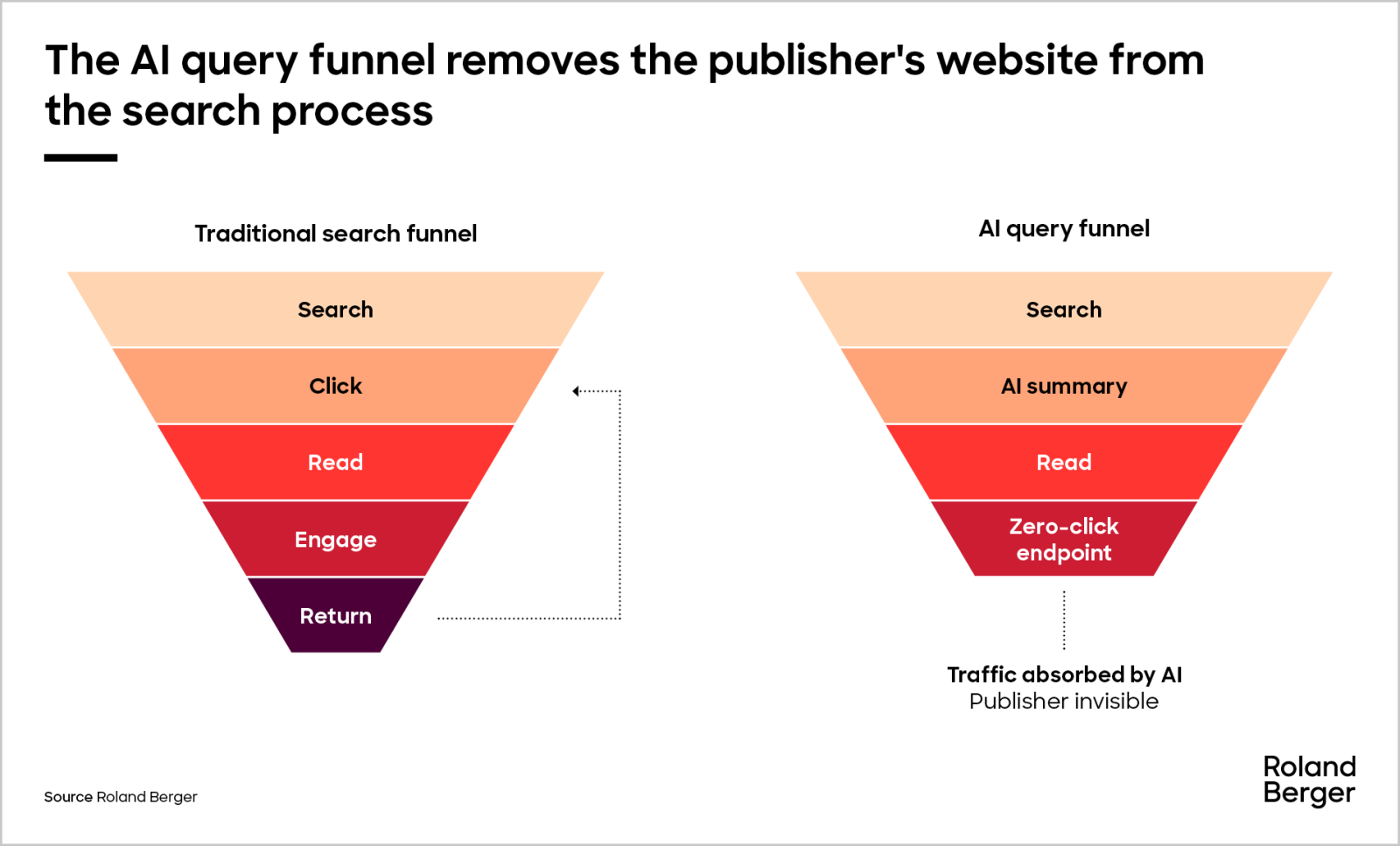
AI agents disrupt this model by acting as intermediaries between publishers and consumers. As readers may not click through, the interaction stage happens inside the AI platform, compromising monetization opportunities. With more and more people using such tools, publishers must therefore now compete to be selected as trusted inputs within AI-generated explanations rather than relying solely on SEO.
Why publishers need to adapt – fast
Before providing strategies to build on these success factors, the publication looks at the risks of not embracing GenAI:
Zero-click news consumption: Each interaction that remains within the AI environment represents a lost opportunity for online article-based publishers.
Loss of attribution: Acknowledgment of their work is as important as being read for online article-based publishers. But when users seek information through AI platforms, the visibility of original sources can become obscured.
Declining value of traditional SEO: For content to be surfaced in AI-generated responses, it must be structured in a way that allows AI systems to easily retrieve, understand, and attribute it – so-called generative engine optimization (GEO).
Intellectual property leakage: AI systems can access, summarize, and redistribute the informational value of original reporting. This raises critical questions about licensing rights, fair use boundaries, compensation mechanisms, content ownership, and paywall protection.
"Organizations must optimize selected content for AI retrieval and citation while protecting premium analysis, investigations, and archives behind controlled access."

How to embrace GenAI and succeed
These strategic risks point to a key takeaway for online article-based publishers – they must adapt their business model from simply publishing articles and capturing traffic to becoming trusted information providers within AI-mediated environments. The question is how?
The publication outlines three strategies. The first explores how to achieve high visibility within AI-generated answers and leverage that exposure to drive audience growth, subscriptions, and revenue. The second strategy centers on control, with online article publishers actively restricting AI from accessing their content through a paywall and prioritizing direct monetization through subscriptions. Lastly, our preferred strategy is to combine both of the others into a coherent hybrid model that captures the benefits of each while mitigating their respective risks.
_large_image.png)
To ensure success, the publication offers recommendations to support this hybrid strategy. These are based around differentiation and monetization.
For more information, download a copy of the publication or contact one of our experts.
A special thanks to Max Goldapp, Victoria Ewering, and Dr. Rebecca Alguera Kleine for contributing to this article.
Request the full PDF here
Sign up now to access the full study. You will also receive regular news and updates, delivered straight to your inbox.
Further readings


