

Roland Berger study on empowering people and anchoring AI in the corporate mindset to unlock its transformative potential.


The AI-First Organization
Nine operating model shifts to unlock AI value
Boards are approving AI investment roadmaps. Technology functions are procuring AI tools. Pilot programs are launching with genuine ambition. Yet measurable results are failing to materialize in the vast majority of organizations. The root cause, time and again, is not the technology but the fact that the operating model is left largely untouched. Our latest global study, based on a survey of 472 executives and senior leaders conducted in late 2025 and early 2026, investigates why AI power so rarely translates into enterprise performance – and what it takes to change that.

"In an AI-First operating model, the starting point is not the process – it’s the result."

The ambition-execution gap is wider than most leaders realize
Some 62 percent of respondents in our survey expect major or radical operating model changes as a result of AI transformation . Yet only 38 percent have already begun to act. More troubling: 59 percent consider their organization’s leadership insufficiently prepared for what lies ahead. This is not a technology readiness gap; it is a structural and human one.
When asked to identify the most significant barriers to AI value generation, respondents ranked people, skills and capabilities first – cited by nearly half of all senior leaders. Organizational structure and processes followed, ahead of technology requirements. For organizations still waiting for a technical solution to drive adoption, this finding should prompt a fundamental reassessment.
Forces reshaping competitive dynamics
AI is not simply changing how work is done – it is rewriting the organizational logic that has governed enterprises for decades. We identify a set of transformational forces already reshaping competitive dynamics today.
First, the productivity gap between AI leaders and laggards is widening at a pace without precedent in previous automation cycles. AI eliminates structural friction that consumes the majority of time in knowledge-intensive organizations. The competitive implications extend beyond cost: organizations operating at AI speed bring products to market faster and generate insight from data volumes that no human team could previously process in time to act.
At the same time, the dominant model of functional value creation is being inverted. In an outcome-led operating model, autonomous AI systems work backward from a defined result, pulling only the inputs that outcome demands. This exposes the inefficiency of legacy functional architectures and accelerates the shift toward cross-functional, agile units as the primary mode of production.
Two further forces – one reshaping leadership accountability and one restructuring talent architecture – add additional urgency to the operating model challenge. Their full implications are examined in depth in the study.
Nine shifts from foundational readiness to sustained scale
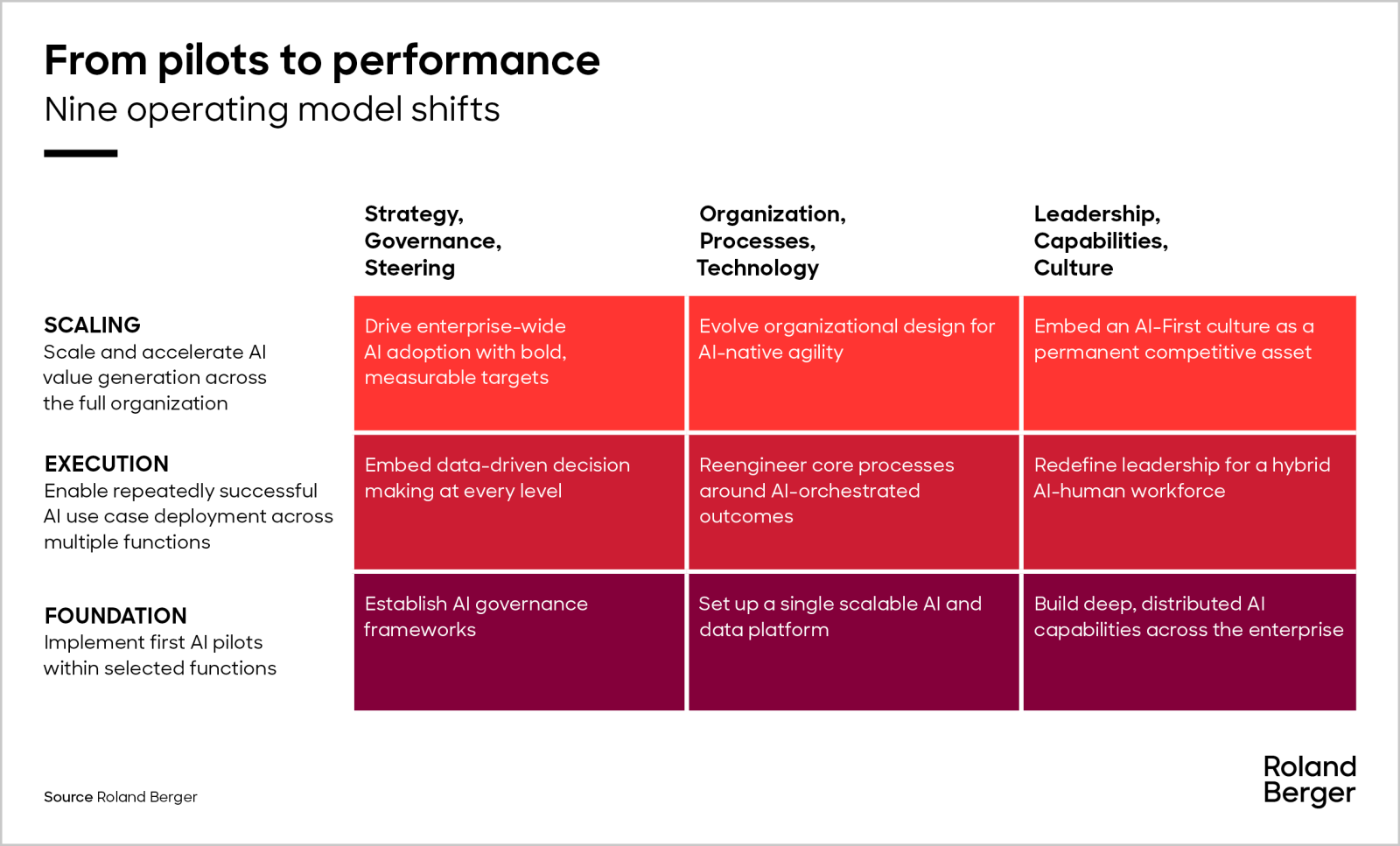
What distinguishes AI frontrunners from their peers? Not superior insight, but superior execution – across a specific set of operating model dimensions. Based on our survey findings, we identify nine concrete shifts that consistently differentiate leaders from laggards, organized across three maturity levels.
"Organizations must deliberately choose: reskill specialists upward into deep domain expertise or outward into AI-augmented generalist roles."

The first three shifts are foundational: establishing the governance, platform and distributed capability prerequisites without which no AI initiative can scale.
The following three drive execution: embedding data-driven decision making, reengineering core processes around AI-orchestrated outcomes and redefining leadership for a hybrid AI-human workforce.
The final three shifts operate at the level of scale: evolving structure, ambition and culture to make AI adoption self-sustaining. Culture emerges as the variable with the greatest effect size in our data.
The divide between AI leaders and laggards is already substantial – and widening every quarter. The strategic question for every senior leadership team is no longer whether AI will transform their operating model, but whether the organizational foundation will be in place before the competitive window closes. Organizations that act with urgency on their operating model, not just the technology, still have a meaningful opportunity to establish a durable advantage.
Request the full PDF here
Sign up now to access the full study. You will also receive regular news and updates, delivered straight to your inbox.
Further readings


