

Roland Berger – How satellite convergence is creating a new reality for telecom operators


Satellites have landed
Why satellite-native companies are becoming mobile network competitors
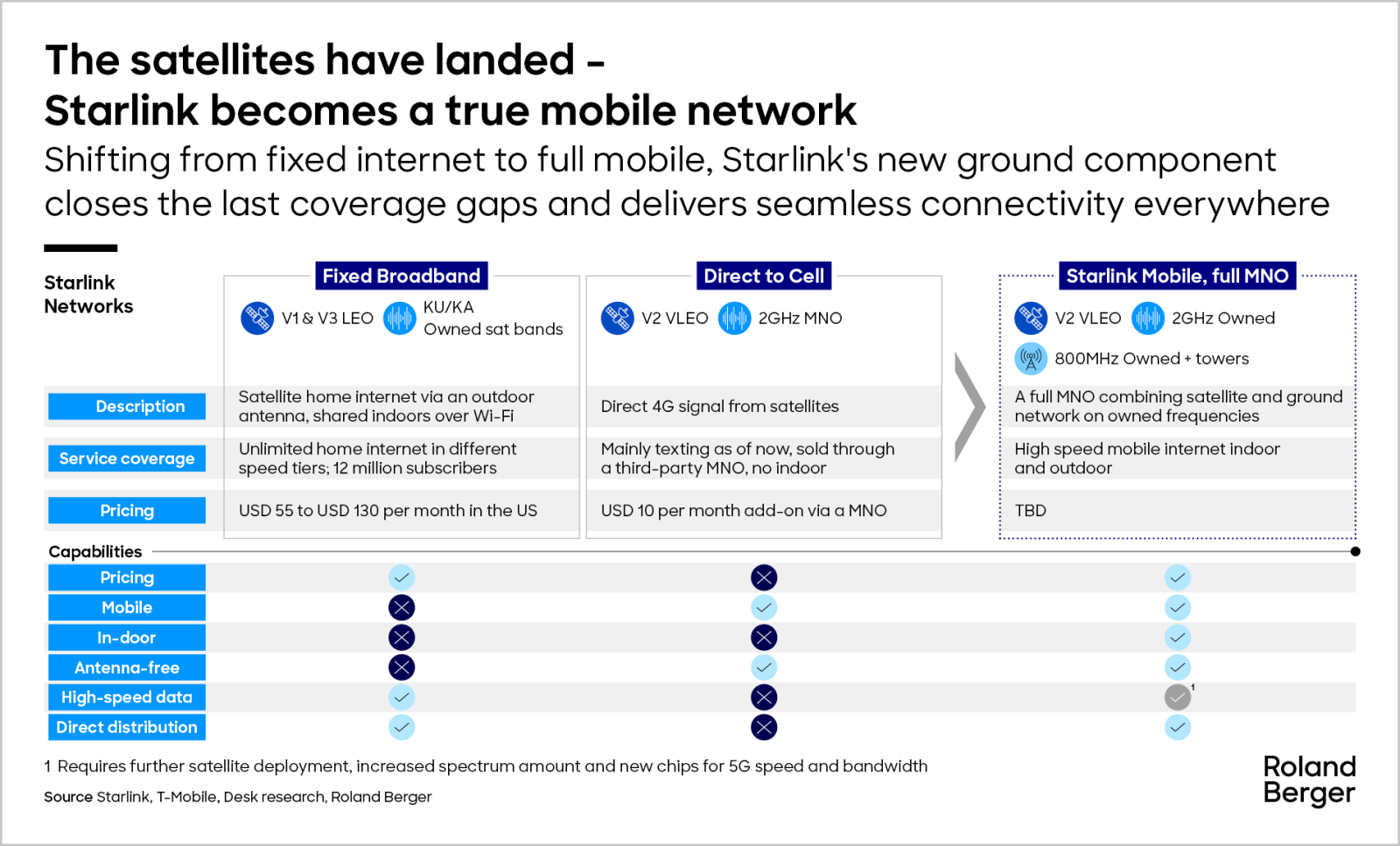
Satellite networks were traditionally distinct from the terrestrial networks operated by MNOs, serving different customers for different usages. Recent developments in the US point to a different future: satellite-native players acquiring mobile spectrum and building hybrid space–terrestrial networks to compete directly with the MNOs on the ground. The implications extend well beyond coverage, challenging the economics, sovereignty and competitive structure of mobile markets.
The satellites have landed
For decades, satellite companies provided connectivity where terrestrial infrastructure was unavailable or uneconomic: remote broadband, maritime and aviation services, emergency communications and, more recently, direct-to-cell messaging sold through mobile operators. Their role was largely complementary. The operator controlled the mass-mobile-market; the satellite operator provided an additional layer of coverage addressing a niche demand at a high premium.
That model is changing. As we set out in Satellite convergence, falling launch costs, higher capacity low Earth orbit (LEO) constellations and direct-to-cell technology are changing the scale of operations of leading satellite players.
Recent acquisitions of mobile-compatible spectrum in the US mark another major step. By securing mobile-compatible spectrum around 2 GHz and low-band spectrum at 800 MHz, satellite players could theoretically overcome two of their last major limitations: limited spectrum available for high-speed direct-to-cell services and poor indoor coverage. These are not simply extensions of existing broadband constellations: they are building blocks of an hybrid mobile network. The satellites have landed.
The architecture behind the disruption : hybrid mobile convergence
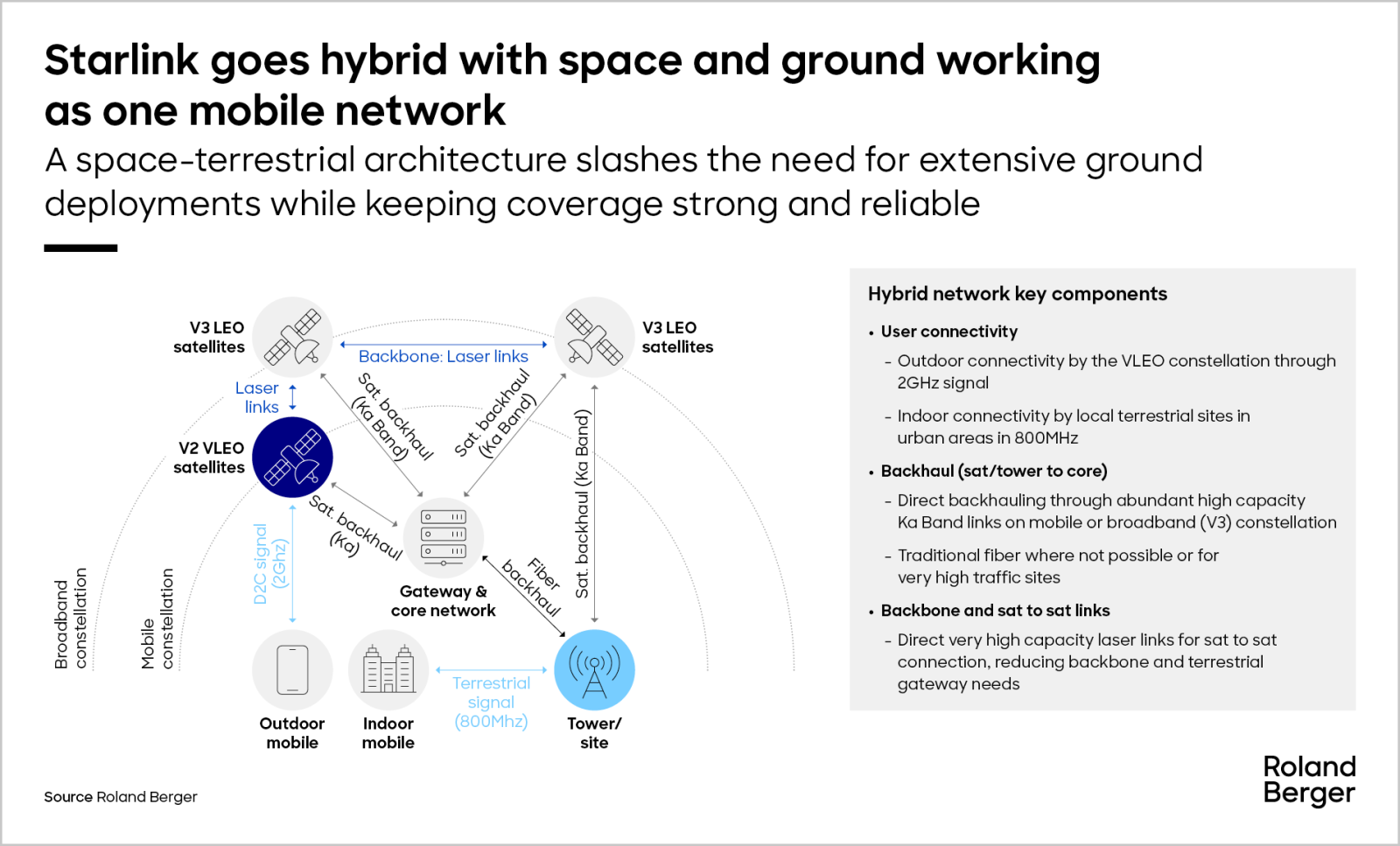
The disruption comes from combining at scale satellite and terrestrial infrastructures and frequencies into a single mobile network. Three complementary layers would provide connectivity from space, indoor coverage from terrestrial sites and high-capacity backhaul.
2 GHz on VLEO constellation, direct connectivity to smartphones. Historically used for both satellite and terrestrial mobile communications, the 2 GHz band offers a good balance between signal propagation and compatibility with mobile devices. Recent acquisitions of wider spectrum allocations around 2 GHz could enable satellite operators to move beyond basic messaging toward high-speed mobile data, although full compatibility will require upgrades to smartphone chips and protocols. This spectrum will be exploited by high capacity VLEO (very low earth orbit) constellations to facilitate direct to device communication
800 MHz, terrestrial coverage to reach indoors. Low-band frequencies offer stronger building penetration, addressing one of the main limitations of satellite connectivity. By deploying terrestrial sites selectively, satellite operators could extend their service indoors and into densely populated areas without replicating the entire infrastructure of traditional MNOs
Ka-band provides high-capacity backhaul from LEO broadband constellation, benefiting from much wider spectrum allocations than mobile-compatible frequencies. It enables high-throughput connections to ground gateways and could also support the backhaul of terrestrial mobile sites. Inter-satellite laser links could additionally provide a global backbone, routing traffic across the constellation without relying on radio spectrum. Both could leverage the extensive infrastructure of already deployed fixed broadband constellations, reducing the need to build a separate transport network for mobile services.
"The next telecom advantage will come from controlling the hybrid network and the customer relationship."

A fundamentally different deployment model
The main advantage is the possibility of building a nationwide mobile network with significantly fewer terrestrial sites. By providing broad outdoor coverage directly from space, satellite-native players could limit ground deployments to areas requiring indoor coverage or additional capacity.
The US cable industry provides an interesting precedent. Comcast and Charter have successfully entered the mobile market by leveraging Verizon's network, building a 21m mobile customer base without deploying their own nationwide mobile infrastructure.
However, significant hurdles remain before satellite-native players can compete at scale. Their capacity and spectrum remain limited compared to terrestrial networks, limiting the available bandwidth. Delivering high-speed connectivity to mass market will require further satellite deployments, spectrum acquisition, enhanced device chips, new protocols and substantial investments in ground infrastructure. Furthermore, becoming a full mobile operator will require regulatory approvals, roaming and interconnection agreements, as well as building distribution channels, billing, customer care and support capabilities to serve a market of a different scale.
Regional exposure will differ
Hybrid mobile convergence will not affect all markets equally.
United States
The United States is likely to feel the most immediate competitive pressure. The market combines high average revenue per user (ARPU), significant rural coverage gaps and a more unified regulatory framework.
The recent spectrum deals suggest a shift from providing satellite coverage through an MNO to building an independent mobile proposition.
An entrant does not need to displace every urban customer to matter. Rural users, secondary lines, coverage-sensitive customers and fixed-mobile bundles could already provide a meaningful starting point. Success would then depend on service quality, spectrum access, distribution and the economics of the hybrid network.
Europe
Europe has strong terrestrial coverage, fragmented national markets and a nascent global regulation still heavily reliant on the national layer. Sovereignty adds another dimension: governments seek to retain control of strategic connectivity assets. For now, this makes operator-led satellite models more plausible than an independent pan-European satellite MNO.
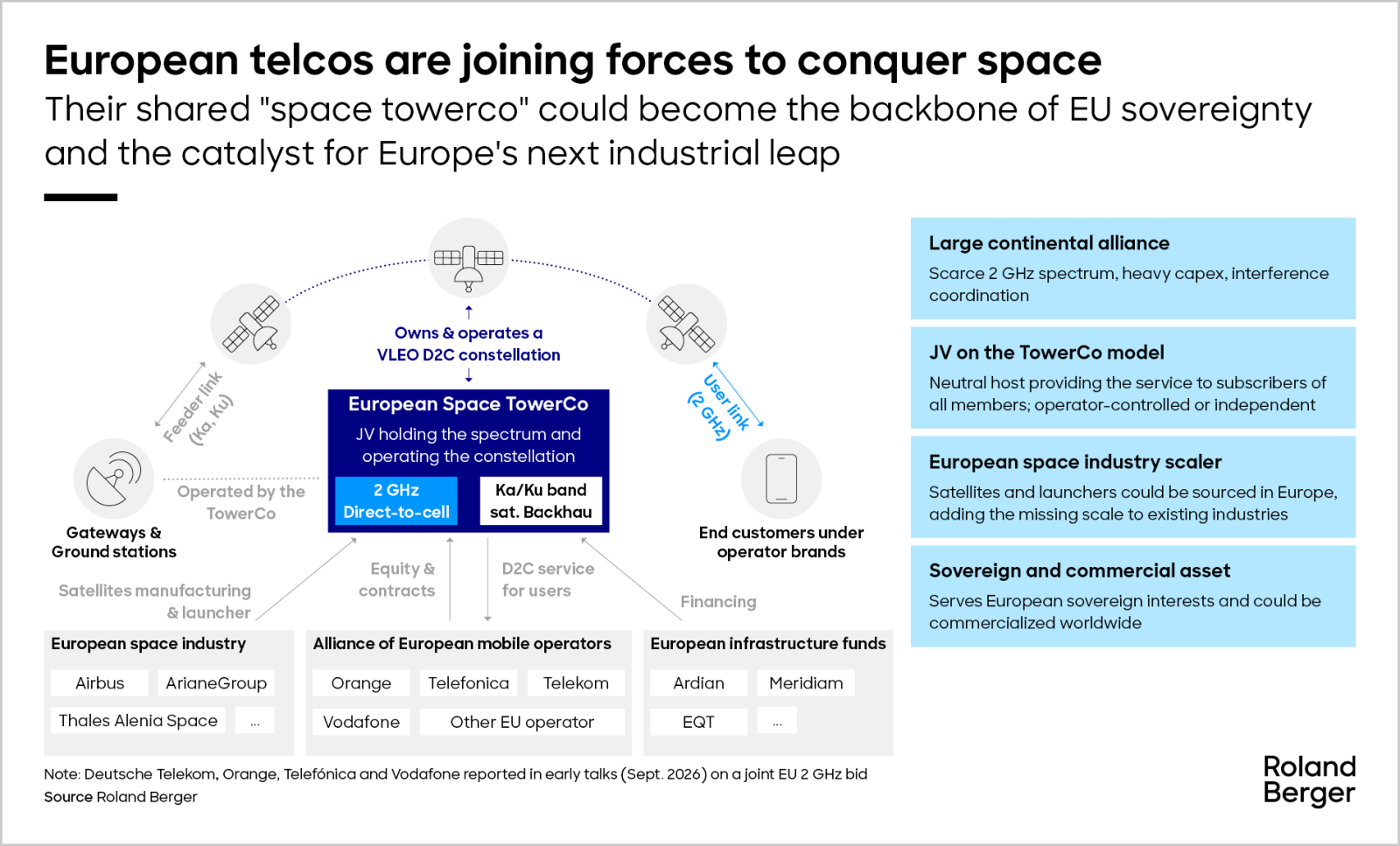
On 19 October 2026, leading European telcos announced a letter of intent to explore a joint bid for European Mobile Satellite Services spectrum. No constellation or technology partner had been selected at that stage, but the direction is clear: European operators do not intend to leave the next generation of D2C entirely to external players.
Beyond securing spectrum, such an alliance could pave the way for a shared European satellite infrastructure, with potential participation from telecom operators, infrastructure investors and the European aerospace industry. While the exact structure remains to be defined, a model similar to a TowerCo could allow operators to pool investments in a common constellation while retaining control over their customer relationships. Beyond addressing European sovereignty ambitions and strengthening the continent's aerospace industry, such an infrastructure could also support the international operations of European telecom groups, many of which have significant footprints in Africa and other regions.
Africa
In Africa, satellites could change coverage economics quickly. Many countries combine large uncovered territories with expensive terrestrial rollout and limited backhaul. Reaching remote households, businesses and public services from orbit offers a compelling proposition.
The commercial equation is harder. ARPU is low in many markets, device affordability is a constraint, and licensing remains country-specific. D2C may first gain traction through operators, government programs and higher-value segments rather than as a stand-alone mass-market offer.
Middle East
The picture varies across the region. Gulf markets typically have strong incumbents and high network coverage, while other markets face wider connectivity gaps and thinner terrestrial infrastructure.
Beyond commercial factors, governments will weigh national security, data sovereignty, resilience and control of critical infrastructure. These considerations may favor partnerships with local operators or regionally aligned satellite providers.
Three strategic choices for operators
This convergence works in both directions. While satellite-native players are adding terrestrial capabilities to compete in mobile, traditional MNOs are integrating satellite connectivity into their own networks. Both are moving towards hybrid networks, but from different starting points. Satellite players bring geographic coverage; MNOs retain the advantage of urban capacity, customer relationships and distribution. The question is how each will combine these assets into a competitive mobile proposition.
Mobile operators should weigh three broad responses.
- Partner
Partnerships can deliver new coverage fast, without financing a constellation. The risk is helping a supplier acquire the scale and market knowledge to become a rival. Commercial agreements should therefore protect customer ownership, pricing, capacity access, data and the freedom to work with more than one partner. - Develop an alternative
Operators can create a differentiated proposition by combining their spectrum, network assets and customer relationships with satellite partnerships. In fragmented markets, regional alliances could make the economics work. Europe’s latest D2C initiative shows that such cooperation is no longer just a theoretical option. The goal need not be owning a complete constellation. It is keeping enough control over the customer proposition and the network architecture. - Protect and reposition the core business
Operators can defend their position through spectrum strategy, network investment and regulatory engagement. Governments must decide the conditions under which satellite and terrestrial players can compete. But regulation may buy time rather than eliminate the competitive threat.
An action agenda for executives
Operators should start by mapping their exposure to satellite-native competition across customer segments and geographies. Seven questions frame the analysis:
- Which coverage gaps are most vulnerable to satellite substitution?
- Which enterprise, government, maritime and aviation customers could satellite providers approach directly?
- Which spectrum holdings may have future strategic value?
- What would partnering, building an alternative or doing nothing cost?
- Which contracts protect customer ownership and data access?
- How quickly could the operator launch an eSIM-based hybrid proposition?
- Which roaming, interconnection and regulatory capabilities create a defensible advantage?
The next phase of telecom competition will not be decided by the number of towers or satellites alone. It will be shaped by control of the complete hybrid network: spectrum, infrastructure, capacity, distribution and customer relationships.
Satellite convergence began as a way to extend mobile coverage. Hybrid mobile convergence turns it into a question of market structure. Operators that treat satellite as a separate product risk losing control of an increasingly integrated service. Those that build it into their core strategy can use it to strengthen coverage, win new segments and keep their place in the customer relationship.
FAQ
Sign up for our newsletter
Further readings


