


Fintech is transforming banking with AI, blockchain and digital-first solutions. Discover how banks can harness fintech partnerships to drive growth, cut costs and stay competitive in a rapidly evolving financial ecosystem.

Blockchain for banks: Is the financial system ready for an upgrade?
The past fifty years has been spent digitizing the front of the bank. It's now time we digitized the back.
Banks present a seamless, digital front end, yet the infrastructure that settles money behind the scenes remains anchored in decades‑old architectures. Transactions may appear instant to customers, but batch reconciliation, operating‑hour constraints and fragmented ledgers continue to slow settlement and tie up capital. As real‑time expectations rise and stablecoins gain traction, these structural limitations are becoming increasingly difficult to sustain.

Banking infrastructure under strain
Despite major investment in digital channels, core banking settlement still depends on sequential processing and delayed synchronization. Interbranch and interbank transactions often reconcile only after execution, creating timing mismatches that require elevated liquidity buffers. Cross‑border payments continue to move through correspondent banking chains, stretching settlement from hours into days and reducing transparency.
"The question isn't whether blockchain will reshape banking - it's whether banks will be the ones doing the reshaping, or watching it happen to them."

Similar frictions persist across lending, escrow and trade finance. Loan payments recorded in one system are frequently reflected elsewhere only later, increasing manual effort and operational cost. Escrow and trade finance remain document‑driven, with separate records maintained by buyers, sellers and banks. Across these activities, settlement delay and reconciliation effort are embedded in the operating model rather than arising from isolated weaknesses.
How blockchain reshapes settlement architecture
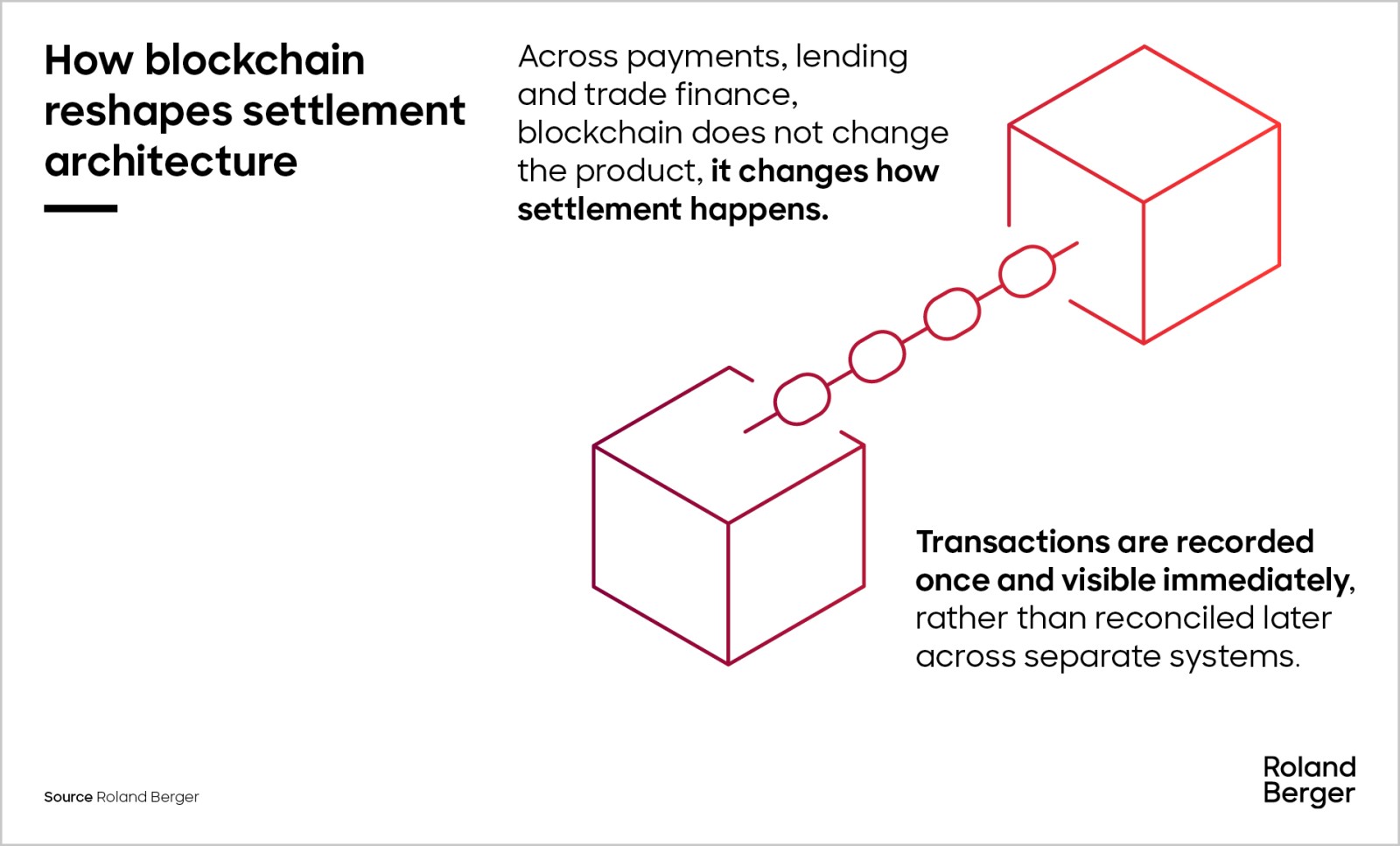
Blockchain technology addresses these constraints at an architectural level. Instead of coordinating multiple independent ledgers, authorized participants operate on a shared ledger that updates in real time. Transactions are recorded once and become immediately visible across the network, removing the need for repeated reconciliation.
Recent advances have made this model viable at banking scale. Improvements in blockchain performance mean transactions can now be executed for fractions of a cent and settled within seconds. This enables production‑grade use cases across interbranch settlement, interbank transfers, cross-border payment, loans, trade finance and escrow without replacing core banking systems wholesale.
Banks are slowly starting to apply this model. Tokenized deposits allow real client balances to move continuously on‑chain within a regulated banking environment. Blockchains can compress interbank settlement from T+1 or T+2 to near real time. In lending, shared ledgers provide a single source of truth for balances and repayments. In trade finance and escrow, smart contracts automate verification and release of funds when predefined conditions are met.
Across these use cases, banking products remain unchanged – but settlement does change. Batch processing gives way to continuous synchronization.
Competitive pressure from stablecoins
The urgency to modernize settlement is reinforced by the rise of stablecoins. Mentions of stablecoins in SEC filings accelerated sharply through 2025, reflecting growing institutional attention. Industry estimates suggest that up to USD 6.6 trillion in bank deposits could be at risk if stablecoin adoption accelerates. Stablecoin‑based transfers can be completed in under a minute and at substantially lower cost than conventional wire transfers.
Tokenized deposits could offer banks a strategic response: delivering blockchain‑based programmability and near‑instant settlement while keeping funds within the regulated banking system and preserving deposit‑based lending capacity.
Turning blockchain into value: A playbook for banks
While pilots have demonstrated technical feasibility, widespread adoption remains limited. The constraint is no longer technology, but institutional execution.
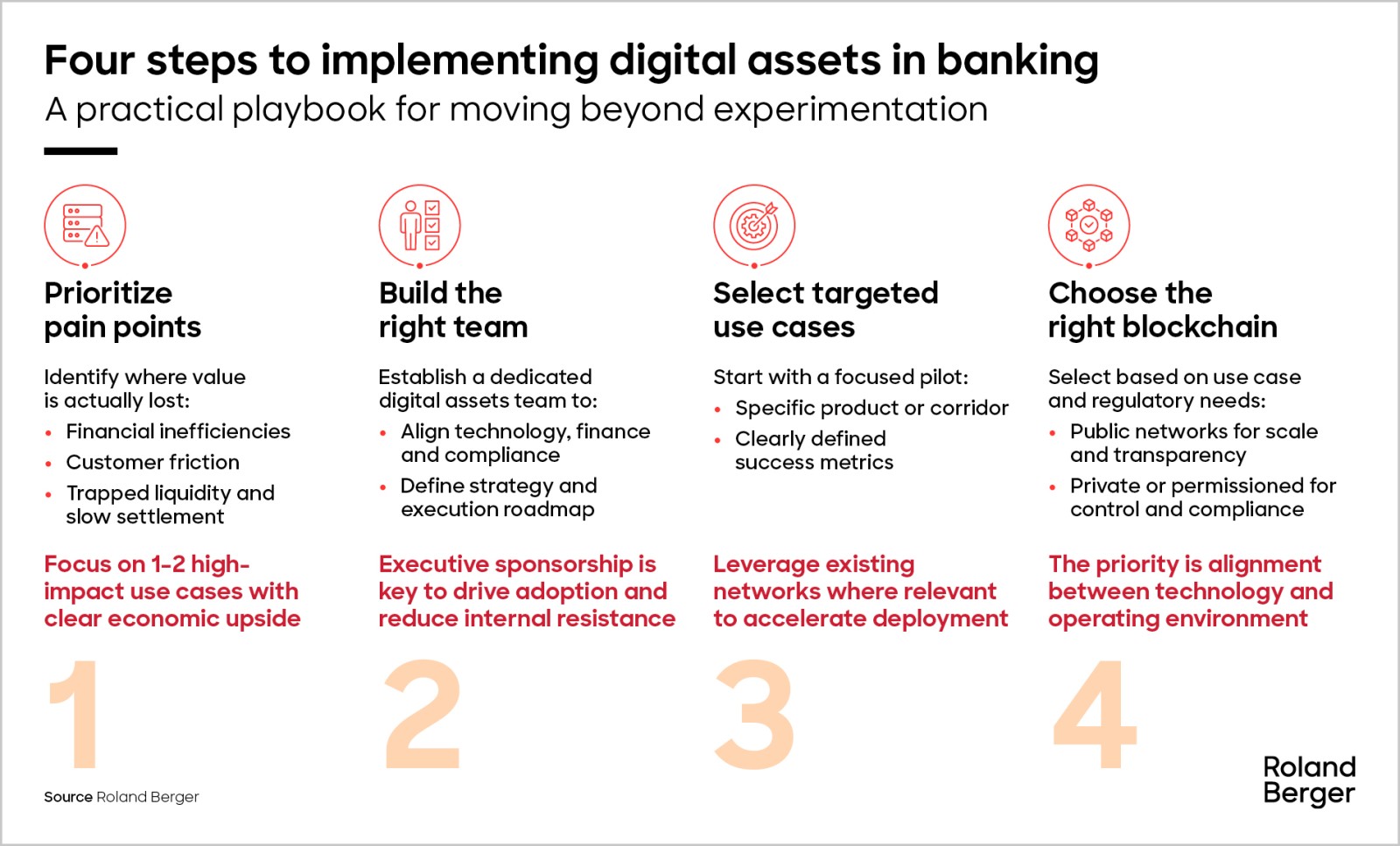
A pragmatic path forward starts with prioritizing high‑impact pain points where settlement friction creates a clear economic cost. Banks should then establish a dedicated digital assets capability with senior sponsorship to bridge technology, finance and compliance. Rather than attempting a full infrastructure overhaul, targeted use cases – such as specific payment corridors or asset classes – allow measurable impact and controlled risk. Blockchain selection should follow regulatory and operational intent, balancing public, private and permissioned architectures, often within a multi‑chain approach.
Conclusion
Blockchain‑based settlement technology is proven, and efficiency gains are measurable. Yet adoption forces banks to confront an uncomfortable trade‑off: parts of today’s system remain profitable precisely because they are inefficient. As neobanks, fintechs and blockchain‑native platforms gain momentum, preserving short‑term float and fee income carries growing strategic risk. Settlement architecture will evolve. The differentiator will be whether banks lead that transition – or are compelled to follow.
Request the full PDF here
Sign up now to access the full study. You will also receive regular news and updates, delivered straight to your inbox.
Further readings


