

As the global automotive industry faces slowing growth, rising costs, and mounting complexity, engineering performance has emerged as a critical driver of profitability and competitive edge.


Mastering variety without the cost: Winning with complexity management
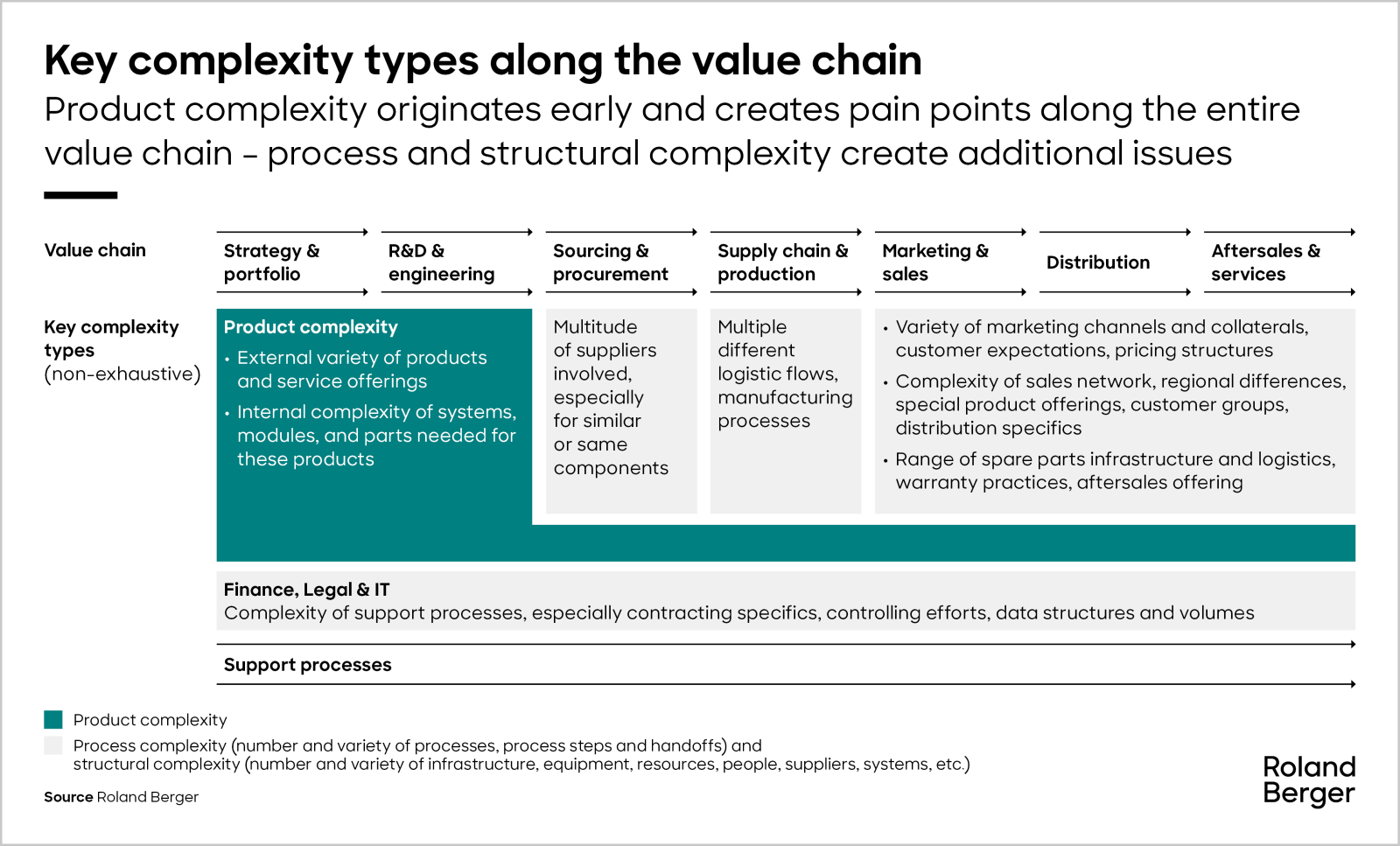
Across industries, companies are grappling with rapidly rising material costs, shifting markets, growing product variety, and increasingly fragmented customer requirements. At the same time, expanding global footprints, acquisitions, technological diversification, and market‑specific variants have created unprecedented internal complexity.
While external variety is often necessary to win in diverse markets, unmanaged internal complexity erodes profitability. It increases engineering workload, drives up procurement and inventory costs, slows down production, and complicates sales, service, and quality management.
When done well, complexity management reduces internal complexity and expands external variety, enabling companies to serve customers better while improving cost, quality, and time‑to‑market.

Why complexity management matters now
Executives often underestimate how far complexity travels. Low‑volume, unique variants force engineering teams to maintain redundant drawings, increase testing and qualification scope, and split precious capacity across niche requests. Procurement must place small orders at fragmented suppliers; logistics holds more part inventory; manufacturing suffers from changeovers, efficiency losses, and quality variation; service and training become harder.
"Companies that take a structured approach to reducing, managing, designing, and planning complexity build the agility required to compete in dynamic global markets."

By systematically applying complexity management, companies eliminate this cumulative drag and unlock scale where it matters most. The effect compounds: product/module/component rationalization reduces R&D load and testing cycles; standardization increases purchasing leverage; modularization increases reusability and decouples innovation cycles; and late‑stage configuration protects external variety without burdening upstream processes.
A common concern is that simplification will limit growth. In practice, the opposite occurs when variety is moved to the right point in the value chain. After consolidating products and aligning on common and carry‑over parts, companies can modularize around clearly defined functional clusters with standardized interfaces. This enables the organization to separate technology roadmaps. For example, upgrading a compute module without touching the base board, and to reusing modules across business units and regions. With late‑stage customization (e.g., market‑specific add‑ons, labeling, or software configuration), businesses maintain or even grow the addressable portfolio while keeping internal complexity low.
A four-level approach to complexity management
In transformation programs, four mutually reinforcing levels are required to build transparency, enable fast savings, and create long-term modular flexibility.
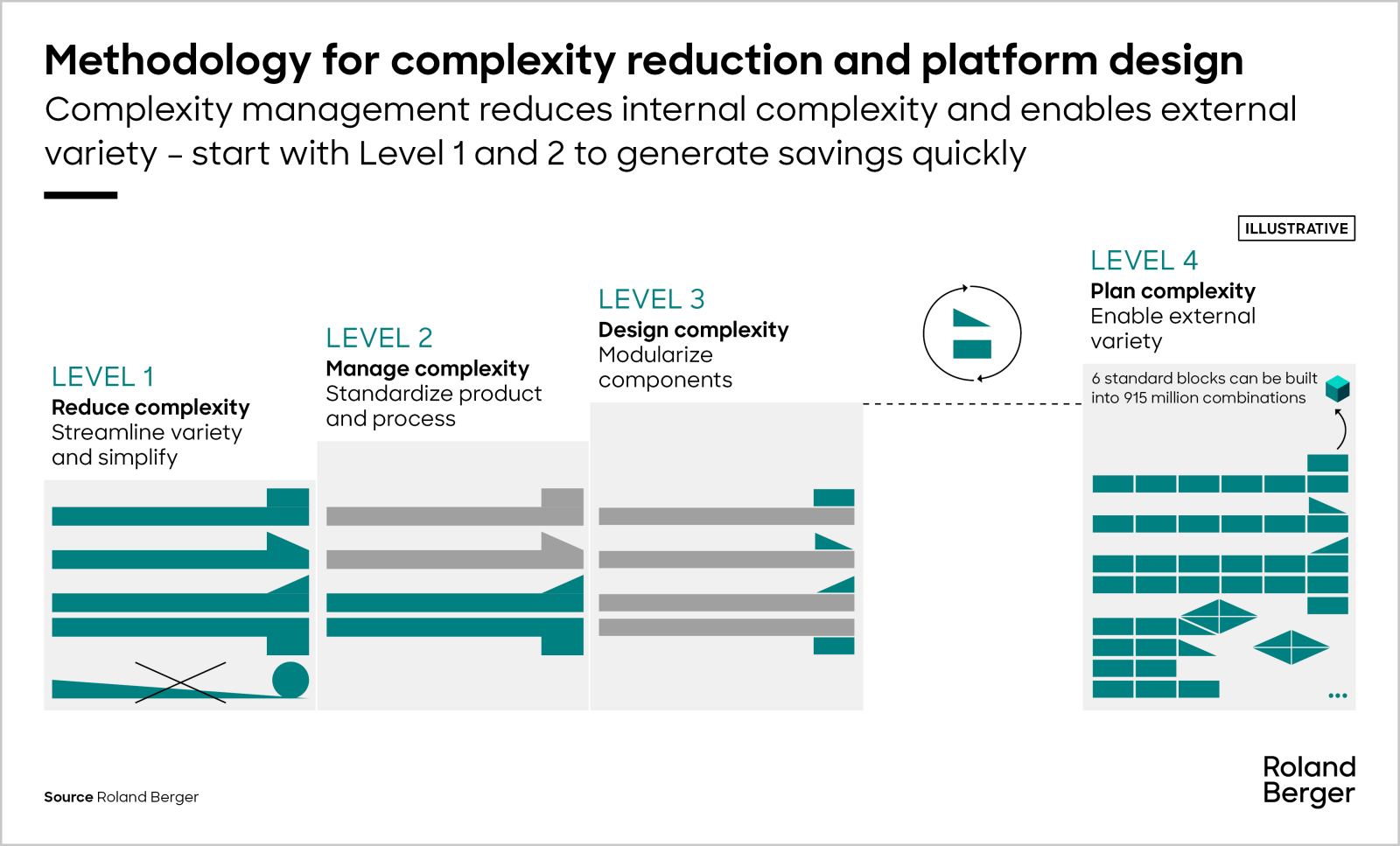
Level 1 – Reduce complexity: Streamline variety & simplify
The first step is to create transparency and clean up the portfolio:
- Cluster products into manageable groups
- Categorize variants based on features, performance, sales volume, and contribution margin
- Identify “long‑tail” products that add minimal value but high cost
- Eliminate legacy products and redundant variants
Case studies show immediate EBITDA improvement by phasing out loss‑making products and rationalizing options.
Level 2 – Manage complexity: Standardize products & processes
Once reduced, complexity must remain controlled:
- Re‑use common parts across products
- Introduce carry‑over components across generations
- Limit “allowed” variant choices to prevent new proliferation
- Rationalize part numbers and consolidate suppliers
- Enable economies of scale with higher purchasing volumes
In one client example, Roland Berger helped reduce unique product count by 45% and cut the number of module variants across major components without reducing revenue.
Level 3 – Design complexity: Modularize for flexibility
Modular product architecture unlocks long‑term efficiency:
- Define building blocks based on functional clusters
- Standardize interfaces
- Apply module drivers (variance, production, quality, after sales, technology evolution)
- Enable independent testing and lifecycle management of modules
- Integrate software‑defined variety
Modularization increases re‑use and allows companies to separate technology roadmaps, accelerating innovation and time-to-market while reducing cost.
Level 4 – Plan complexity: Enable external variety
Once modular systems exist, companies can expand external differentiation without adding internal complexity:
- Variation through configuration, not new unique products
- Late‑stage customization (e.g., regional options, add‑ons)
- Clear segmentation and catalog-based options
- Kitting for market‑specific needs
- Re‑using global modules for New Product Development
This approach helps companies serve diverse markets efficiently while maintaining a lean internal structure.
Governance that sustains results
Operating models must evolve alongside the product architecture. We typically recommend two pivotal roles:
1. Module owners manage a module’s lifecycle, technology roadmap, interfaces, and supplier strategy, ensuring carry‑over and reuse across business units.
2. System owners integrate modules into coherent systems, maintain system roadmaps, and translate system requirements into module requirements.
Clear governance, e.g. by a central Module Management Group responsible for the Module Master Lists, prevents “variant creep”, aligns investments with strategic platforms, and keeps accountability transparent across engineering, procurement, manufacturing, and service.
"Complexity management reduces internal complexity and enables external variety."

The benefits: End-to-end impact across the value chain
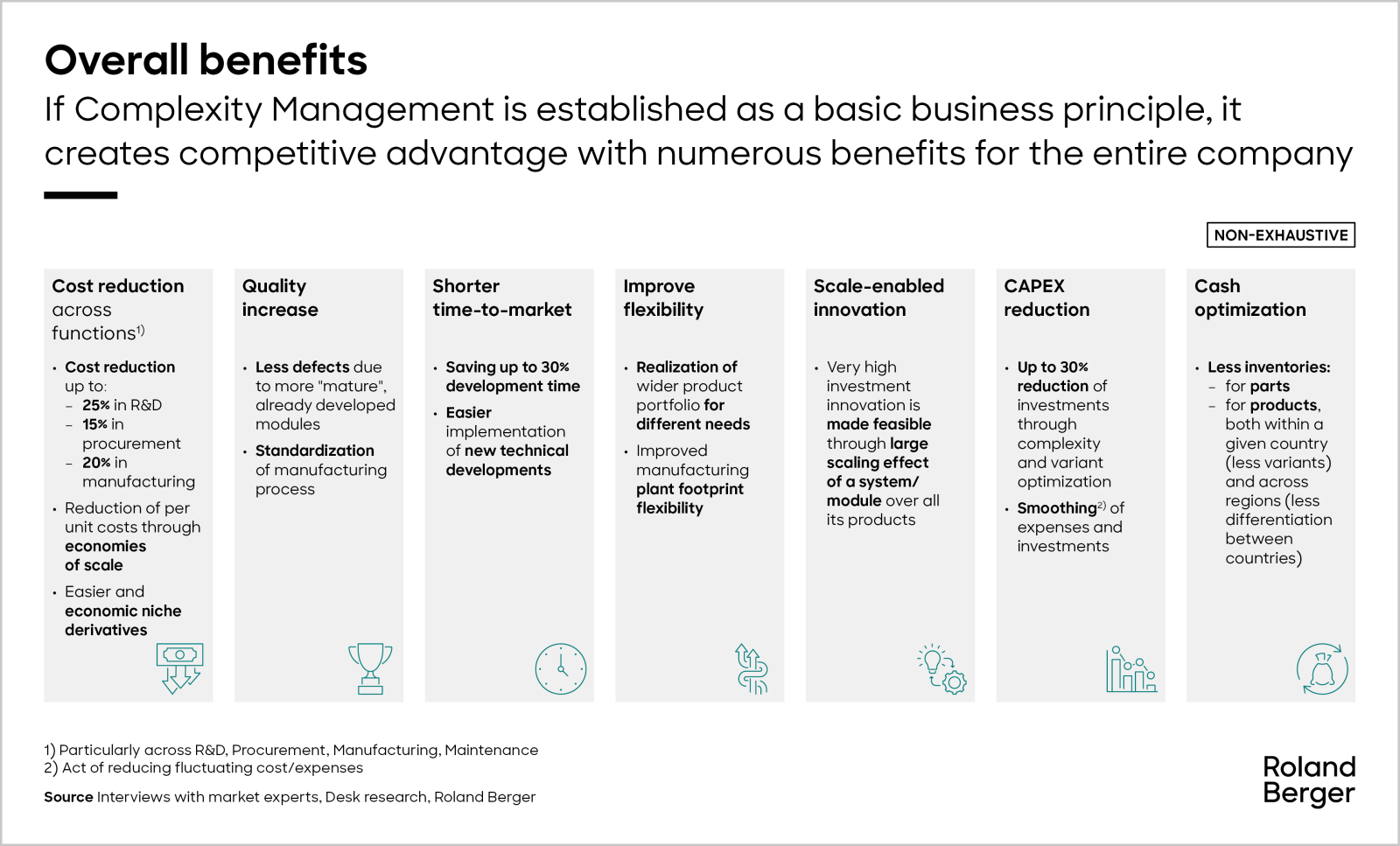
When complexity management becomes a basic business principle, the impact is felt across the P&L and the product pipeline. Companies report fewer defects thanks to mature, reused modules; lower inventory from fewer unique parts and clearer planning; and stronger pricing discipline because the offer structure is simpler and better segmented. Crucially, modular product architectures enable scale‑powered innovation: next‑generation technologies become economically feasible when amortized across a broad portfolio of systems and products.
How to get started — fast
Leadership teams that move quickly follow a repeatable path. They begin with a fact‑based baseline of the portfolio, products, and modules, including a commercial view on contribution margin by item. They run cross‑functional design‑to‑value workshops and product teardowns to surface immediate rationalization actions and to identify standardization targets. In parallel, they pilot module definitions on a priority product line, establish “allowed variant” guardrails in the product development process, and stand up a global Module Master List and parts library. Finally, they appoint Complexity Management Champions, name Module owners and System owners, and roll out the approach across regions and product lines with a structured learning journey and governance cadence. This is how results persist beyond the first savings wave and become a durable competitive advantage.
Roland Berger offers deep experience across industries – automotive , industrials, machinery, and more. Our approach integrates holistic value-chain perspective, proven tools and analytics (complexity mapping, modularity screening, machine-learning-based clustering), cross‑functional workshops with teardowns, governance models for platform management, and capability building to create lasting adoption.
Further readings


Sign up for our newsletter


