

As the US and China become less reliable partners, Europe must rethink its trade strategy to secure lasting prosperity.


Ten years after the Brexit vote
By David Born
What's next for the UK economy?
Ten years after the Brexit referendum, the UK faces a more challenging economic environment than most forecasts anticipated in 2016. GDP growth has slowed, goods exports to the EU remain well below pre-referendum levels, and a persistent productivity gap relative to the US and major EU economies continues to widen. Fiscal savings from leaving the EU have not offset these broader costs.
Public opinion has shifted considerably. Support for Brexit now stands at its lowest point since the vote, as the gap between promised benefits – on trade, migration and deregulation – and delivered outcomes has become more apparent.
In this analysis, we examine the full ten-year economic record: what the data shows, where the pressures are most acute, and what the strategic choices ahead look like for the UK.

Britain's new prime minister, Andy Burnham, takes office against a challenging economic backdrop. The UK continues to trail both the US and much of the EU across several key indicators. Productivity growth remains subdued, economic expansion has slowed, foreign direct investment has weakened, and rising interest rates have increased the cost of servicing public debt. While not all of these challenges stem from Brexit, the UK's departure from the EU continues to weigh on economic performance.
A decade after the Brexit referendum, public opinion over it has shifted markedly. Recent YouGov surveys indicate that support for Brexit has fallen to around 30%, the lowest level since the vote. Demographics are part of the explanation. An estimated 3.2 million "Leave" voters have died since 2016, while younger and generally more pro-European voters have entered the electorate. At the same time, the economic consequences of Brexit have become more apparent. Nearly three in ten "Leave" voters – around four million people – now say they would vote differently if another referendum were held.
Economic data underpins these considerations. Official estimates by the UK's Office for National Statistics (ONS) suggest that UK GDP per capita could be up to 8% higher had Britain remained in the EU. Since the referendum, annual GDP growth has slowed from roughly 1.5% p.a. to about 0.9% p.a., leaving the UK's growth below the current EU average growth rate. Household consumption has weakened in particular, with its contribution to average GDP growth falling from 1.1 percentage points before Brexit to just 0.3 percentage points today.
The UK's export performance tells its own story. Goods exports to the EU remain well below pre-Brexit levels in real terms – down around 14% compared with 2019. What complicates the standard Brexit narrative, however, is that exports to the rest of the world have not simply filled the gap. After an initial and partly Covid-19-related catch-up in 2021–22, growth in non-EU exports also stalled, and volumes to markets outside the EU have been broadly flat to declining since 2022 – even as the UK signed new trade agreements meant to offset the loss of frictionless EU access. The pressure on UK exporters, in other words, looks less like a story of EU-specific frictions being offset elsewhere and more like a broader loss of competitiveness across export markets as a whole.
The UK's trade agreement with the EU preserved tariff-free trade for most goods. It did not, however, eliminate non-tariff barriers. Exporters now face customs declarations, rules-of-origin requirements and a range of additional administrative procedures. For an economy that still sends almost half of its goods exports to the EU, these frictions have raised costs and reduced competitiveness.
The depreciation of sterling has done little to offset these effects. Following the referendum, the pound recorded its sharpest one-day fall since 1971, declining 8% against the US dollar and 6% against the euro. It has yet to return to its pre-referendum level. Ordinarily, a weaker currency would be expected to support exports. The limited response suggests that higher trading costs and supply chain disruptions have outweighed any gains in currency devaluation.
The service industry presents a more positive picture. UK service exports have expanded strongly since Brexit, reflecting the country's longstanding comparative advantage in sectors where cross-border trade faces fewer barriers. According to the ONS, telecommunication and intellectual property exports more than doubled since 2022. That growth appears to reflect the continued expansion of the global services economy rather than any direct benefit from Brexit.
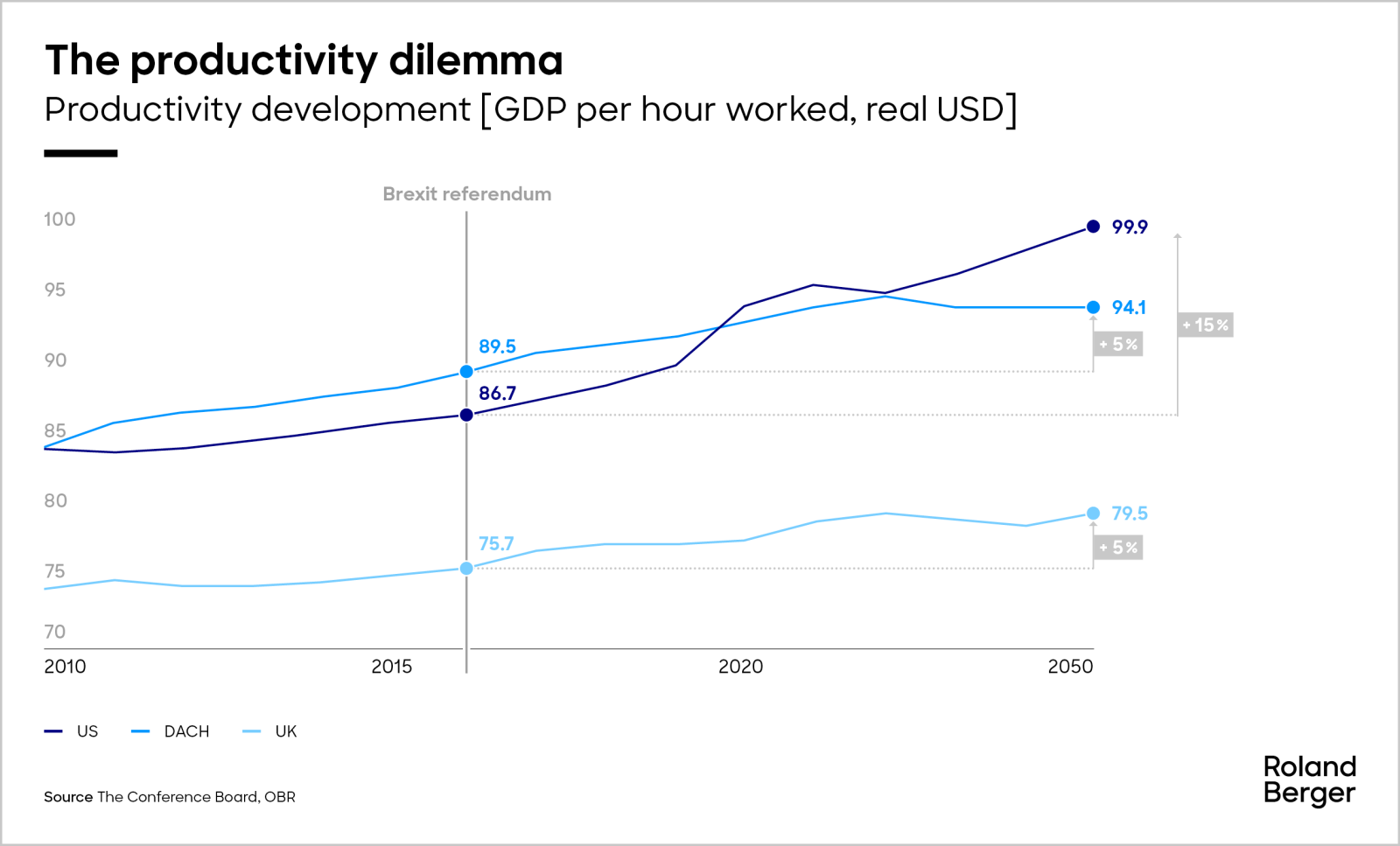
Productivity remains a more persistent concern. The UK continues to underperform both the EU average and, more significantly, the US, where productivity growth has remained substantially stronger. In 2025, an hour worked generated almost USD 100 of output in the US, compared with around USD 94 in the DACH economies and USD 79.50 in the UK. The Office for Budget Responsibility (OBR) estimates that Brexit will reduce long-run UK productivity by around 4%, largely because lower trade intensity limits competition, investment and the diffusion of new technologies.
Brexit's economic balance sheet
The shift in public opinion reflects a broader reassessment of Brexit's economic record. Excluding savings of an estimated GBP 9–11 billion a year in net contributions to the EU budget, the economic costs have outweighed the direct fiscal benefits.
The loss of frictionless access to the EU Single Market remains the most significant factor. Other promised gains have also proved elusive. Reducing immigration was a central objective of the "Leave" campaign, yet net migration has increased sharply since Brexit, reaching a record 944,000 in 2023. New trade agreements with partners including the CPTPP, Australia and New Zealand have so far generated only relatively modest economic gains. Likewise, the anticipated wave of post-Brexit deregulation has yet to materialize.
Ten years on, the referendum's economic legacy is only part of the picture. The vote exposed and then deepened fault lines running through British society – between town and city, young and old, university graduates and workers – that successive governments have struggled, and largely failed, to bridge. The instability at the top of Downing Street tells its own story: not one of the five prime ministers since David Cameron's referendum-triggered resignation has managed to serve out a full term, a churn without precedent in modern British politics. Andy Burnham now inherits that fractured environment, along with a sluggish economy, stretched public budgets and a foreign policy inbox complicated by an unpredictable Washington and a more assertive Russia. Whether he proves any more capable than his predecessors of drawing the country back together – and of steering it through the challenges of his own era – will do much to determine whether Britain's post-Brexit decade of turbulence gives way to something calmer.
Sign up for our newsletter
Further readings


