

AI is redrawing the banking market. Explore four strategic options for banks in the AI-driven financial ecosystem of 2030.


The machine customer
What agentic commerce means for European banks
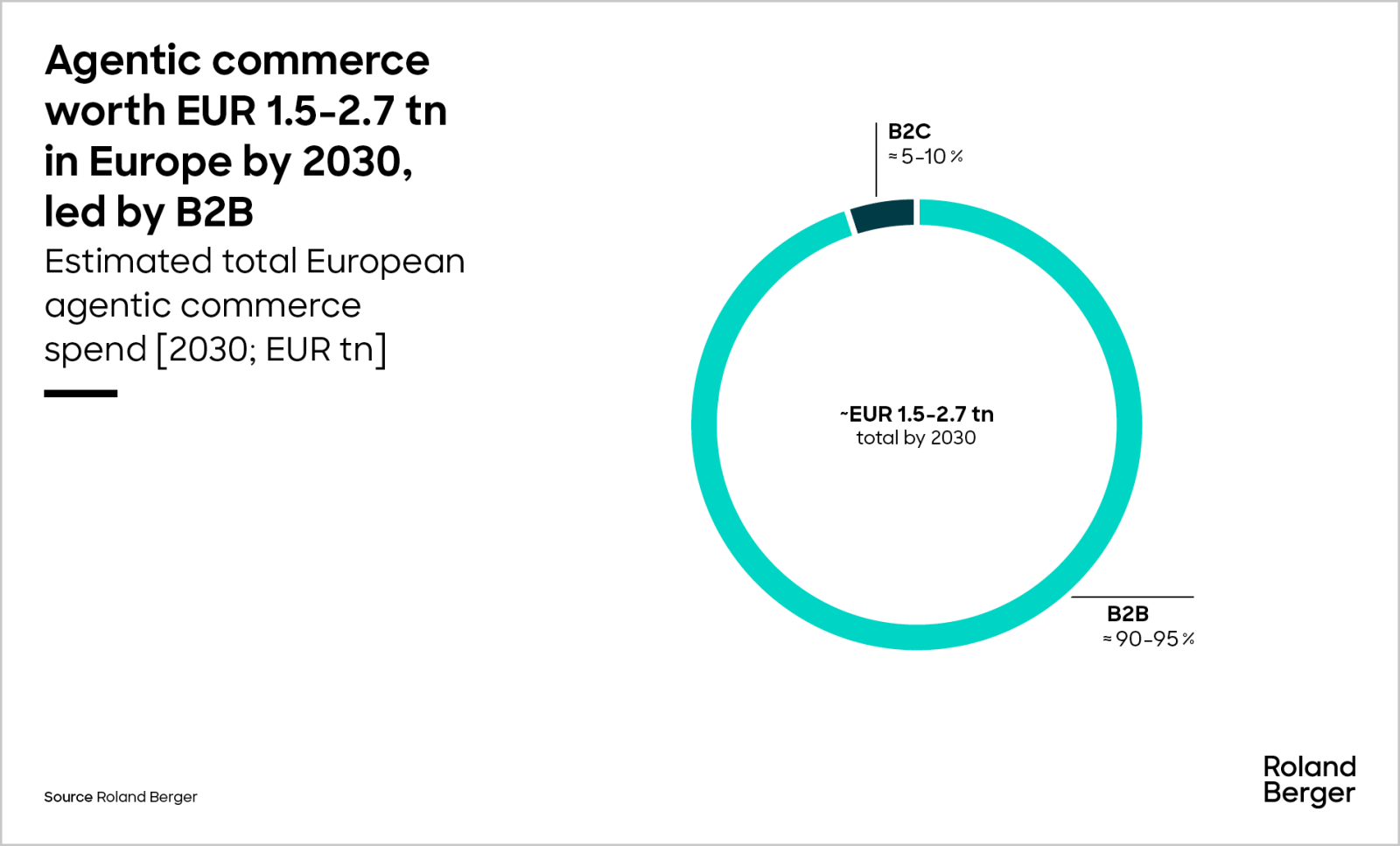
Agentic commerce is moving rapidly from concept to commercial reality. Adoption is expected to be strongest in business-to-business (B2B) activity, with agent-mediated buying forecast to become a significant share of B2B commerce by 2028. We estimate that total European agent-mediated volume could reach EUR 1.5–2.7 trillion by 2030, with more than 90 percent of that volume stemming from B2B. In this article, we present our view of market development and the potential of agentic commerce in Europe, along with the opportunities this creates for banks agentic commerce in Europe, along with the opportunities this creates for banks and how to capitalize on them, but also the risks of being a late mover. Finally, we explain our approach to how banks can get started with agentic commerce.
Key insights from this study:
• Agentic commerce is scaling fast, with B2B moving first: 60-90 percent of B2B buying globally is expected to be agent-mediated by 2028
• For banks, B2B represents the largest opportunity, with an estimated revenue pool of EUR 2.0-3.7 billion per year by 2030 across financing, trade-finance automation, machine-to-machine (M2M) payments and verified data services
• In B2C, agentic commerce is expected to represent 10-20% of European e-commerce by 2030
• In B2C, embedded lending and subscription-management tools offer the biggest opportunities. The total revenue pool is estimated at EUR 0.7-1.7 billion by 2030
• The next 12-18 months will be critical for shaping standards and liability rules and securing banks’ future role in agentic commerce
• Banks should focus on five priorities: ensure agentic readiness, rebuild the customer experience for real-time control, modernize the technology stack, negotiate liability rules and checkout placement and build the controls and evidence trail regulators will require
Agentic commerce moves into the mainstream
Agentic commerce is moving rapidly from concept to commercial reality. We estimate that total European B2B and B2C agent-mediated volume could reach EUR 1.5-2.7 trillion by 2030, with around 95 percent stemming from B2B. Globally, 60-90 percent of B2B buying is expected to be agent-mediated by 2028. B2C adoption will develop at a more measured pace, reaching an estimated 10-20% of European e-commerce by 2030.
But the shift is not simply about scale. Agentic commerce will develop through different stages, moving from AI-assisted discovery toward mandate-based delegation and ultimately autonomous commerce. Live agentic payments are already showing how quickly the technology is moving from experimentation into real-world transactions.
"Being connected is not enough: banks need to make sure they are actually chosen at checkout."

The opportunity differs sharply by segment
For banks, that shift translates into very different opportunities in B2B and B2C. B2B represents by far the larger near-term opportunity, with an estimated revenue pool of EUR 2.0-3.7 billion a year by 2030, spanning invoice and supply-chain financing, trade-finance automation, machine-to-machine (M2M) payments and verified operational data. In B2C, the corresponding revenue pool could reach EUR 0.7-1.7 billion, led by embedded lending and subscription-management tools.
The opportunity comes with a strategic risk, however. Payment networks and technology platforms are already building infrastructure and setting standards, while banks are beginning to move as well. Institutions that act too slowly risk losing transaction revenue and customer access – and being pushed toward a purely back-end infrastructure role.
Five priorities for banks
That makes timing critical: the next 12-18 months will be crucial as standards and liability rules take shape. Banks are not starting from zero, but they need to move now. We see five priorities:
- Ensure agentic readiness by making existing products fit for agent-initiated transactions
- Rebuild the customer experience for real-time control around mandates, exceptions and visibility
- Modernize the technology stack and integrate early with emerging standards and agent platforms
- Negotiate liability rules and checkout placement so bank products are not merely connected but actually chosen
- Build the controls and evidence trail regulators will require as more transactions move outside the bank’s own interface
Download the full article to explore how agentic commerce is likely to develop in Europe and what banks need to do now to capture the opportunity and secure their role in the emerging market.
Download the full study
Further readings


Request the full PDF here
Sign up now to access the full study. You will also receive regular news and updates, delivered straight to your inbox.


