

Residential property management is emerging as a highly attractive investment opportunity, driven by resilient recurring revenues, extreme market fragmentation, and significant opportunities for operational transformation. Private equity investors are increasingly capitalizing on this untapped sector through buy-and-build strategies and technology-enabled value creation.


The second PE cycle in express car wash: More disciplined, more investable
By Neury Freitas and Sean Stephens
The return of private equity to express car wash
How subscriptions, technology, and consolidation are reshaping one of private equity's most durable recurring-revenue platforms in consumer services.
Key insights from this article
The express car wash industry has entered a more attractive second PE cycle, with lower valuations and a greater focus on disciplined growth and operational excellence.
Unlimited membership programs have transformed the business into a recurring-revenue model, driving stronger customer retention, predictable cash flows, and higher lifetime value.
The next wave of value creation will come from operational improvements, including technology adoption, data-driven decision making, membership optimization, and cost efficiencies.
Geographic density is becoming a key competitive advantage, as operators build strong regional networks that improve efficiency, customer convenience, and acquisition opportunities.
The first PE cycle created today's opportunity
The US express car wash industry is not a new discovery for private equity. Over the last decade, investors helped transform a fragmented local-service business into a scalable recurring-revenue platform. Between 2019 and 2022, abundant capital, aggressive development, and consolidation drove valuations to unprecedented levels. At the same time, operators raced to add locations, creating oversupply in certain markets and exposing highly leveraged business models as interest rates increased. The result was a market correction that reset valuations, slowed transaction activity, and created a more disciplined investment environment. For investors, that reset has created a more attractive entry point than existed during the peak of the last cycle.
While the US remains the world's largest and most developed express conveyor market, professional car wash adoption continues to expand across Europe. The growing presence of conveyor-based formats in Germany, the UK, and other European markets highlights the broader global shift toward professional vehicle care, recurring membership models, and operationally scalable wash formats.

Why investors continue to favor express conveyor car wash
Despite the correction, the core investment thesis remains intact. The express exterior conveyor format has emerged as the industry's preferred operating model because it combines high throughput, low labor intensity, and scalable unit economics. Unlike self-service or in-bay formats, express conveyor locations are designed to process large vehicle volumes while maintaining operational consistency and attractive margins. Importantly, the format supports membership enrollment at the point of sale, making it the foundation for recurring revenue growth. As a result, the top-50 car wash operators in the US are almost exclusively conveyor washes (most are express only) and about half are PE -backed. In fact the largest player, Mister Car Wash, was recently taken private by Leonard Green & Partners who first invested in the platform in 2014 before taking it public in 2021.

"The express car wash sector has evolved beyond a simple roll-up opportunity. Future value creation will come from operators that combine subscription economics, technology-enabled operations, and disciplined expansion strategies."

Subscriptions transformed the economics of the industry
The rise of unlimited monthly memberships fundamentally changed car wash economics. Historically, operators relied on weather-driven transactions and infrequent customer visits. Today, leading platforms generate a majority of revenue from subscription programs. Mature operators can derive as much as two-thirds of revenue from members, creating predictable cash flow and stronger customer retention (Mister reported 74% of total sales from subscription in 2024). Memberships also increase lifetime value, with members visiting more frequently and generating multiple times the annual revenue of non-members. According to a 2025 report from Rinsed (a leading carwash CRM platform), members generated 315% more value than retail customers over a 36-month period.
Layered on top of the membership model is a good-better-best pricing strategy that encourages customers to move into premium packages with higher-margin services such as ceramic coatings, paint protection, and wheel treatments. As a result, many operators are generating growth not only through new locations but also through deeper monetization of existing customers.
The next chapter of value creation will be won operationally
The first phase of consolidation focused on acquiring assets and building scale. As the market matures, value creation is increasingly driven by operational excellence and the ability to extract synergies from expanded platforms. Leading operators are achieving superior performance through equipment standardization, technology enablement, membership optimization, professionalized operating models, and data-driven performance management Together, these levers improve profitability, increase retention, and create more scalable operating platforms.
Equipment standardization reduces maintenance complexity and improves purchasing power. Membership optimization increases recurring revenue and customer lifetime value. Professionalized marketing and talent-development programs create capabilities that independent operators often struggle to replicate. The result is a shift away from financial engineering toward sustainable operational improvement.

"The next phase of value creation in automotive aftermarket services will come from operators that can translate scale into stronger customer retention, recurring revenue, and operational efficiency."

Technology is evolving from table stakes to differentiation
Technology adoption in car wash has entered a new phase. Capabilities such as license plate recognition, cloud-based point-of-sale systems, and digital payment infrastructure have become standard expectations rather than differentiators. Competitive advantage increasingly comes from how operators harvest and use data. Customer-facing applications, including predictive churn analytics, customer segmentation, and personalized promotions, help drive retention and revenue growth, while operational applications such as AI-enabled workforce management, equipment optimization, and predictive maintenance improve uptime and efficiency.
This shift was evident at the International Carwash Association's (ICA) annual convention, The Car Wash Show 2026 in Nashville, where AI-driven analytics, predictive maintenance, membership optimization, and customer-retention technologies were among the industry's most discussed topics.
The industry's international nature was also reflected in the event's Hall of Fame induction of Richard Enning, Chairman and CEO of Germany's Mr. Wash AG, one of Europe's largest professional car wash operators. The recognition highlights the increasing exchange of operational best practices and technology adoption across North American and European markets.
Geographic density remains the most overlooked value driver
While scale and operational excellence matter, geography matters more. Analysis of the largest operators suggests that successful platforms pursue density before breadth, building regional clusters that benefit from shared marketing, operational oversight, maintenance support, and membership portability. The strongest operators create regional dominance before expanding nationally.
The South/Southeast deserves particular attention. The region has become one of the most active areas for development, consolidation, and competition. A zoomed-in Southeast view is more informative than a national map because it clearly illustrates concentration patterns, overlap between major operators, and remaining whitespace opportunities. However, the lessons of the 2021-2023 expansion cycle remain important: density creates value only when supported by disciplined site selection and thoughtful trade-area planning.
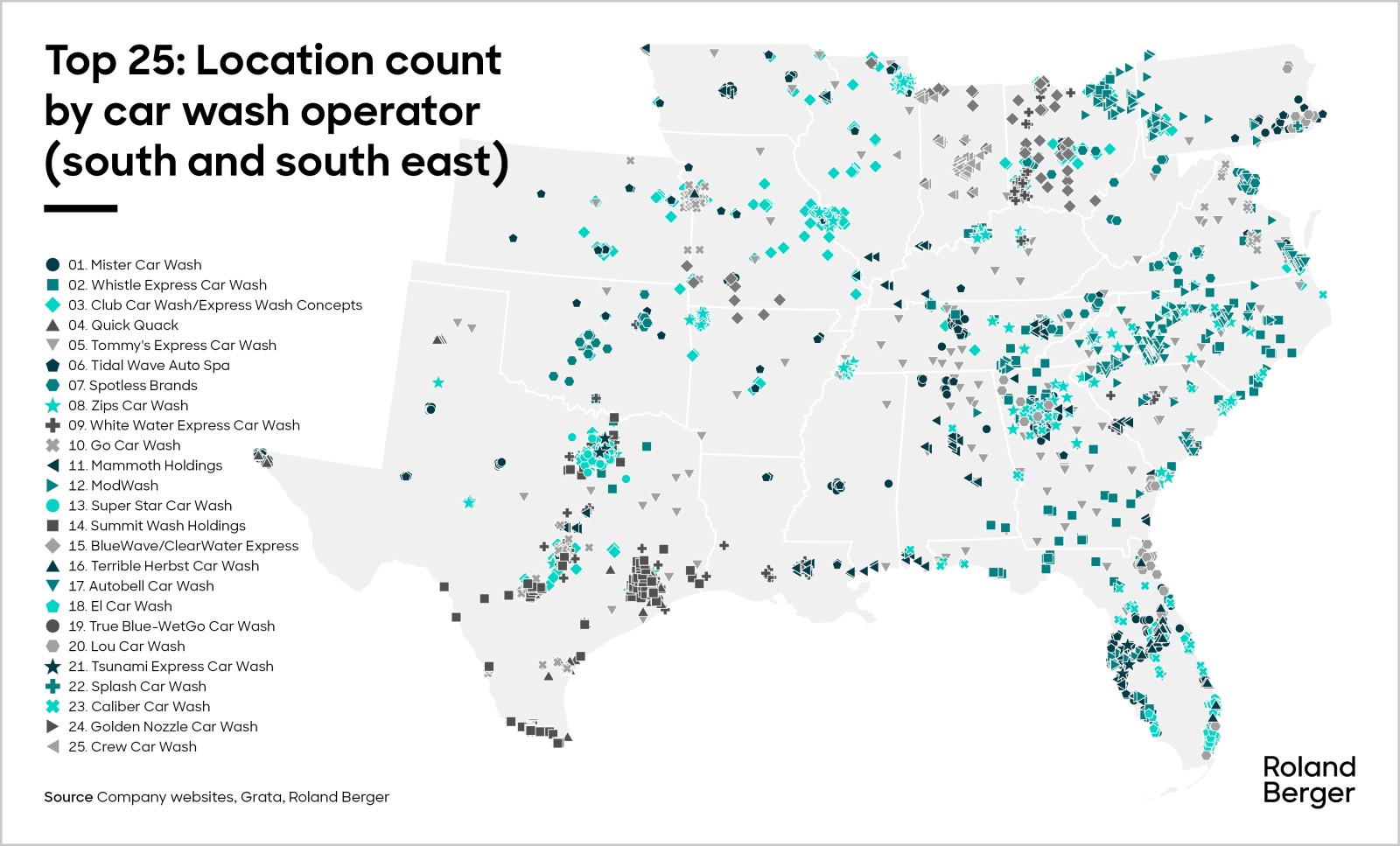
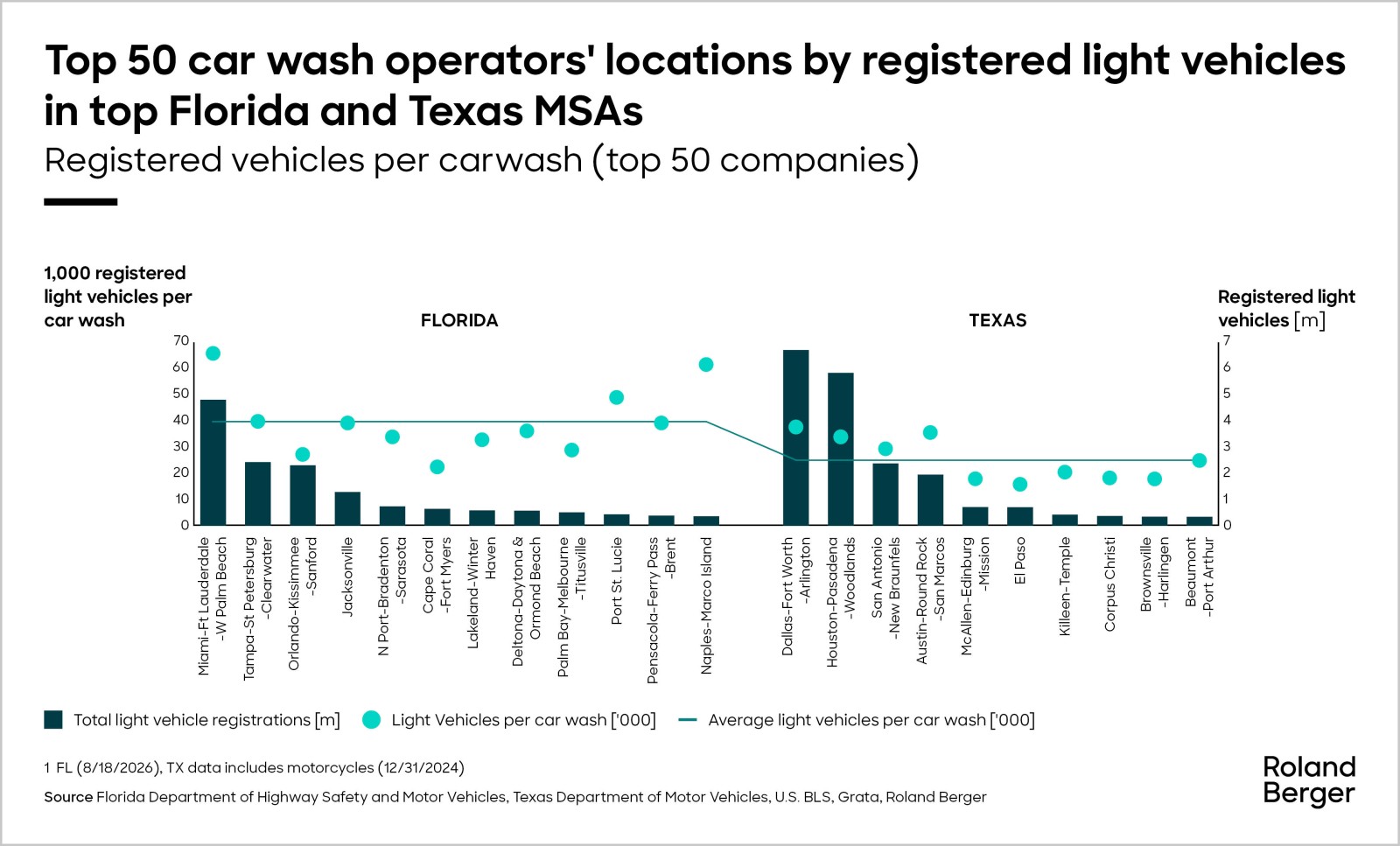
The Florida and Texas analysis highlights how consolidation in the car wash industry is increasingly being driven by geographic density rather than national expansion. Many of the industry's largest operators have concentrated their footprints in a relatively small number of metropolitan areas, creating localized networks that improve membership value, brand visibility, and operating efficiency.
The concentration of Top-50 operators in major markets also reflect the ongoing shift from simple site growth toward cluster-based expansion strategies. By increasing density within existing regions, operators can improve marketing efficiency, streamline management oversight, and enhance customer experience through greater membership portability across locations.
At the same time, these markets illustrate the importance of disciplined site selection. While density can create meaningful scale advantages, the industry's expansion cycle between 2021 and 2023 demonstrated that excessive development within a market can pressure same-store sales growth and increase competition for membership customers. As a result, the most successful operators are balancing growth ambitions with careful market planning and trade-area analysis.
The fundamental drivers of demand remain intact
The underlying demand drivers for professional car wash services remains strong. Consumers continue to shift toward convenience-oriented vehicle care, while professional washing remains a relatively affordable service with recurring usage characteristics.
Membership adoption continues to create opportunities for revenue growth, customer retention, and increased lifetime value. While leading operators have achieved significant membership penetration, substantial opportunities remain to grow and optimize subscription programs across many markets.
At the same time, the industry remains highly fragmented despite years of consolidation. Thousands of independent operators continue to represent potential acquisition targets, while many regional markets remain underpenetrated by scaled platforms. Recent transactions also reinforce continued investor conviction in the sector and highlights the enduring appeal of recurring revenue, operational improvement opportunities, and geographically dense networks. Together, these factors suggest that the industry's next phase of value creation is far from complete.
The Roland Berger perspective
The express car wash industry is transitioning from a consolidation story into an operational excellence story. The first PE cycle demonstrated the attractiveness of the asset class. The second cycle will likely reward operators that excel in membership growth, customer retention, technology-enabled decision making, disciplined site selection, and regional density strategies. For investors seeking recurring revenue, fragmented ownership, and multiple pathways to value creation, express conveyor car wash remains one of the most compelling opportunities in automotive services.
Sign up for our newsletter
Register now to receive regular insights into our Transaction & Investor Services topics.
Further readings


_person_320.png?v=1966195)