
Article
Timing the energy transition

Timing the energy transition

December 14, 2025

Why some utilities can act today, while others must prepare for tomorrow’s opportunities

Europe’s utilities are entering a period of intense pressure. The shift toward a cleaner energy system demands heavy investment, and many companies have already poured significant capital into renewables, grids and new technologies. Yet the strain keeps building. Margins are tightening and leverage is rising, which makes the gap between investment needs and financial strength even harder to close. A few players still have the balance-sheet power to push ahead, while others need to pause, regroup and rebuild resilience before reentering the race. We set out to answer the question on every utility operator’s mind: Should I invest now, or wait for later opportunities to emerge?

The transformation of Europe's energy system remains one of the defining challenges for utilities.

Why utilities are struggling to keep pace

Five powerful forces are reshaping the utility sector. Decarbonization is driving interest in hydrogen and storage. Geopolitical tension is unsettling supply chains and raising the cost of securing reliable generation. Advances in AI (artificial intelligence) are changing how processes run and how services are delivered. Demand is shifting as electrification grows and data centers expand. And market fragmentation is bringing new competitors and digital models. Together, these forces are driving the sector to transform – with increasing urgency.

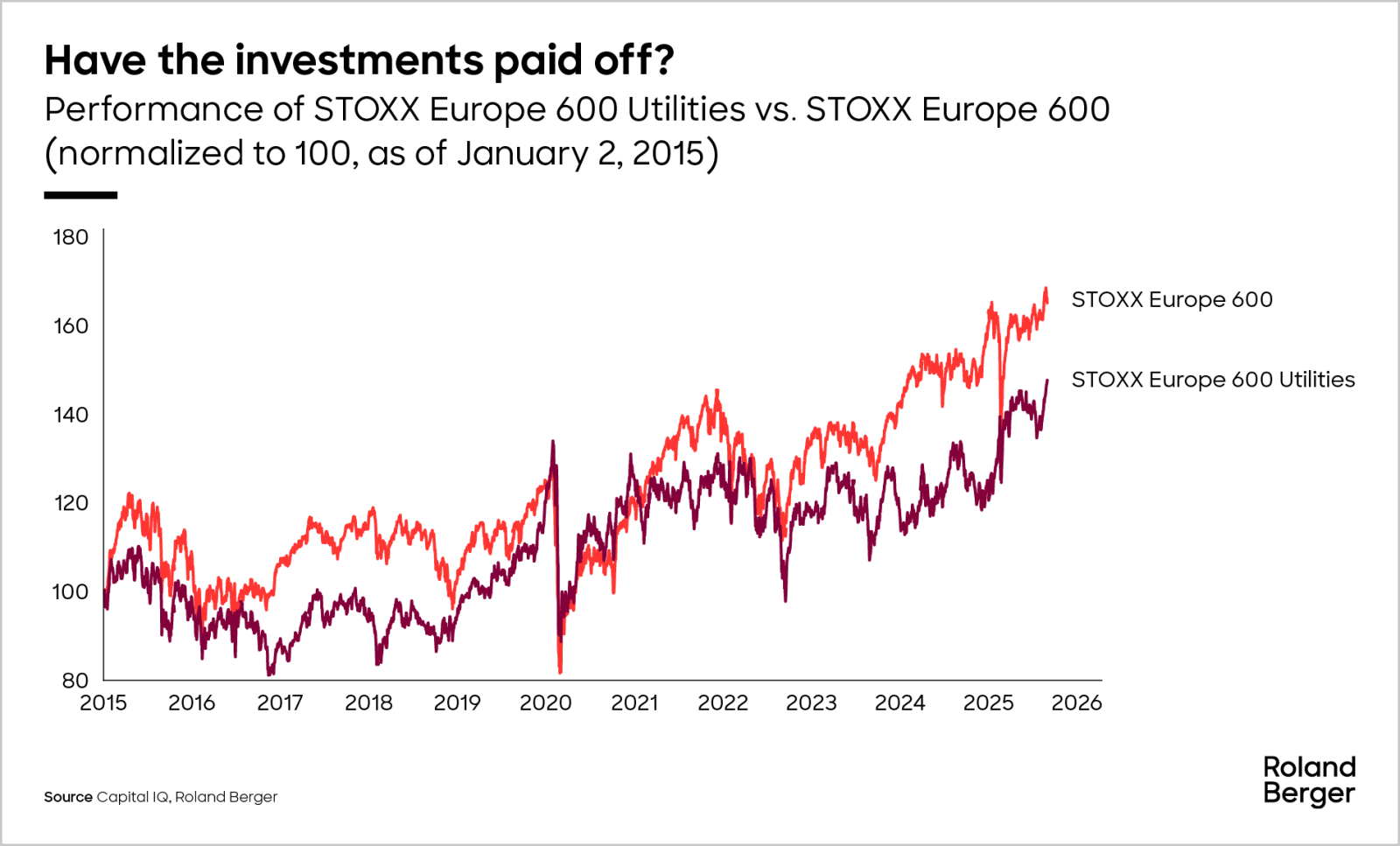
In response, industry players have invested heavily. Yet this surge in investment has not produced the stability many expected. Billions have gone into renewable assets, grid upgrades and low-carbon heating, but the rewards remain limited. Stock performance continues to lag behind the wider market, and investors still question the sector’s ability to generate attractive returns. Combine this with weaker margins, tighter regulation, pressure on diversified operations and volatile earnings due to market swings, and the result is a landscape where financial strain is impossible to ignore.

"Financial headroom is shrinking across Europe’s utilities – and the gap keeps widening."
Torsten Henzelmann
Senior Partner, Managing Director Central Europe
Frankfurt Office, Central Europe

In fact, Europe’s transformation gap is now too large for utilities to close on their own. Our research shows that only 55 percent of the top 60 European utilities meet the minimum profitability and leverage thresholds needed to finance large-scale change. Many have a combination of volatile returns and high debt, which leaves little room to fund the transition without outside support. Even the strongest players face tightening financial headroom as temporary gains from the 2022 price shock fade. Utilities have an estimated EUR 190 billion in financial headroom, even after dividend payouts and without assuming extra earnings – but this covers only a fraction of the EUR 1 trillion Europe needs for the Green Deal. Clearly, help will have to come from elsewhere.

Four archetypes shaping the transition

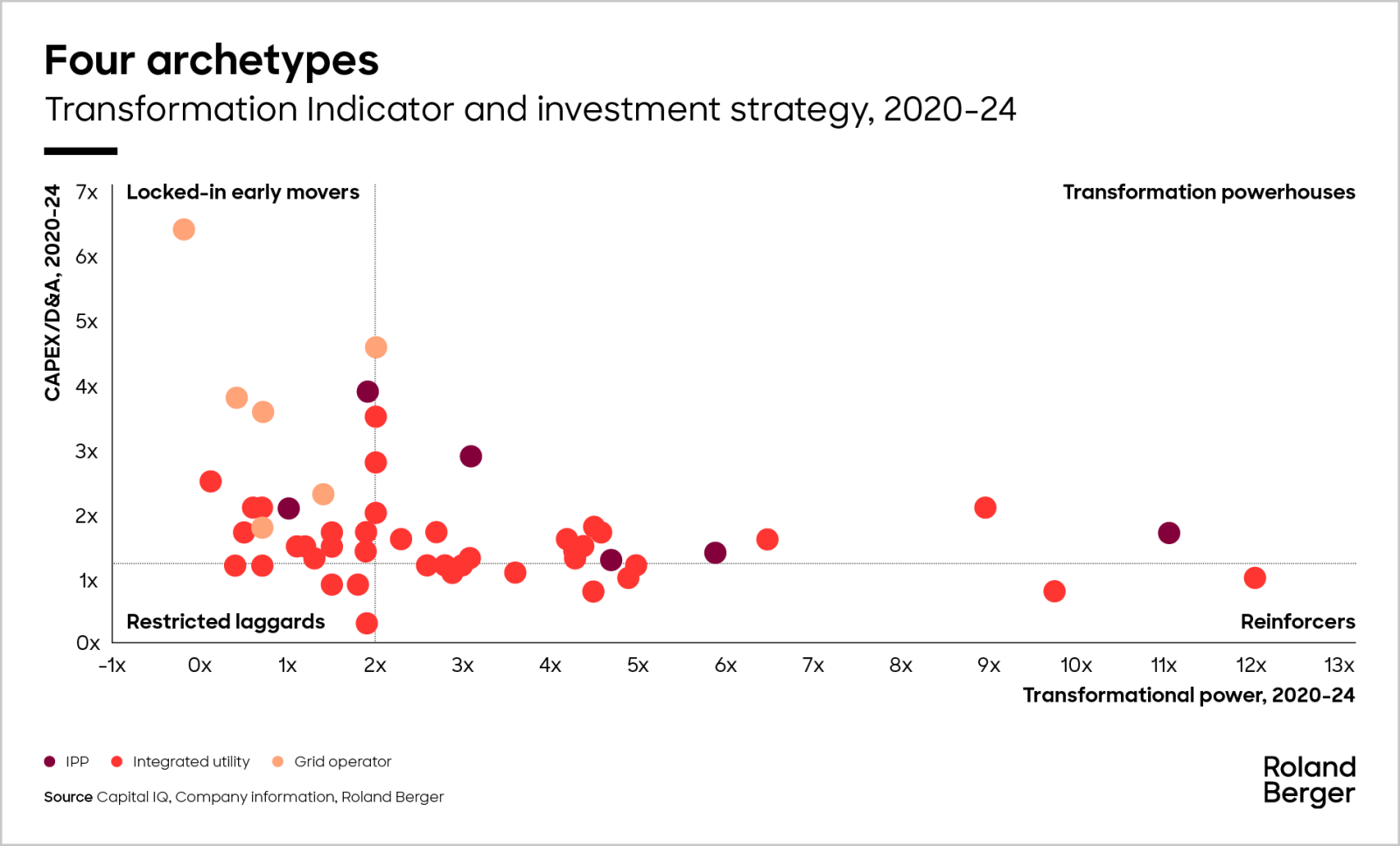
Europe’s utilities fall into four clear archetypes in terms of their financial strength and investment momentum. Transformation powerhouses sit in the top-right quadrant, with strong balance sheets and large asset bases that give them the capacity to drive new business models. Reinforcers have solid financials and written-down assets, which leaves them well placed to invest when technologies mature. Locked-in early movers invested first but now face falling returns and limited financial headroom. Restricted laggards entered late and suffer from weak earnings and outdated portfolios. Overall, the picture is one of a sector split between those able to move now and those who must rebuild before they can take part in the next wave of transformation.

"Only the strongest utilities can act now; others must rebuild financial strength before they move."
Marc Sauthoff
Senior Partner
Frankfurt Office, Central Europe

What next?

Europe’s utilities need clear strategies that match their financial strength and investment momentum. The strongest players can push the transition forward but must protect value and deploy capital with discipline. Others will need time to strengthen their balance sheets and prepare for technologies that are not yet mature. Early movers should tidy up their portfolios and shift toward lighter service models. The weakest players may need partners to stay viable. Our strategic advice for each of the four archetypes – presented in our full report – reflects differences in financial headroom, recent investment pace and the shape of each asset base.

Europe’s utility sector is shifting fast, and the space for inaction is shrinking. Those that match financial strength with the right timing will shape the next phase of the transition. Those that fall behind may not catch up. Understanding your archetype and acting accordingly is now the most strategic move you can make.

Want to find the right strategic next steps for your business? Download the full study here for the complete analysis, or contact us to discuss how we can support you through the transition.

Download the full PDF
STUDY

Timing the energy transition

{[downloads[language].preview]}

Europe’s utilities face tighter margins and rising investment needs. Which players can move now and invest and which should wait for future opportunities?

Published December 2025. Available in
Sign up for our newsletter

Further readings
Andrea Bassanino
Senior Partner
Milan Office, Southern Europe
+39 02 29501-233
Pierre Bastien
Senior Partner, Managing Partner Belgium
Brussels Office, Western Europe
+32 2 6610-300
Emmanuel Fages
Senior Partner
Paris Office, Western Europe
+33 1 5367-0902
Pedro Galhardas
Senior Partner, Managing Partner Portugal
Lisbon Office, Southern Europe
Torsten Henzelmann
Senior Partner, Managing Director Central Europe
Frankfurt Office, Central Europe
+49 69 29924-6303
Szabolcs Nemes
Partner, Managing Partner Romania
Bucharest Office, Eastern Europe
+40 21 30605-01
Frigyes Schannen
Partner, Managing Partner Hungary
Budapest Office, Central Europe
+36 1 301-7070
Konrad Gruda
Senior Advisor
Munich Office, Central Europe
Load More